
Technical Case Study
600m² Bamboo Decking Fading in 30 Days: Material Defect or Weathering?
A technical investigation framework for fading bamboo decking: separating weathering from finish failure and substrate core defects for developers and contractors.
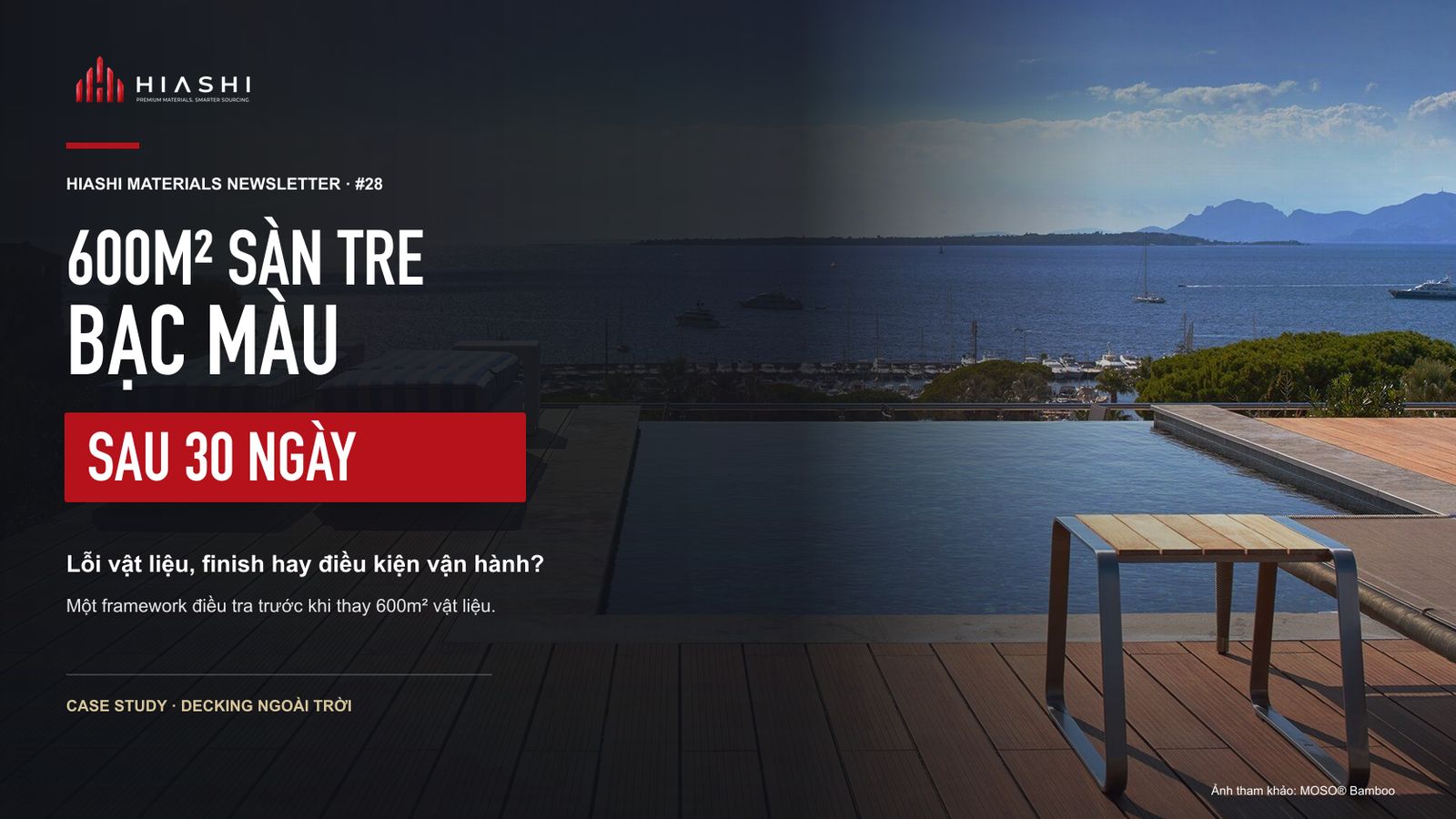
An exterior bamboo decking area of approximately 600m² began to show noticeable fading after only 30 days of operation.
The anomaly was not found on high-traffic walkways subject to constant foot friction. Instead, the color shift was most pronounced inside the board grooves—where virtually no footsteps had ever fallen.
The property owner was understandably concerned. However, visual discoloration alone is insufficient to declare a defect in the bamboo core. Nor is it sufficient to dismiss the issue as mere natural aging.
A rigorous technical conclusion requires separating three distinct domains:
- Has the structural substrate core degraded?
- How is the protective surface oil system weathering?
- Are drainage geometry, pool chemicals, or cleaning methods accelerating localized fading?
This is how HIASHI analyzes an exterior decking case before proposing remediation or material replacement.
Discover high-performance exterior bamboo decking systems at HiYo Bamboo.
60-Second Summary for Developers & Contractors
Color fading does not equate to structural failure.
Thermo-treated exterior bamboo, like most natural timbers, changes shade under ultraviolet (UV) exposure and tropical weather. Leading manufacturers like MOSO Bamboo X-treme explicitly distinguish structural core warranties from natural weathering, surface roughness, and tonal shifts.
However, uneven, patchy fading within 30 days must still be investigated as an anomaly of the surface finish system, especially when concentrated in grooves, pool edges, or standing-water zones.
Project teams should avoid extreme assumptions:
- "It faded, so the material must be defective."
- "It is natural timber, so no investigation is needed."
The correct engineering approach is to identify which material layer is affected, what physical forces are at play, and where contractual responsibility lies.
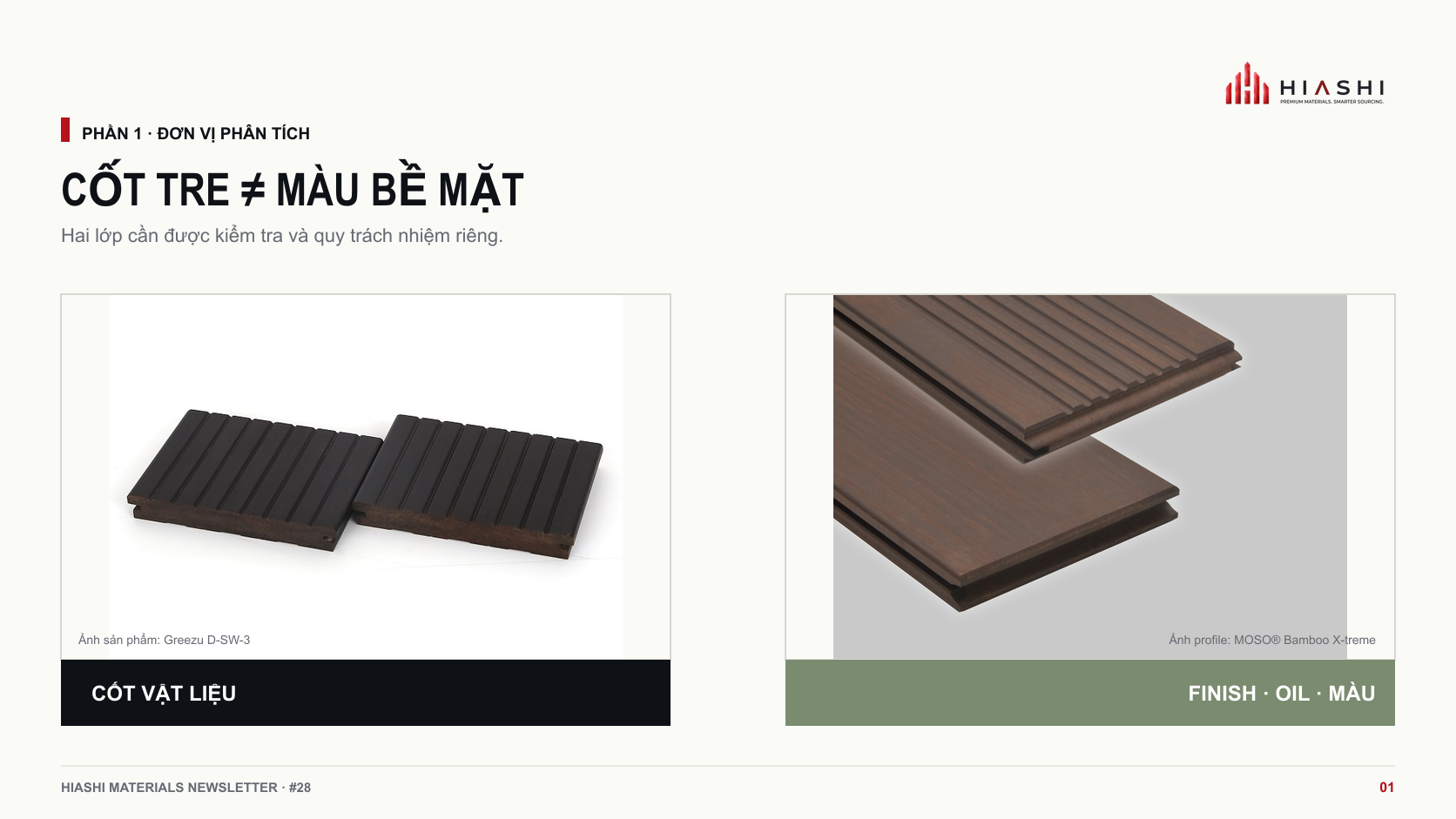
Section I — Substrate Core and Surface Finish Are Two Independent Systems
An exterior deck board can remain structurally sound while exhibiting significant surface color evolution.
Structural Substrate Core
Inspect for evidence of:
- Cracking or structural delamination;
- Warping or cupping exceeding manufacturer tolerances;
- Abnormal thickness swelling;
- Biological rot, soft spots, or bond failure;
- Damage at board ends, screw fixing points, and subframe contact zones.
This evidence directly relates to the physical durability and manufacturing quality of the bamboo substrate.
Surface Finish System
The penetrating oil or saturator maintains color tone, mitigates water uptake, and moderates weathering.
Its actual service life depends on:
- UV radiation levels and thermal loads;
- Rainfall volume and surface water retention time;
- Swimming pool sanitization chemicals;
- Sun exposure orientation;
- Routine maintenance schedules;
- Applied oil chemistry and coating thickness;
- Profile geometry, expansion gaps, end-grain sealing, and substructure drainage.
Consequently, structural core warranty terms cannot substitute for an operational color maintenance schedule.
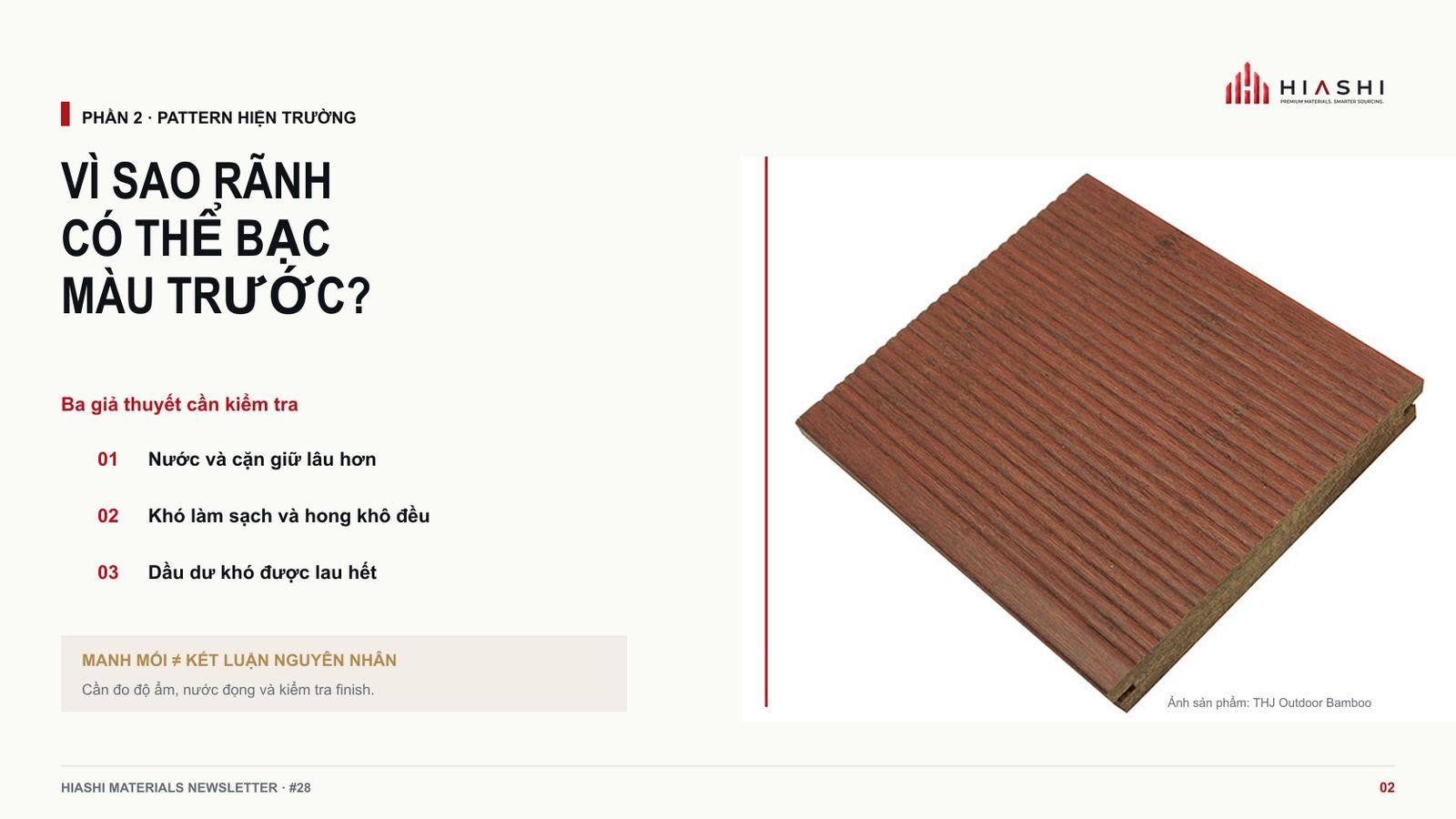
Section II — Why Do Grooves Fade Ahead of Flat Walkways?
This failure pattern indicates that mechanical abrasion is not the primary driver.
Sub-surface grooves retain water, fine sand, chemical detergents, and splash-out water longer than flat ridges. Under repetitive wet-dry cycling, the surface finish in grooves degrades differently from exposed walking faces.
Additionally, grooves are inherently more difficult to:
- Clean uniformly;
- Dry thoroughly;
- Saturate with the exact recommended oil volume;
- Wipe clean of excess unabsorbed oil after coating.
If drainage slope or ventilation is inadequate, the visual contrast becomes even starker.
Crucially: loss of pigment in grooves is an investigative lead, not a definitive root cause.
Attributing the phenomenon to oil degradation, adhesive migration, or chemical washing requires verified data. Project teams should not presume "phenolic resin bleeding" without surface sampling, production records, or laboratory cross-sectional analysis.
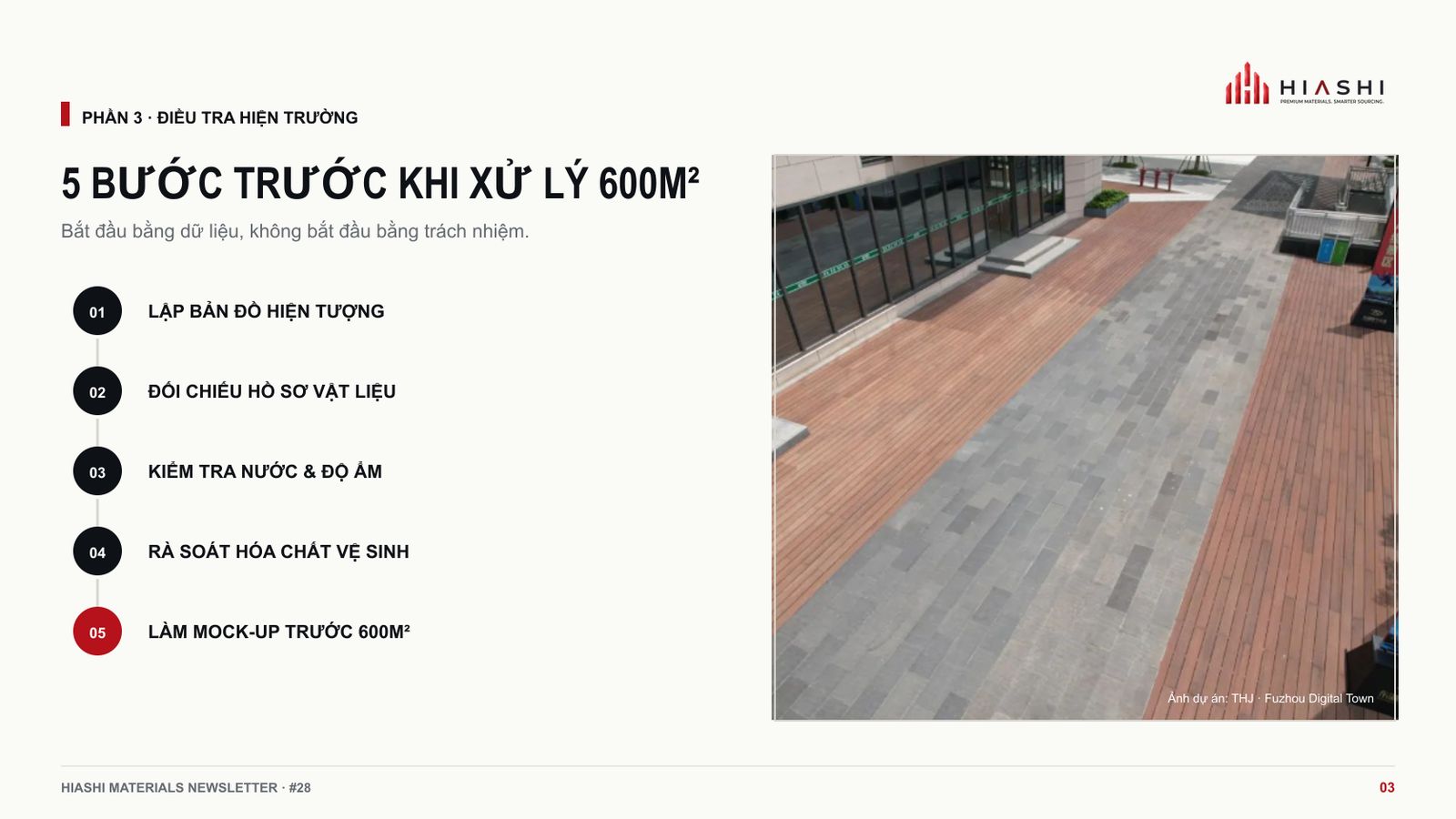
Section III — 5-Step Field Investigation Before Treating 600m²
Step 1 — Map the Phenomenon
Chart the discoloration patterns against:
- Solar orientation and shading lines;
- Swimming pool splash zones;
- Covered vs. open canopy areas;
- Primary pedestrian routes;
- Outdoor furniture and planter footprints;
- Drainage scuppers and low points;
- Grooves, board ends, and cut edges.
A systematic site map reveals root causes far more effectively than isolated close-up photographs.
Step 2 — Reconcile Material Documentation
Verify the exact:
- Manufacturer and product series;
- Production batch codes;
- Supply specification (unfinished, pre-oiled, or pre-finished);
- Factory finish formulation;
- Official installation manuals;
- Oil Technical Data Sheets (such as Vernites WB Deck Oil or WOCA Exterior Wood Oil);
- Warranty terms governing color vs. structural core.
No universal maintenance schedule applies across all bamboo products.
Step 3 — Inspect Moisture Content and Drainage
Measure moisture across flat faces, inside grooves, at board ends, and near pool perimeters after comparable dry periods.
Examine:
- Standing water in grooves;
- Blocked drainage gaps between boards;
- Substructure cavity ventilation;
- Runoff paths from floor washing, irrigation, or pool splash.
Step 4 — Audit Cleaning Chemicals and Maintenance Practices
Document cleaning agent brands, dilution ratios, application frequencies, and scrubbing tools.
Detergents formulated for poolside tiles can strip oiled timber surfaces. High-pressure jet washing, stiff wire brushes, or harsh alkaline degreasers accelerate uneven finish wear.
Step 5 — Execute a Controlled Mock-up
Select a representative test patch. Clean, dry, and recoat strictly according to the product TDS, then monitor performance.
Evaluate:
- Cured dry color tone;
- Uniformity between flat ridges and grooves;
- Dirt resistance;
- Site closure duration;
- Water-shedding response after rain.
Never apply an unverified remedial procedure across the entire 600m² deck on the first attempt.
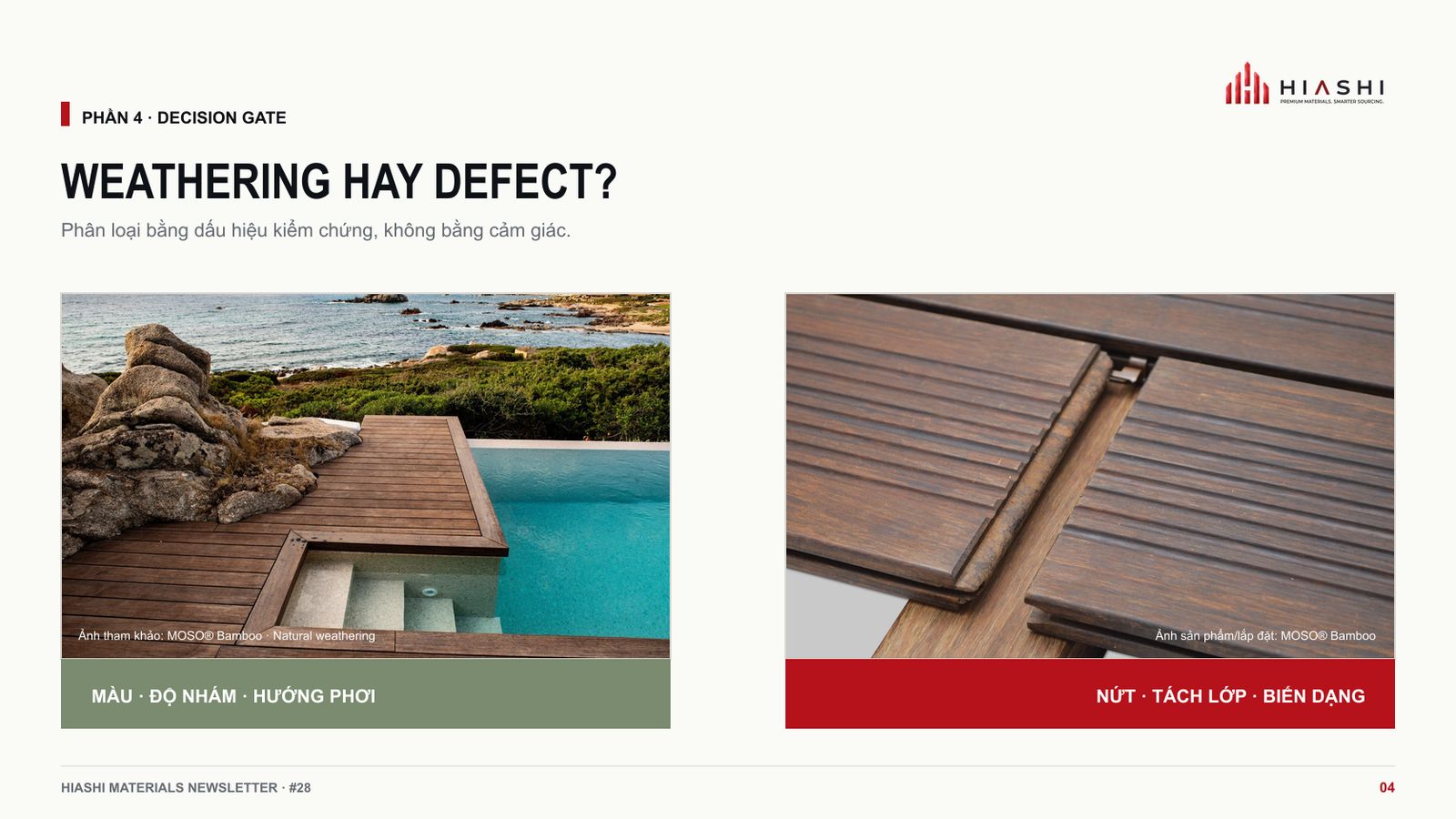
Section IV — Weathering or Defect?
Classify as Weathering or Maintenance Issues When:
- Changes are confined to surface color and texture;
- No structural splitting, rot, or abnormal deformation is present;
- Discoloration correlates with sun paths, water accumulation, and traffic zones;
- Test mock-ups show marked visual restoration after cleaning and recoating;
- The phenomenon aligns with the manufacturer's official natural weathering documentation.
Initiate Formal Defect Protocols When:
- Multiple boards from the same batch show unexpected delamination or severe cracking;
- Dimensional deformation exceeds published technical tolerances;
- Supplied finish failed to match ordered specifications upon delivery;
- Discrepancies exist between batches under identical site conditions;
- Investigation proves non-compliance in manufacturing, fabrication, or finish application;
- Performance conflicts with approved physical reference samples and contract terms.
The governing principle is: evidence must precede liability.
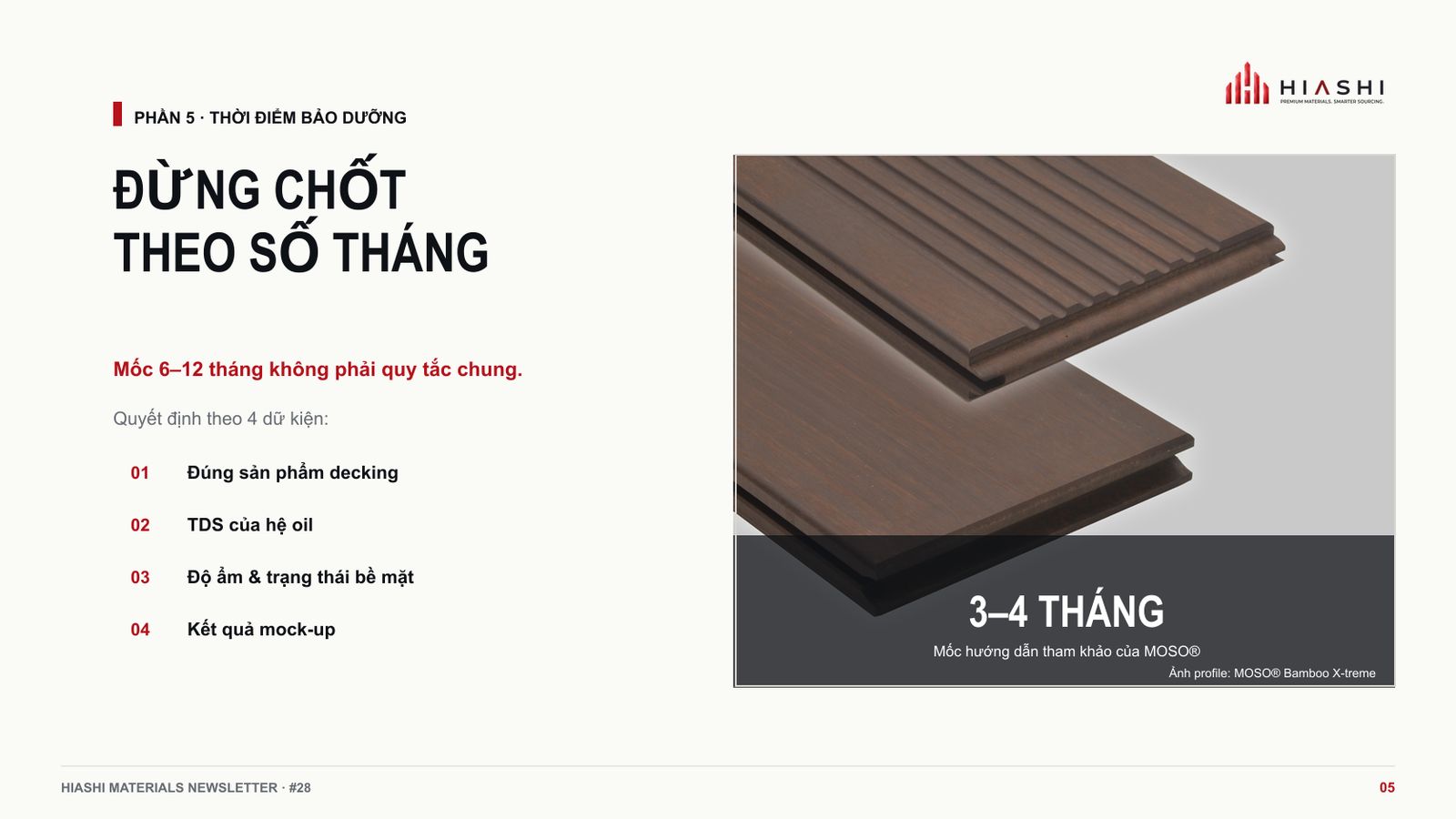
Section V — Avoid Fixed "6–12 Month" Rules for All Projects
Trade folklore often dictates that bamboo decking must sit for 6 to 12 months before its first maintenance oiling. This is not a universal rule.
In MOSO Bamboo X-treme guidelines, post-installation treatment is permitted, and the optimal initial maintenance window is frequently identified at 3 to 4 months when board pores open naturally.
Around swimming pools or harsh chemical environments, WOCA notes that recoating may be required on shorter intervals.
Maintenance timing must be determined by four site realities:
- Exact decking manufacturer guidelines;
- Oil system Technical Data Sheets;
- In-situ substrate moisture and surface condition;
- Empirical mock-up performance.
Do not schedule maintenance solely by counting elapsed calendar months.
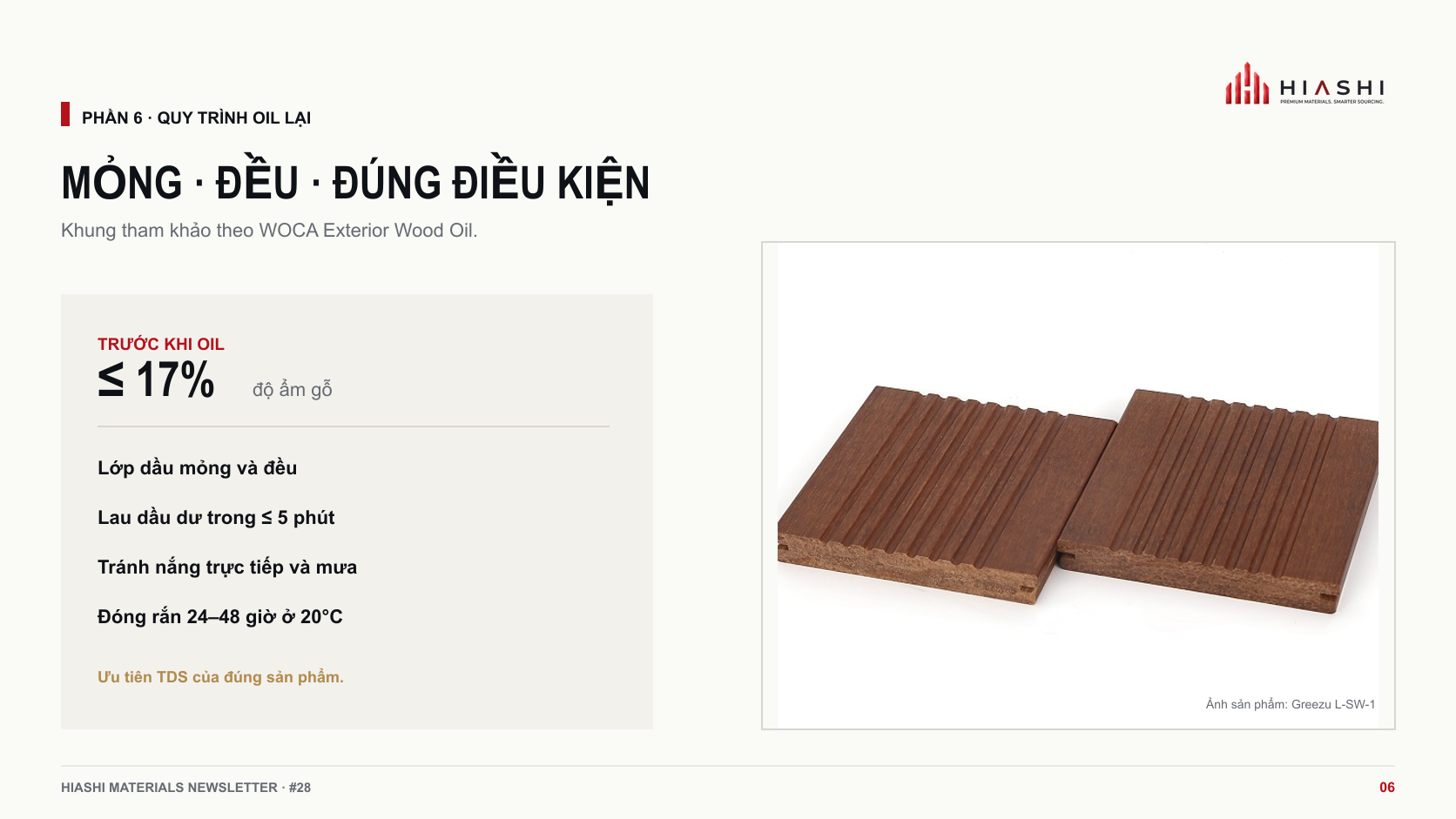
Section VI — Recoating: Thin, Uniform, and under Controlled Conditions
The following framework references the application parameters of WOCA Exterior Wood Oil. Project specifications must always adhere to the specific product TDS selected.
Preparation
- Clean new and weathered surfaces with an approved exterior wood cleaner.
- Allow thorough drying as specified in the TDS.
- For WOCA, substrate moisture must not exceed 17% prior to oiling.
- Apply only in dry weather, avoiding direct intense sunlight and overheated substrates.
- Test in an inconspicuous area to confirm compatibility and dried appearance.
Application
- Stir thoroughly before and during use.
- Intermix cans from different production batches to ensure color consistency.
- Apply a thin, uniform coat along the longitudinal board grain.
- Ensure thorough coverage of grooves, joints, and end grains.
- Wipe away all excess surface oil within manufacturer time limits; WOCA mandates wiping within 5 minutes.
- Apply a second coat only if the substrate requires further saturation per the TDS.
Curing
WOCA specifies a full curing timeframe of 24 to 48 hours at 20°C, dependent on local ambient conditions. The deck must remain sheltered from rain and standing water during this window.
An effective maintenance plan accounts for weather forecasts, pedestrian rerouting, and operational facility downtime.
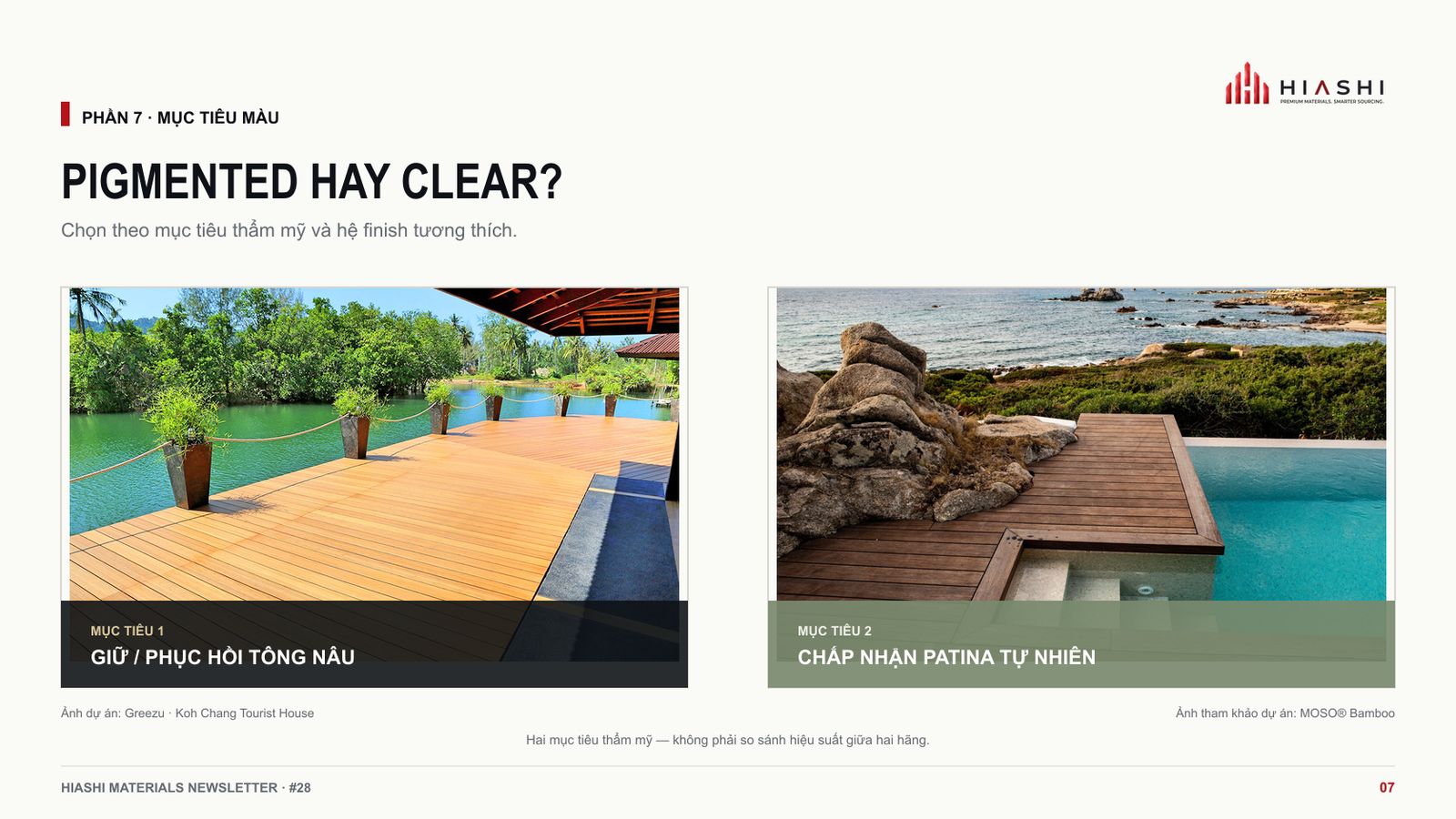
Section VII — Pigmented vs. Clear Oil
This choice should not be treated as an absolute dogma.
Pigmented oils are optimal when a project seeks to retain or restore deeper brown architectural tones. WOCA recommends pigmented formulations to rejuvenate weathered surfaces.
Natural or clear penetrating oils suit schemes embracing authentic silver-grey patinas, provided the system is approved by the decking manufacturer. Certain clear oils contain transparent UV filters.
The essential engineering questions are:
- Does the architectural vision require rich brown tones or natural weathered patina?
- What exact physical sample was approved by stakeholders?
- Is the chosen oil chemically compatible with the existing finish?
- What is the anticipated maintenance interval?
- Does the pool environment require a dedicated recoating frequency?
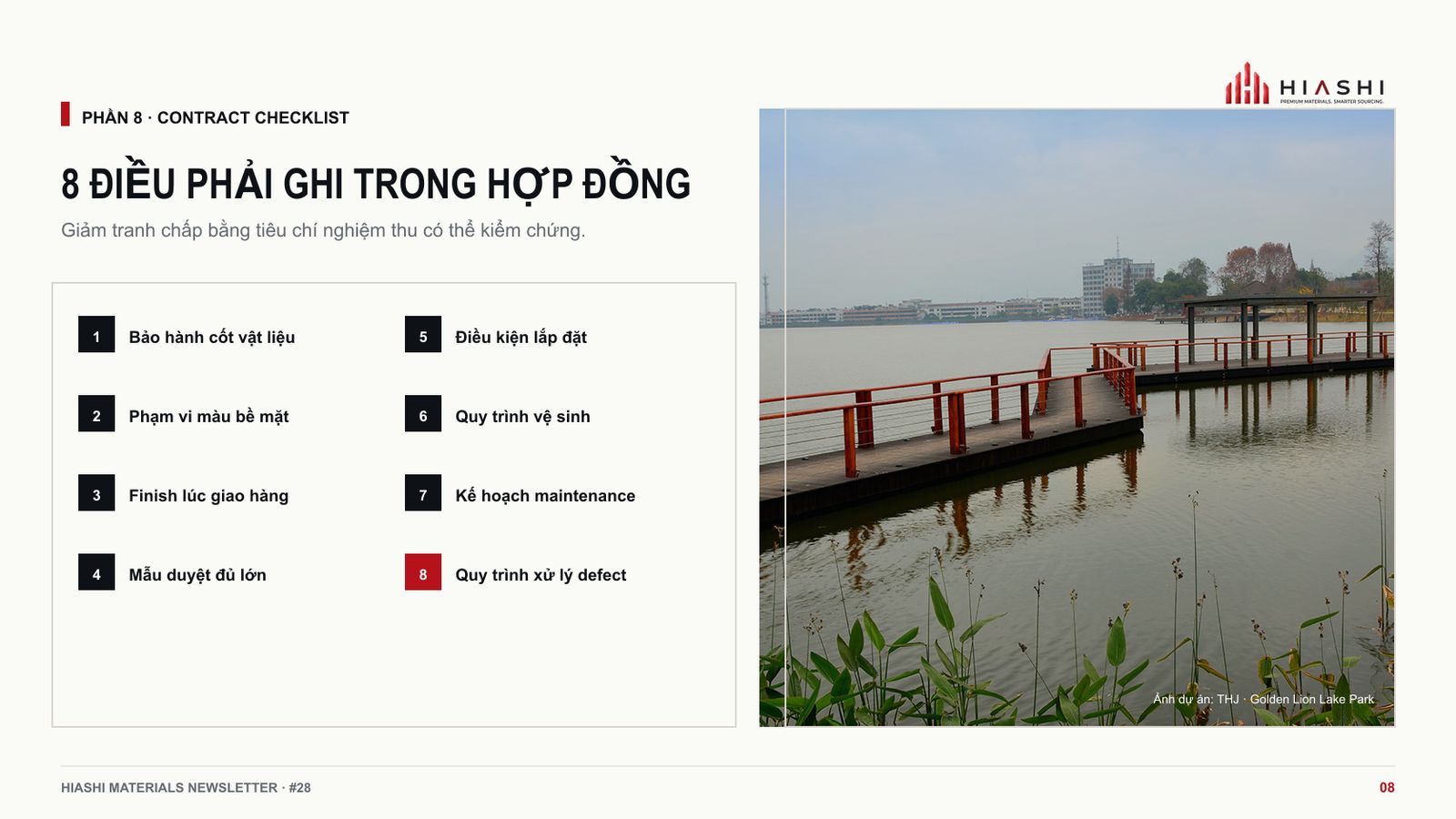
Section VIII — Exterior Bamboo Decking Contract Checklist
Prior to contract execution or final handover, ensure documentation defines:
- Substrate Core Warranty Scope: rot, fungal decay, termite resistance, delamination, and dimensional tolerances.
- Surface Finish Coverage: explicit clarity on whether fading, natural weathering, and color variation are excluded from core warranties.
- Delivery Finish State: unfinished, pre-oiled, or pre-finished; number of coated faces.
- Approved Physical Reference Sample: sufficiently sized to exhibit natural multi-board variation.
- Installation Constraints: slope, expansion gaps, substructure ventilation, and pool proximity details.
- Maintenance & Cleaning Protocol: permitted chemical cleaners, brush types, and water pressure limits.
- Operational Maintenance Schedule: first inspection milestone and quantitative recoating criteria.
- Defect Resolution Procedure: photographic documentation, moisture logging, physical sampling, mock-up protocols, and approval authority.
This proactive contractual alignment prevents costly post-handover disputes.
Conclusion & Strategic Recommendations
A bamboo deck fading after 30 days should neither be condemned prematurely as defective material nor dismissed as uninspected natural aging.
In the 600m² case study, the most vital insight is not merely the degree of fading, but where fading occurs, what spatial pattern it follows, and which material layer is truly impacted.
When the bamboo core remains sound, root causes can be systematically isolated through site mapping, finish history, moisture logging, cleaning audits, and small-scale mock-ups.
This disciplined approach protects all project stakeholders:
- Developers avoid premature, expensive board replacement;
- Contractors are shielded from unfounded liability;
- Architects preserve the original design intent and aesthetic warmth of the decking.
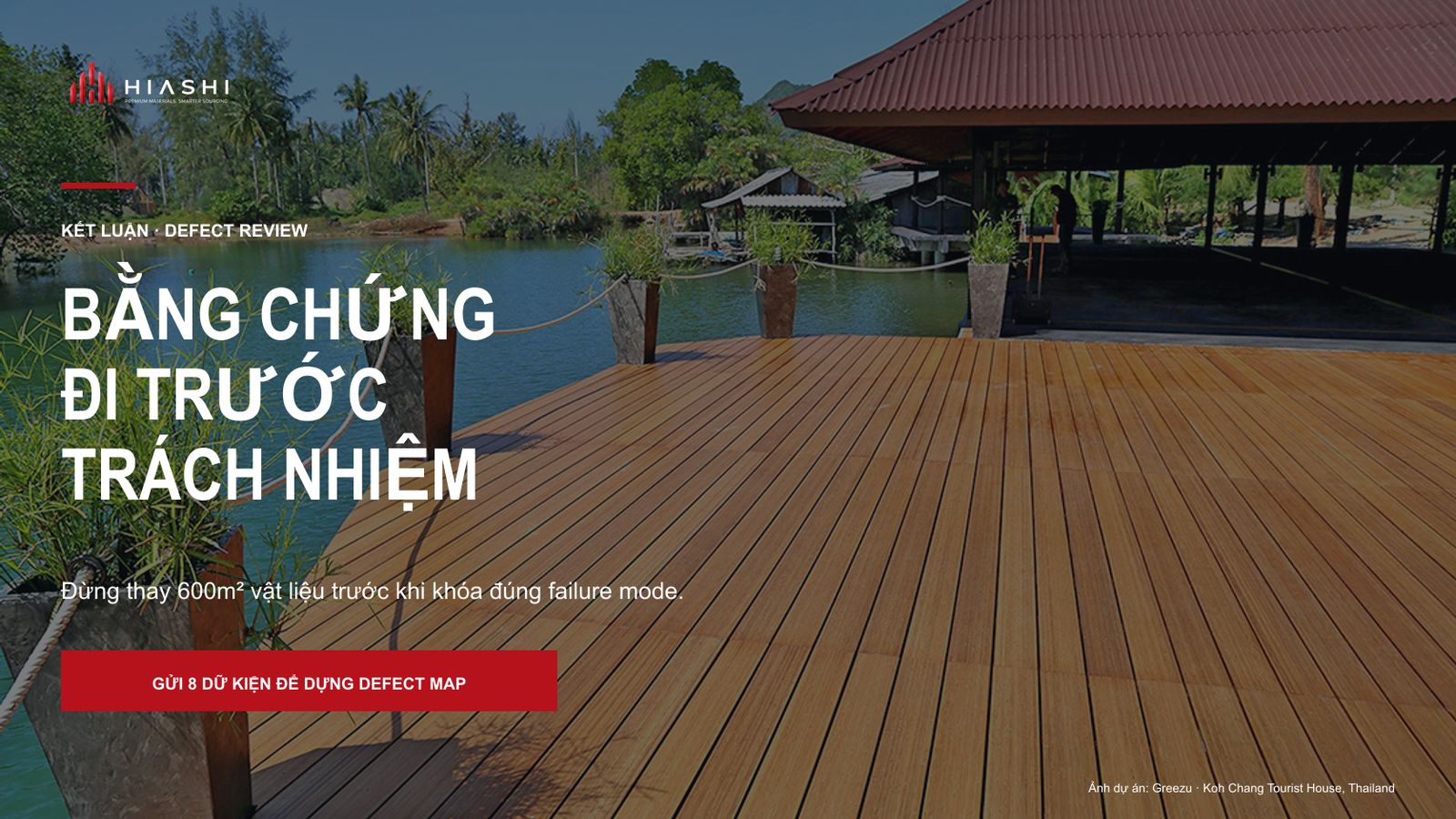
If your team is managing an exterior decking inquiry, provide HIASHI with 8 key data points: product name, batch code, finish specification, installation date, dry/wet photographs, ponding water maps, cleaning records, and TDS/warranty files.
HIASHI will assist in generating a defect map and defining a controlled mock-up protocol via HIASHI Contact.
Primary Technical References
- MOSO Bamboo X-treme — Installation & Maintenance Instructions: https://www.moso-bamboo.com/product/bamboo-x-treme-decking/
- MOSO Bamboo X-treme — Colour Change & Warranty Context: https://blog.moso-bamboo.com/how-do-bamboo-decking-and-cladding-boards-change-colour
- WOCA Denmark — Exterior Wood Oil Specifications: https://wocadenmark.com/exterior-wood-oil
- Vernites S.r.l. (Italy) — WB Deck Oil Matt WEI945: https://www.vernites.it/catalogue/exterior-products/preservatives-and-oils/decking-oils-25.html
Need material guidance for a project?
Share the technical brief so HIASHI can support material shortlisting, samples, TDS and RFQ preparation.