
Knowledge
Signing an MOU Doesn't Mean the Solution is Ready for Spec
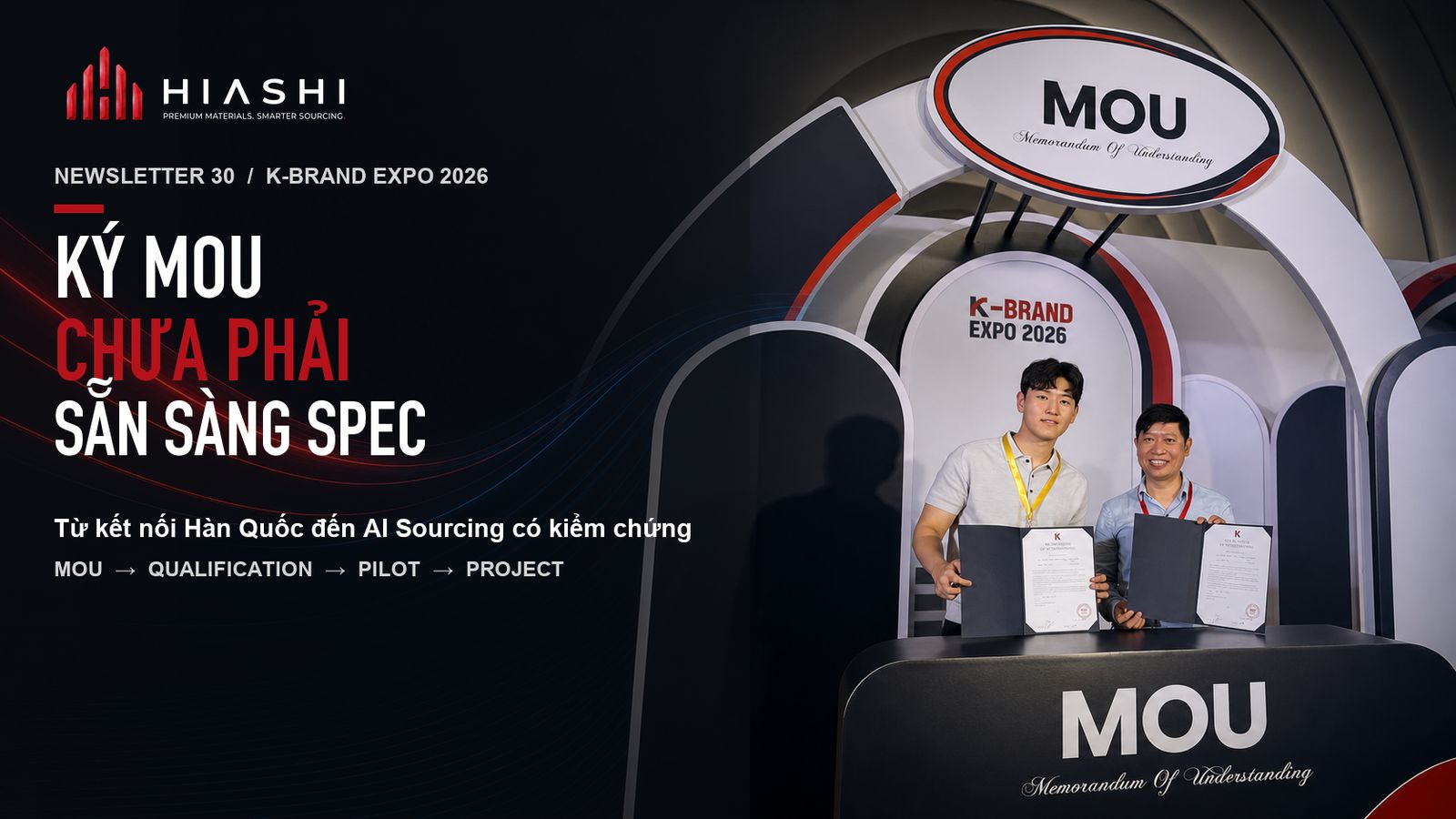
Signatures at K-Brand Expo 2026 open a dialogue, but for a solution to enter project specifications, it must pass four verification gates: correct identity, sufficient technical evidence, suitability for Vietnam, and project proof.
60 Seconds
If you only have 60 seconds, remember five points:
- MOU is not product approval: An MOU establishes the right to begin evaluation; project documentation still requires the correct brand, code, configuration, test conditions, and warranty scope.
- Do not compare technical statements under different conditions: Electricity savings, luminescence duration, or pressure ratings are only meaningful when the test sample, baseline, method, and usage limits are known.
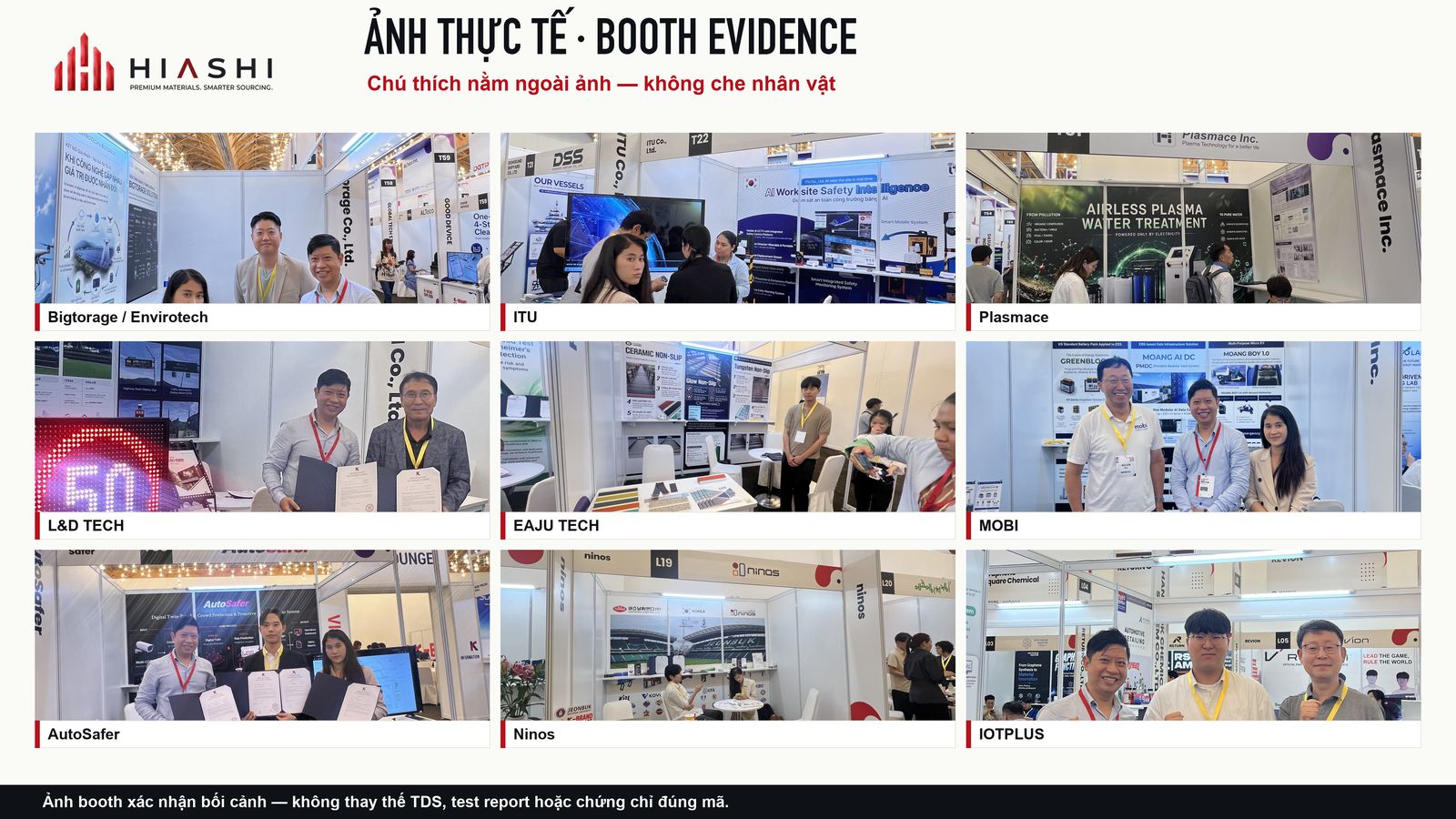
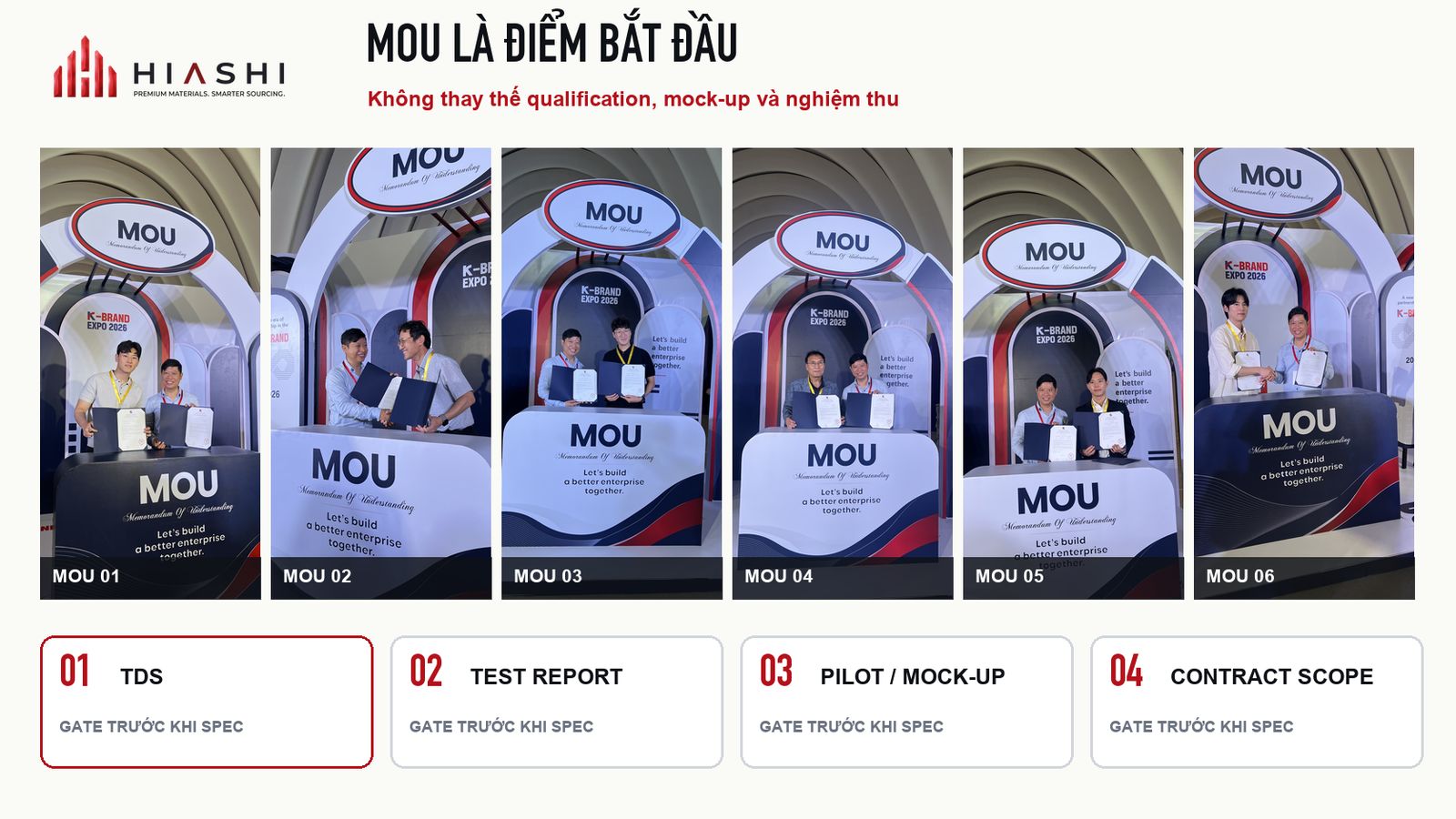
- Booth photos are contextual evidence: Photos help confirm who met whom and which solutions were introduced; photos do not prove technical performance.
- Legal compliance must be classified by each commodity: QCVN 16, fire safety, electrical safety, pressure, telecommunications, or cybersecurity requirements do not apply uniformly to all products.
- AI Sourcing Platform must create an auditable trail: Each claim needs to be linked to its source, version, approver, sample, and project decision — not just create a longer list of suppliers.
On stage, everything happens in minutes: handshakes, document exchanges, photos, and signatures. But the next morning, when an architect opens a BOQ or an engineer begins reviewing a technical submittal, there's no backdrop or applause. Only very specific questions remain: Is this the exact model tested? Under what conditions were the savings measured? Which products does the certificate cover? Who is responsible if the pilot fails? Learn more at LinkedIn HIASHI.
That is the gap between an MOU and a solution ready for a project.
At K-Brand Expo 2026 in Ho Chi Minh City, HIASHI completed B2B 1:1 sessions with nine Korean business groups retained in this article and recorded numerous signing activities. The actual photo set confirms the meetings, technology booths, and working context. But these very images also show the limitations of an event: they prove the meeting took place; they do not replace TDS, test reports, certificate scope, samples, or pilots. According to B2B market research reports, technical evidence is a core factor.
A signature opens a dialogue. Only technical evidence can open the door to the spec.
Therefore, this article is not a "9 must-buy technologies" catalog. This is a story about how to transform a B2B meeting into verifiable documentation — through four gates: correct identity, sufficient evidence, suitability for Vietnam, and project proof.
Gate 1 — Identity: Are we talking about the correct company, product, and configuration?
The trade name on the booth is not enough to lock down the identity of the goods. Minimum input documentation required:
- Legal name of the manufacturer and factory;
- Product code, model, software version, or system configuration;
- Catalog and TDS with issue date;
- Scope of the certificate correctly linked to the model;
- Sample, serial, or lot number for physical goods.
The public list in this article only includes businesses with direct meeting evidence or booths clearly identified in the event inventory. Company names, photos, and claims are not added solely from appointment schedules, attendee lists, or unverified CRM data.
Gate 2 — Evidence: Which claims have been proven?
A technical claim should only enter public discourse or a spec when it answers all four questions:
- Value: What number or attribute is published — consumption level, luminescence duration, or pressure rating?
- Baseline: Against which configuration is the result compared — same brightness, same load, or same operating cycle?
- Method: Tested according to which standard or protocol — laboratory report, field test, or pilot protocol?
- Scope: To which specific model, size, firmware, and environment do the results apply?
If a field is missing, the safe way to write it is "supplier claims" or "needs verification," not "fully resolved."
Gate 3 — Vietnam fit: Is the solution suitable for Vietnamese project conditions?
Hot and humid climate, salt spray, power quality, building load, internal network, operating procedures, and maintenance capabilities can alter results. Each shortlist requires a Vietnam Fit Sheet including:
- Location and corrosive environment;
- Design temperature, humidity, UV, rain, and wind;
- Electrical, network, server infrastructure, and integration protocols;
- Fire, electrical, pressure, data, and cybersecurity requirements;
- Spare parts, SLA, training, and maintenance capabilities in Vietnam.
Gate 4 — Project proof: Is there a pilot, mock-up, or acceptance criteria?
For new technology, a small pilot is often cheaper than lengthy discussions in a meeting. A pilot must have a baseline, measurement duration, data owner, and pass/fail criteria. Otherwise, the project will only have a nice demo but no evidence for decision-making.
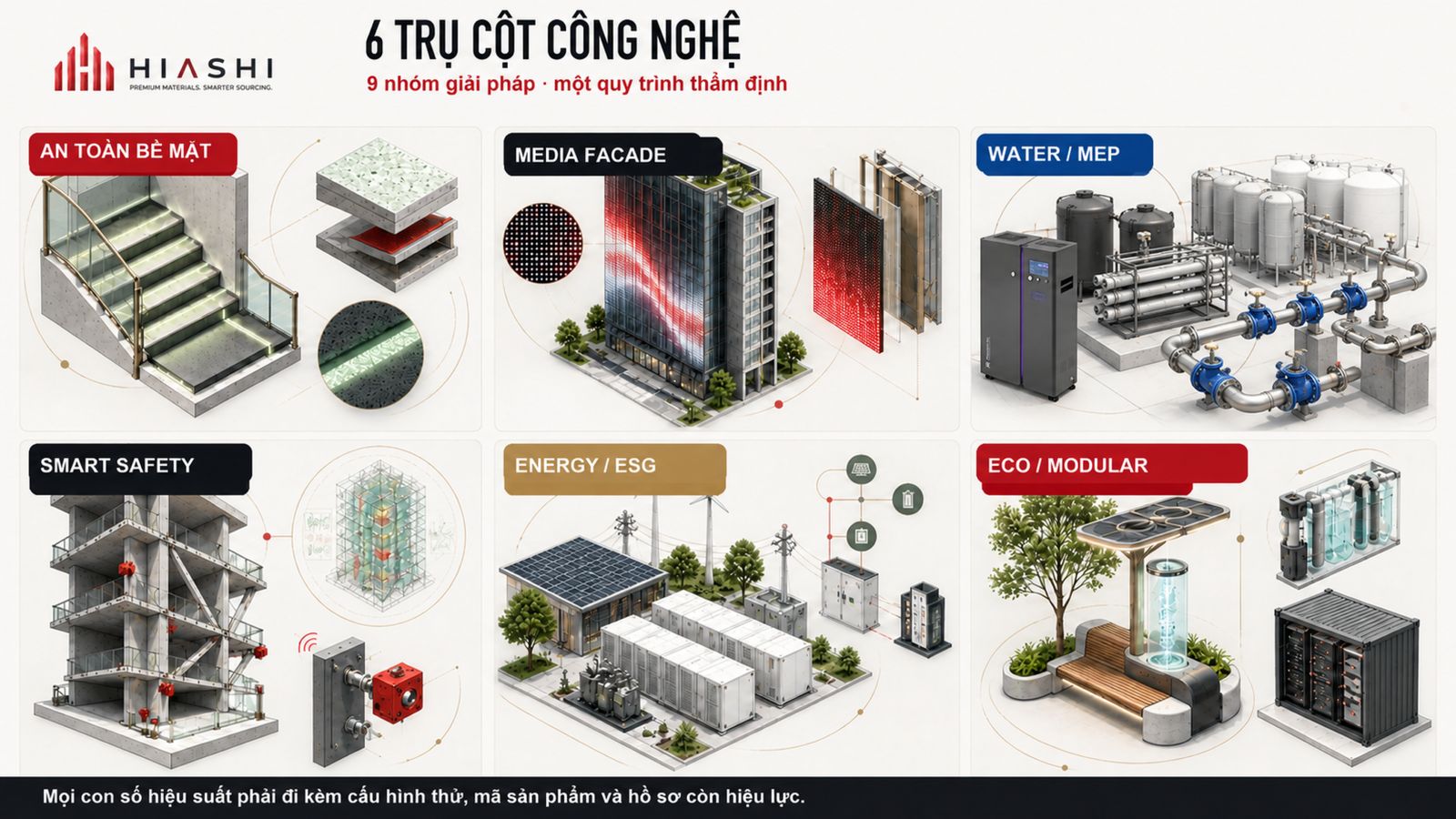
The new ecosystem can be read across six pillars: surface safety; media facade; EV infrastructure; smart safety; energy–ESG; and eco/modular infrastructure. The value lies not in the number of logos, but in whether each solution can pass the four gates above. For details, see K-Brand Expo Information Portal.
1. EAJU TECH Co., Ltd. ((주)이주테크) — Anti-slip solutions tailored to specific usage conditions
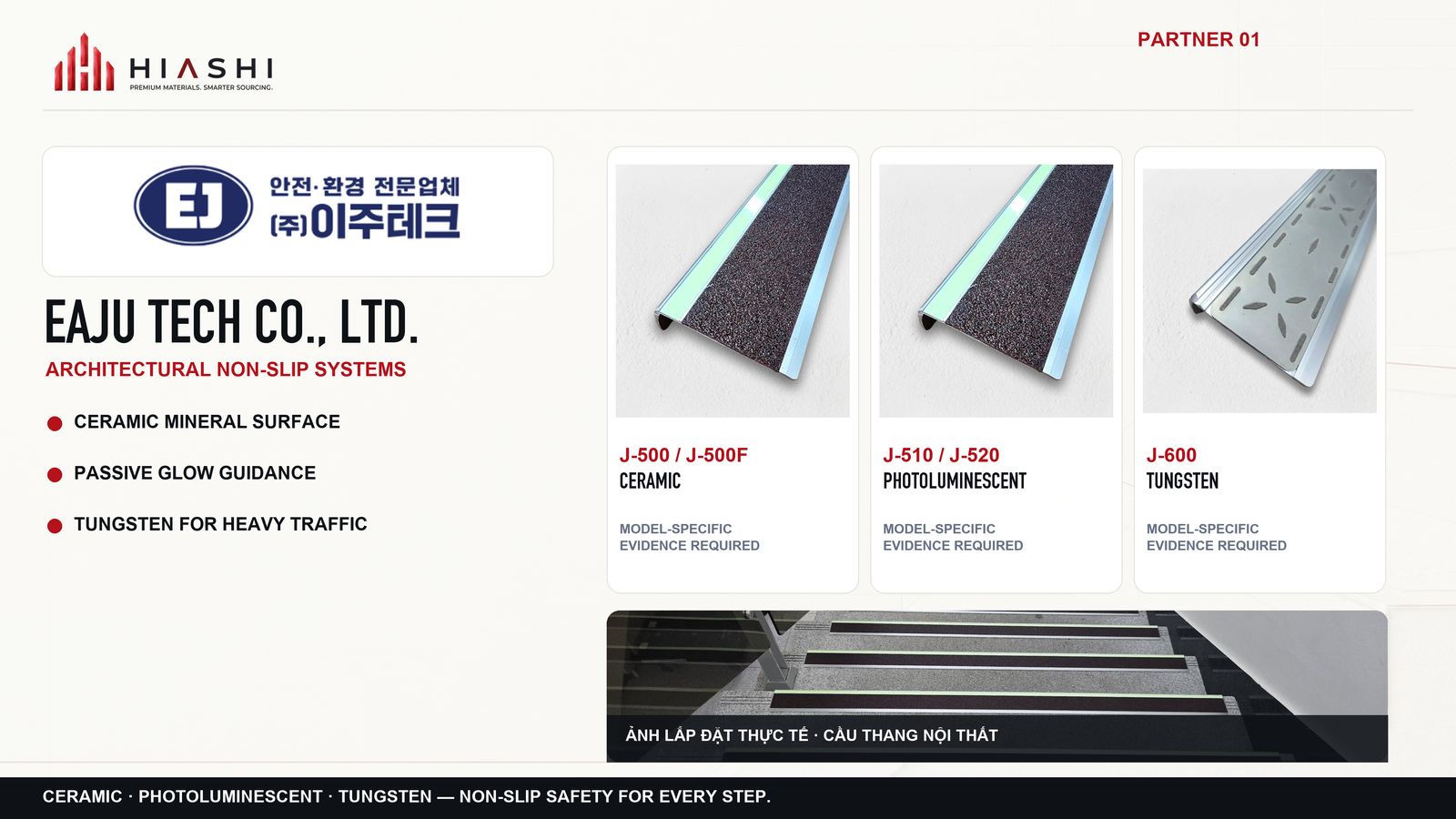
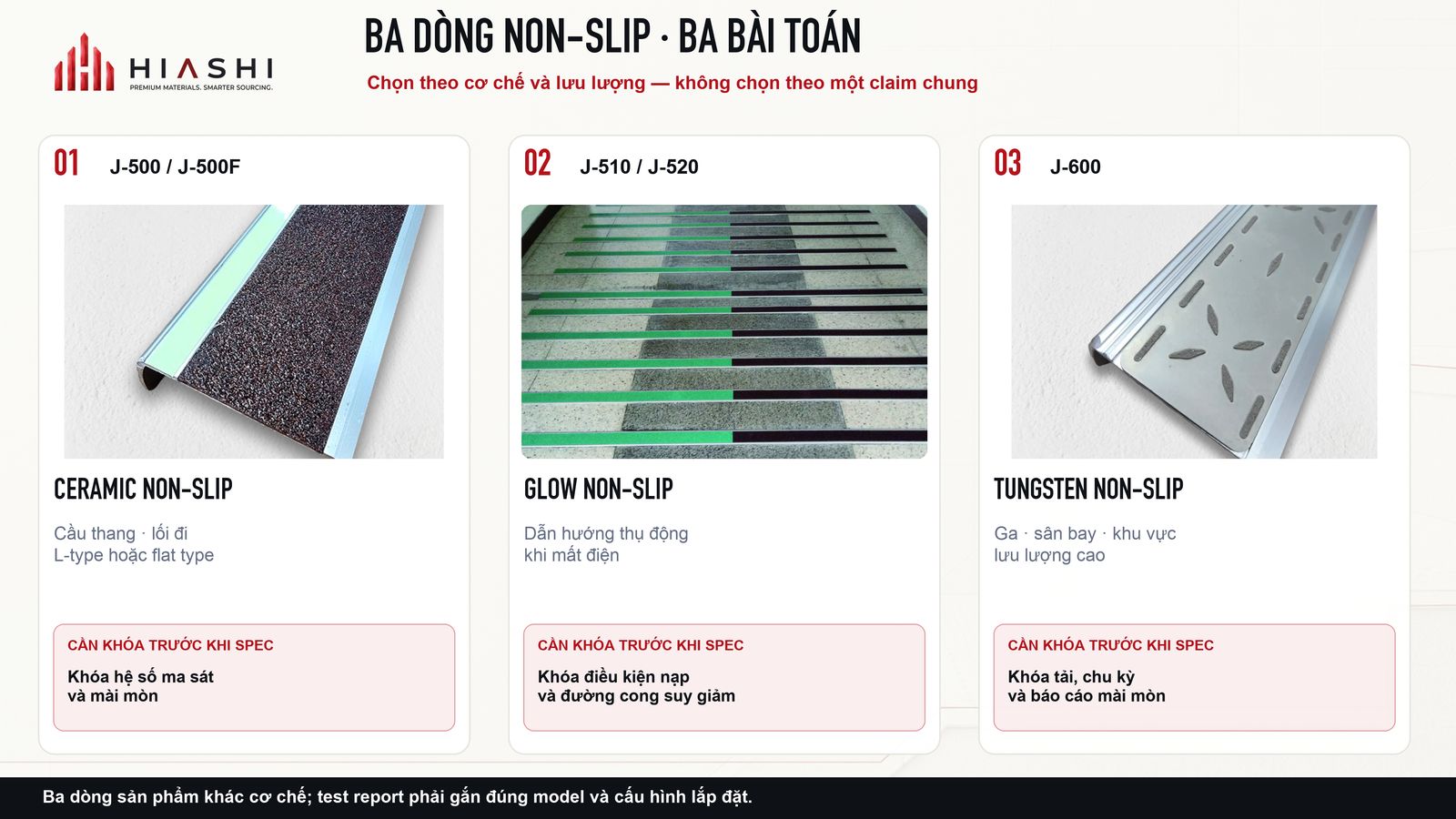
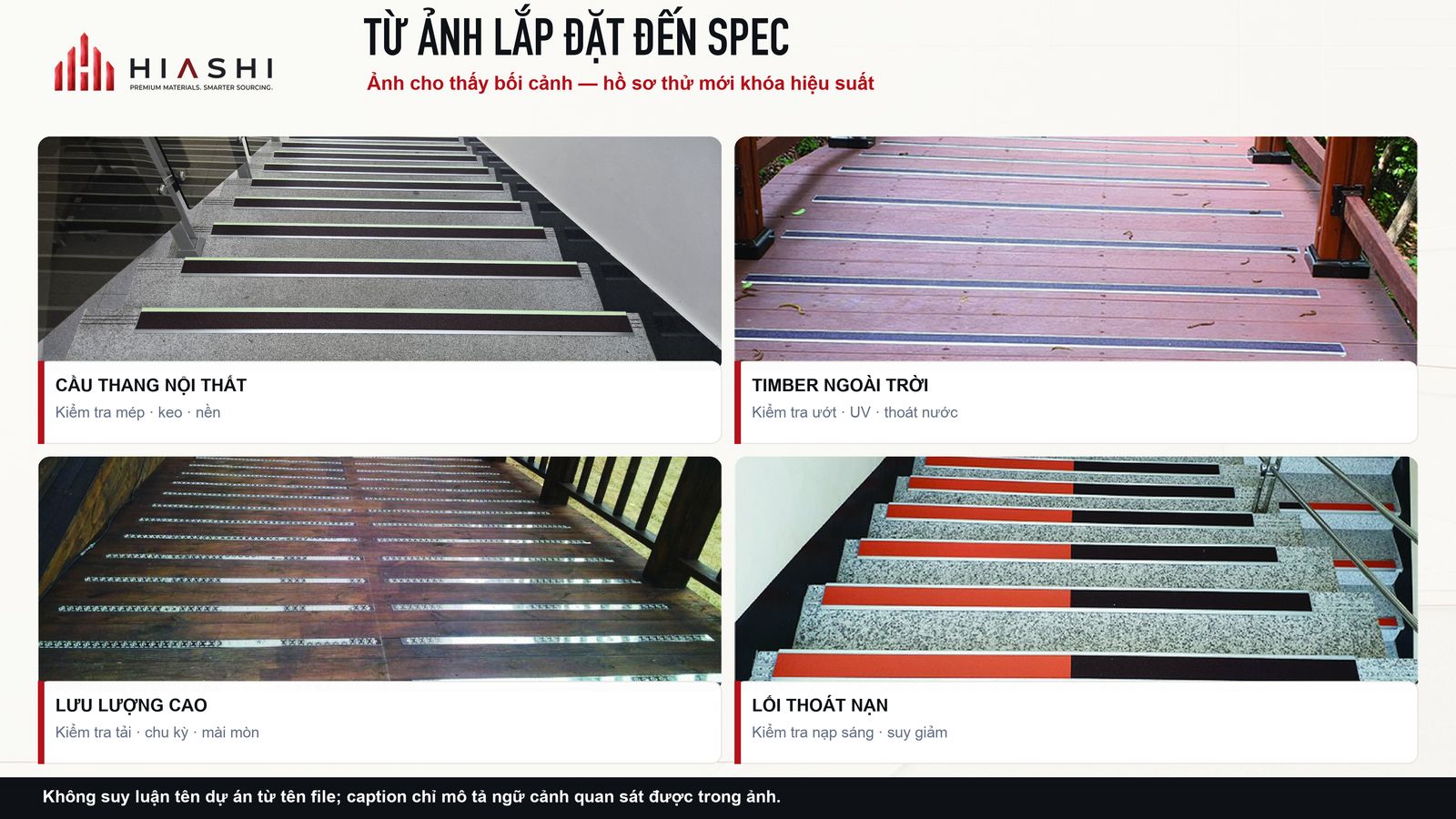
EAJU TECH is a Korean company specializing in safety accessory systems for stairs and walkways. Instead of using one type of nosing for all locations, the company develops three distinct material approaches: ceramic granules for general anti-slip needs, photoluminescent strips for passive guidance in low light, and tungsten carbide for high-traffic areas. EAJU TECH's USP is the ability to select the anti-slip mechanism according to the specific operational risk. The solution is suitable for shopping malls, train stations, stadiums, hotels, schools, and public buildings.
J-500 and J-500F — Ceramic non-slip for stairs and walkways
J-500 uses an L-shaped profile for stair nosings; J-500F is a flat variant. The structure consists of a 6063-T5 extruded aluminum base, a layer of fired ceramic mineral granules, and a weather-resistant coating. This approach is suitable for consideration for interior stairs, outdoor walkways, or decking surfaces when a clearly textured warning strip is needed.
J-510 and J-520 — Photoluminescent non-slip for passive guidance
The J-510/J-520 series integrates a photoluminescent material strip to absorb light and glow in the dark without needing an electrical power source at the nosing. The design value is to create an additional layer of passive guidance when normal lighting is interrupted.
J-600 — Tungsten non-slip for high-traffic areas
J-600 uses a tungsten carbide surface, targeting stations, airports, stadiums, and areas with trolleys or high foot traffic. For this group, the decisive questions are cyclic wear resistance, ability to retain roughness after use, and bond strength to the substrate.
2. L&D TECH Co., Ltd. — One-stop LED systems for indoor and infrastructure
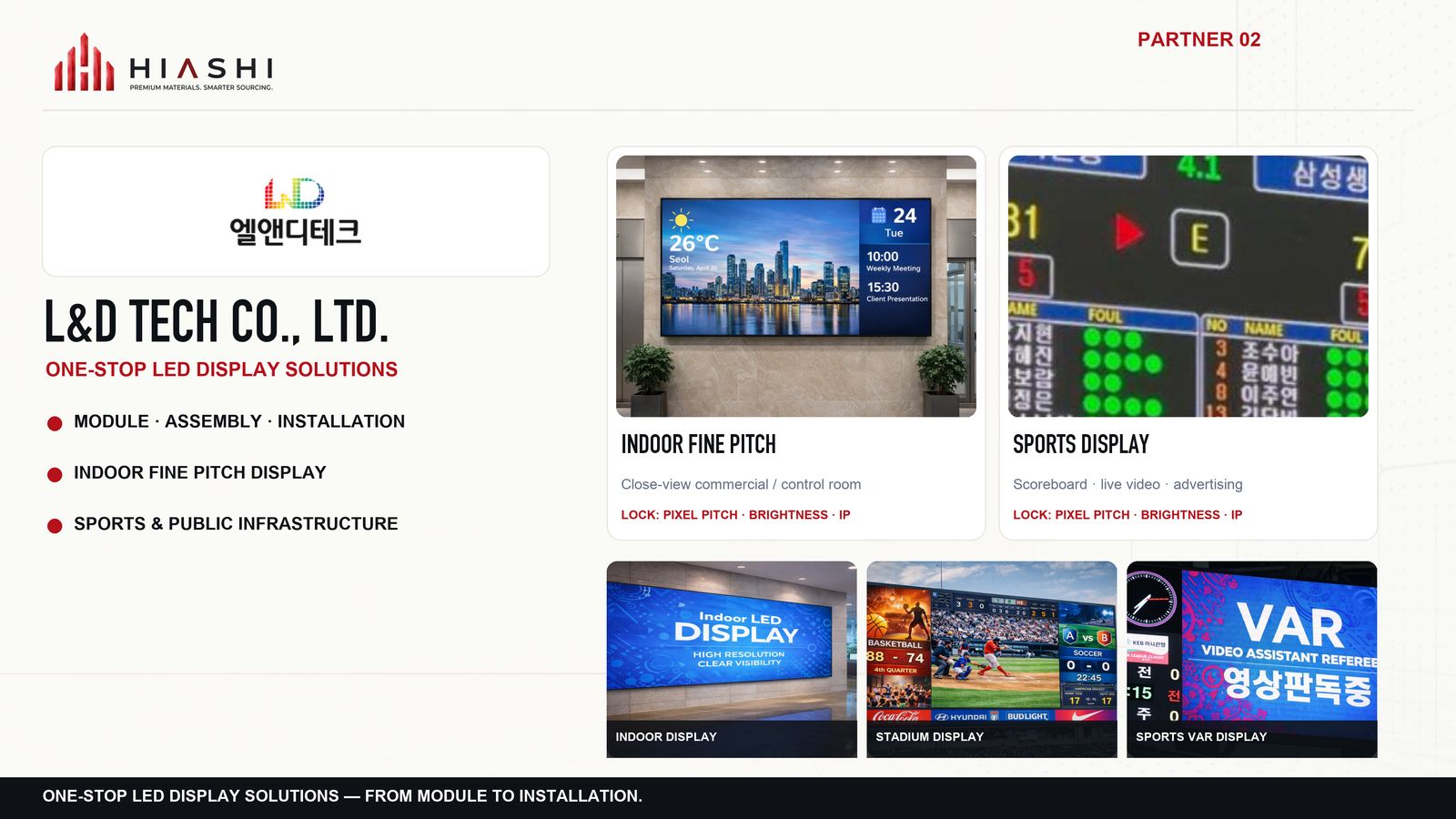
L&D TECH develops LED display systems following a one-stop model, including display modules, system assembly, and on-site deployment. Two prominent application groups are fine-pitch displays for indoor spaces requiring sharp images, and versatile display boards for stadiums, arenas, or event centers. L&D TECH's USP lies in connecting hardware design with the operational requirements of the entire system, optimizing brightness, power consumption, heat dissipation, and component replacement capability.
3. AutoSafer — AI-powered crowd safety prediction and management
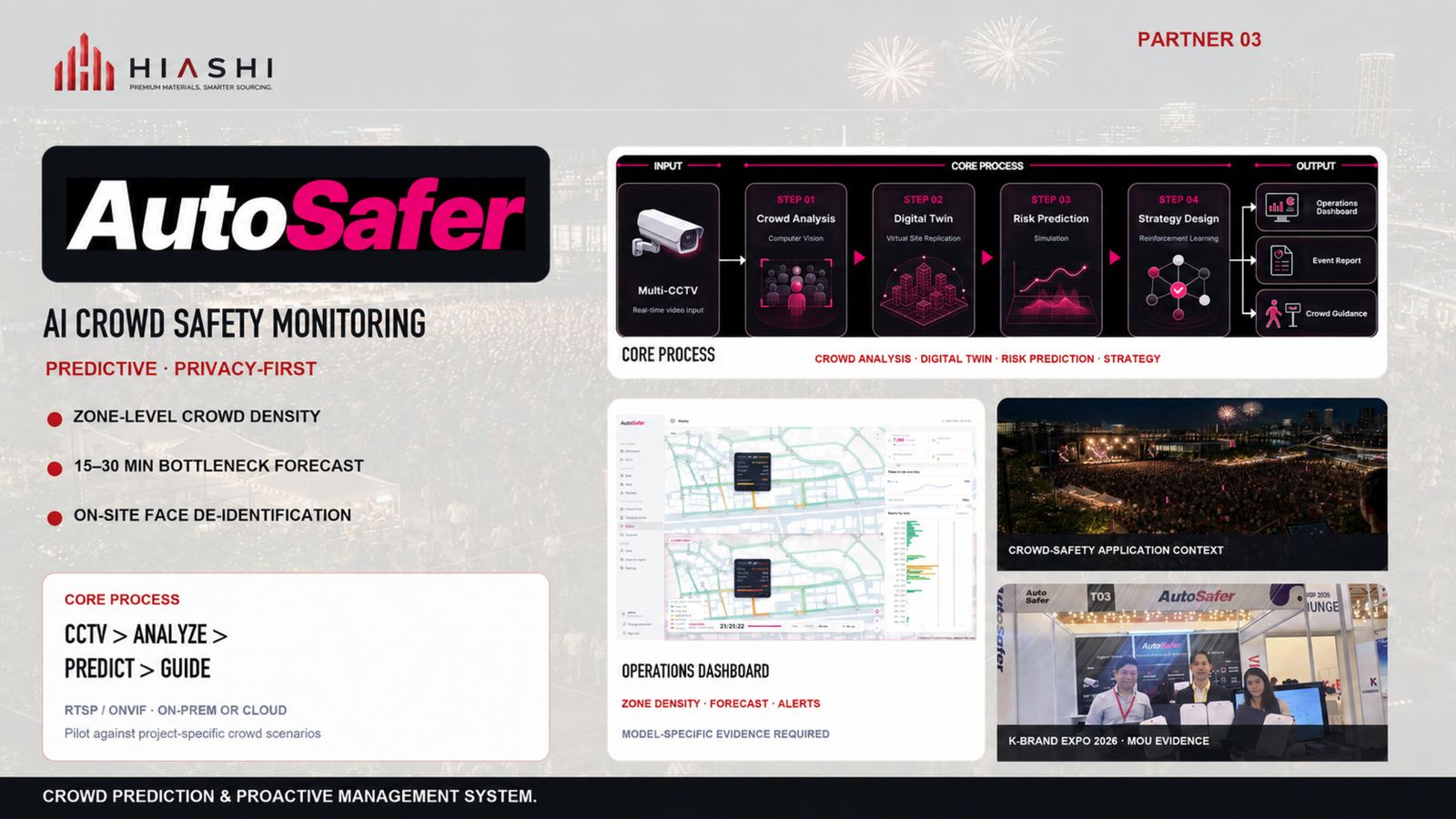
AutoSafer is a crowd safety platform that uses AI to analyze multiple CCTV streams, monitor density by area, simulate spaces with digital twins, and provide early warnings of potential bottlenecks. The system focuses on aggregated regional data and performs de-identification before analysis. AutoSafer's USP is shifting crowd management from post-incident reaction to proactive scenario-based preparation.
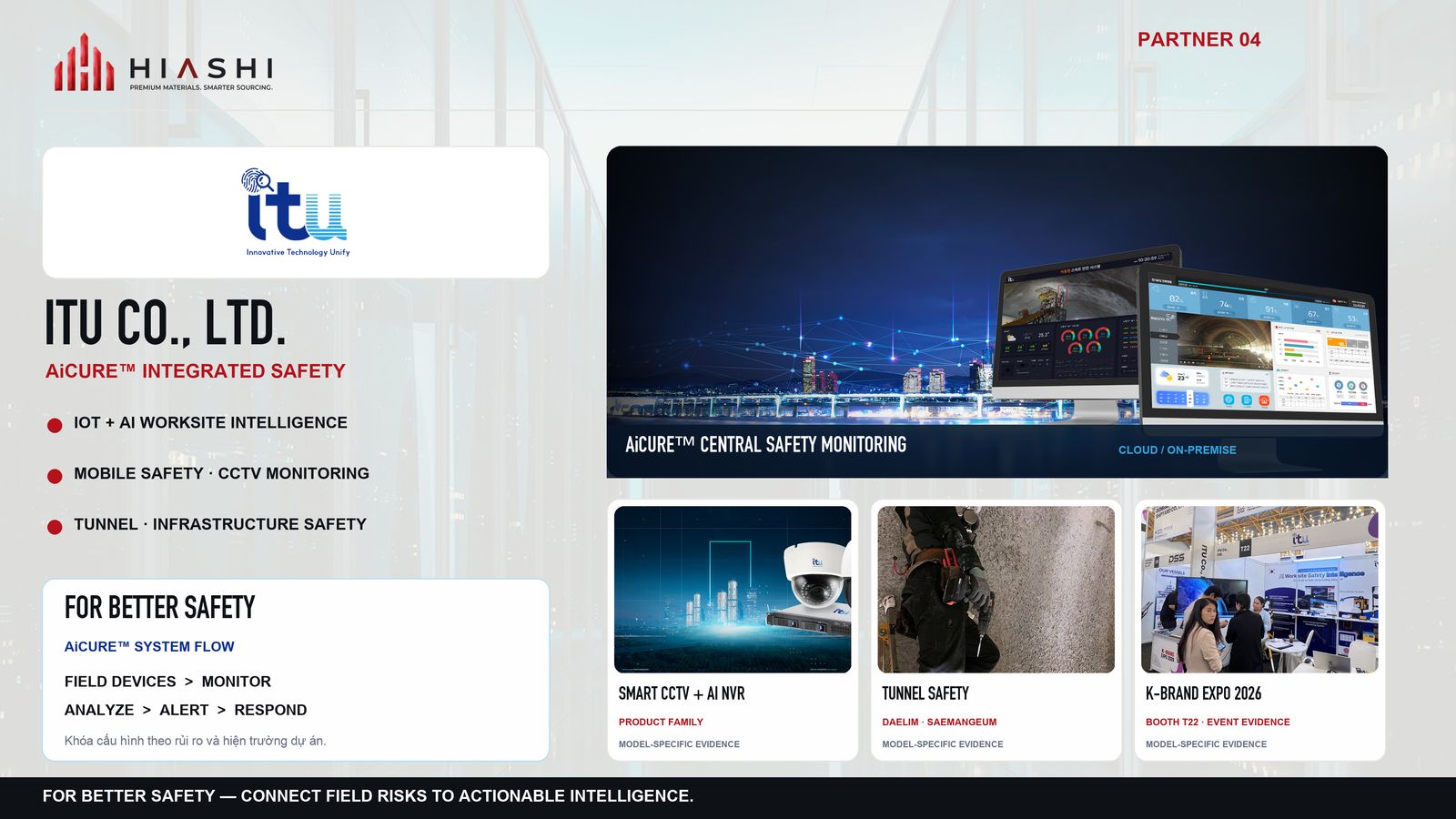
4. ITU AICURE — Safety monitoring platform for construction sites
ITU developed AICURE as an integrated IoT safety monitoring platform, connecting fixed cameras, mobile cameras, and on-site measurement devices within a single monitoring stream. AICURE's USP is bringing images and sensor data to a common operational interface, helping project teams detect anomalies earlier and reduce reliance on manual inspections.
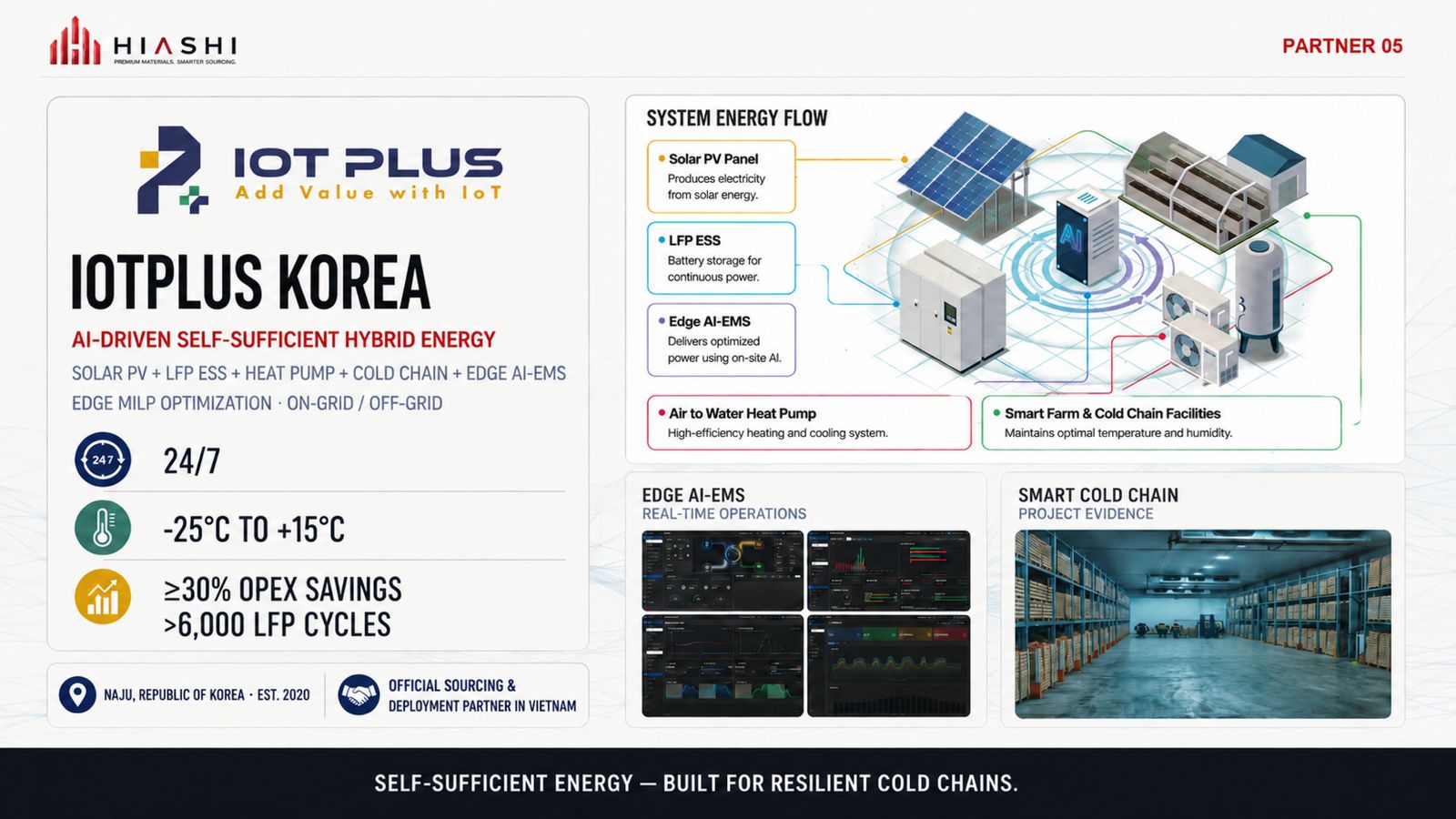
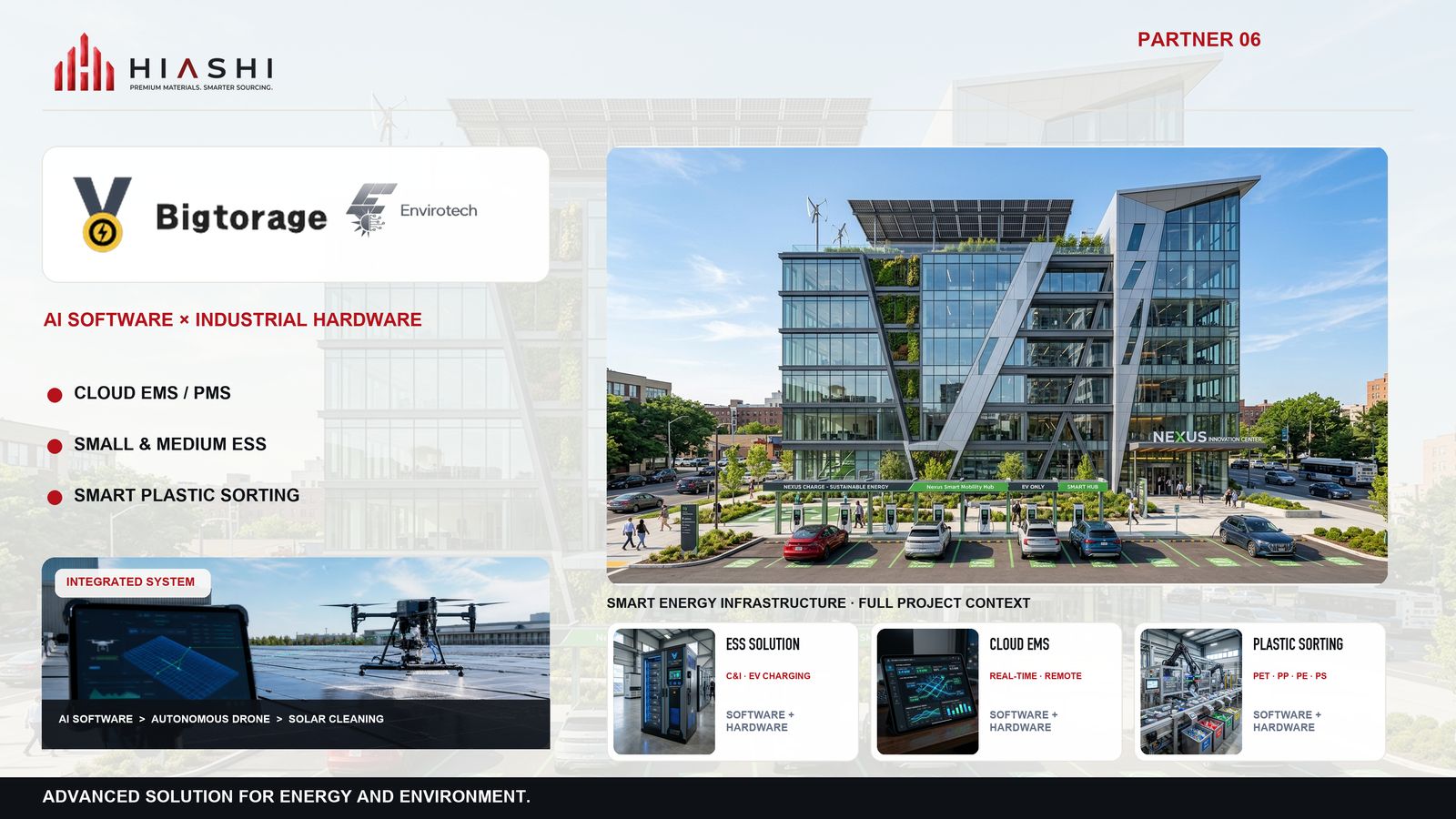
5. IOTPLUS and Bigtorage/Envirotech — Turning energy data into action
IOTPLUS provides an Energy Management System (EMS) for microgrids and ESS, with real-time monitoring, demand forecasting, and charge-discharge control functions. Bigtorage and Envirotech extend the value chain to energy asset operation, AI O&M, solar power maintenance support, and environmental solutions. The USP of this group of solutions is connecting measured data with operational decisions instead of just displaying a dashboard.
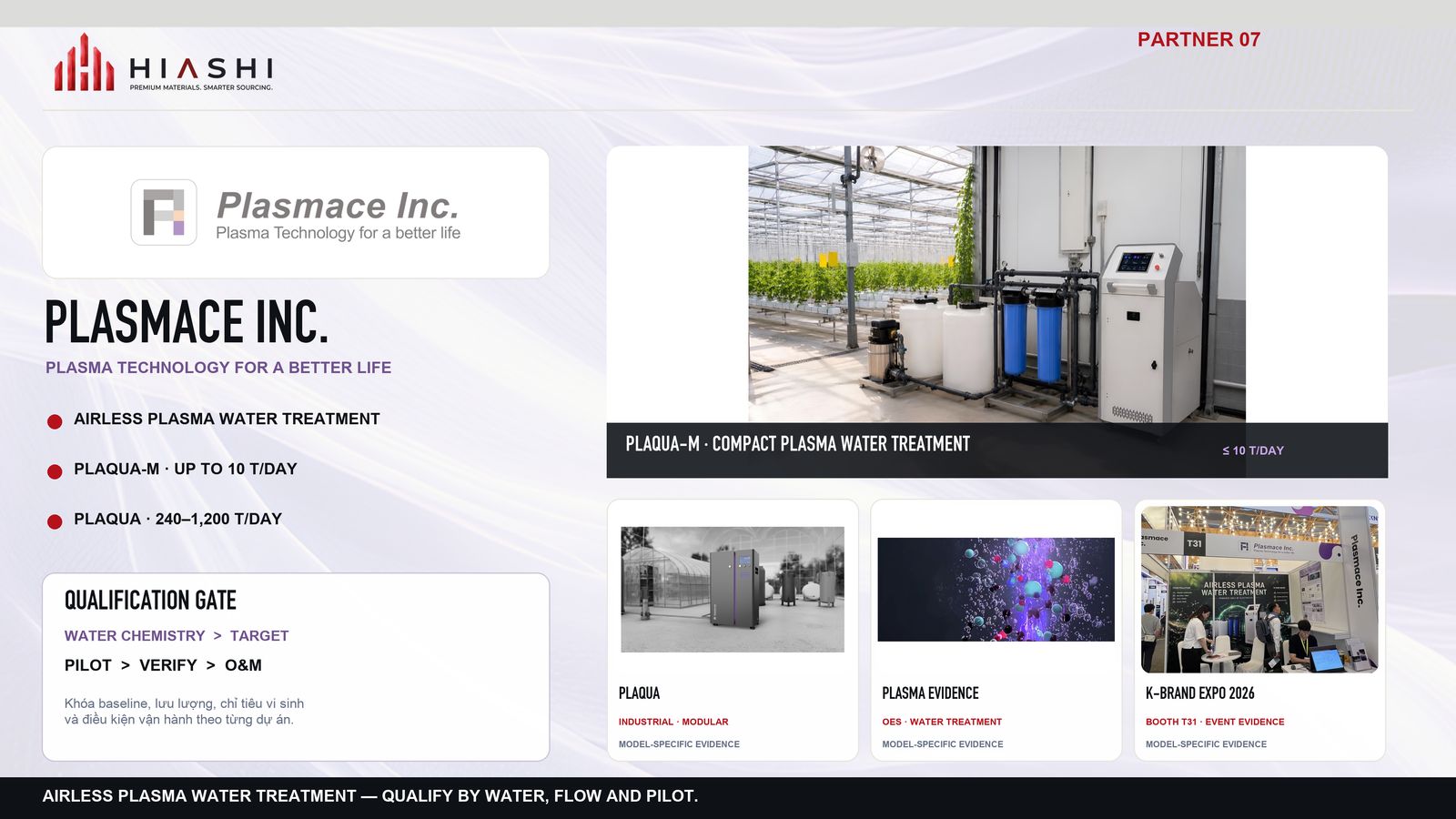
6. Plasmace PLAQUA — Plasma technology for water treatment
Plasmace is a plasma technology company, developing PLAQUA for water treatment applications. Instead of relying solely on traditional chemical dosing methods, the system uses plasma reactions to create a treatment effect directly in the water flow. PLAQUA's USP is opening up a compact, automatable treatment approach suitable for projects aiming to control water quality according to actual operational load.
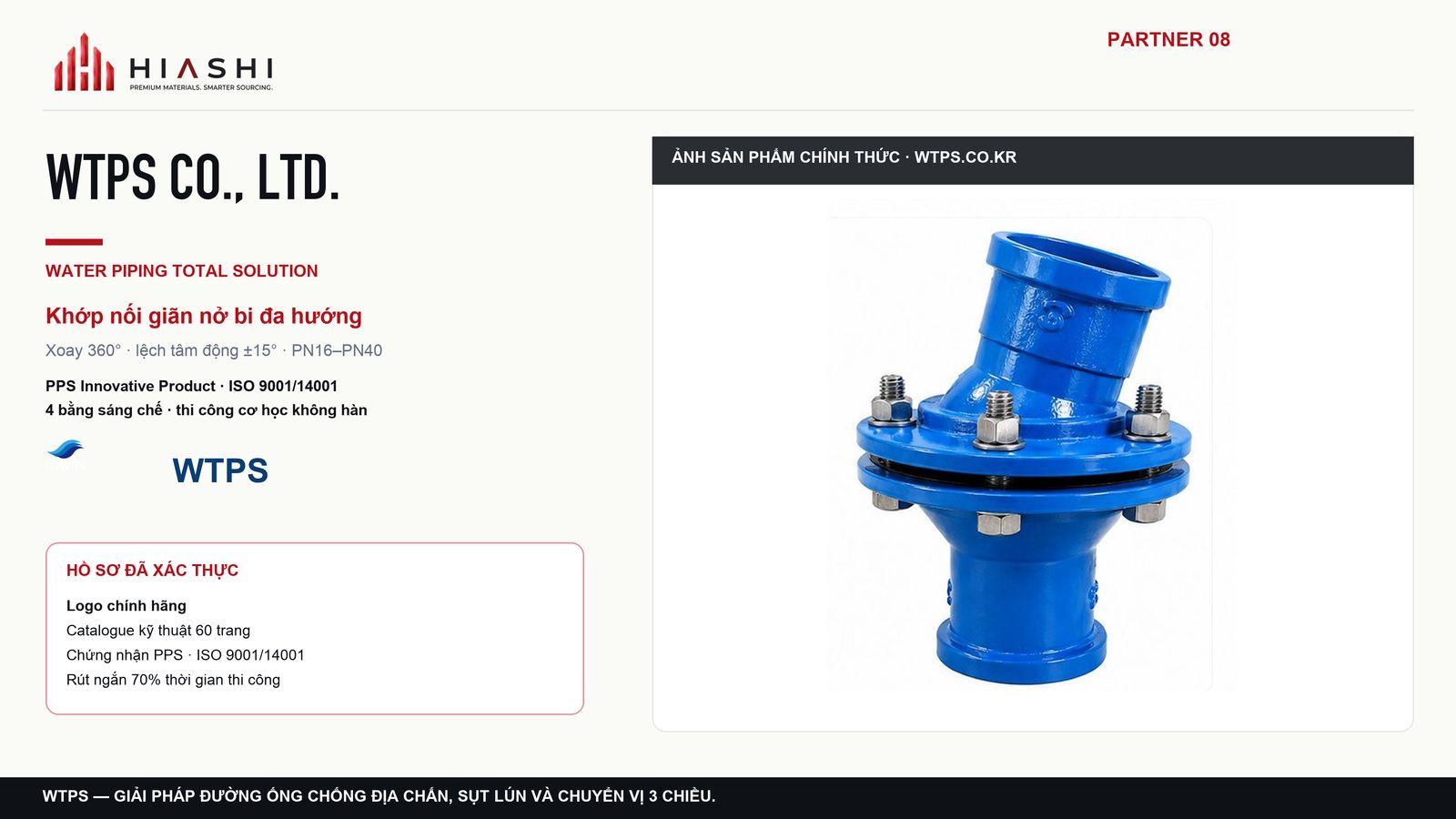
7. WTPS — Ball expansion joint for multi-directional pipe displacement
WTPS develops ball expansion joints—expansion joints that use a rotating ball mechanism to accommodate multi-directional displacement in piping systems. WTPS's USP lies in its ability to handle displacement not just along a single axis, providing engineers with more options for complex or space-constrained pipe runs, reducing the risk of leaks at critical connection points.
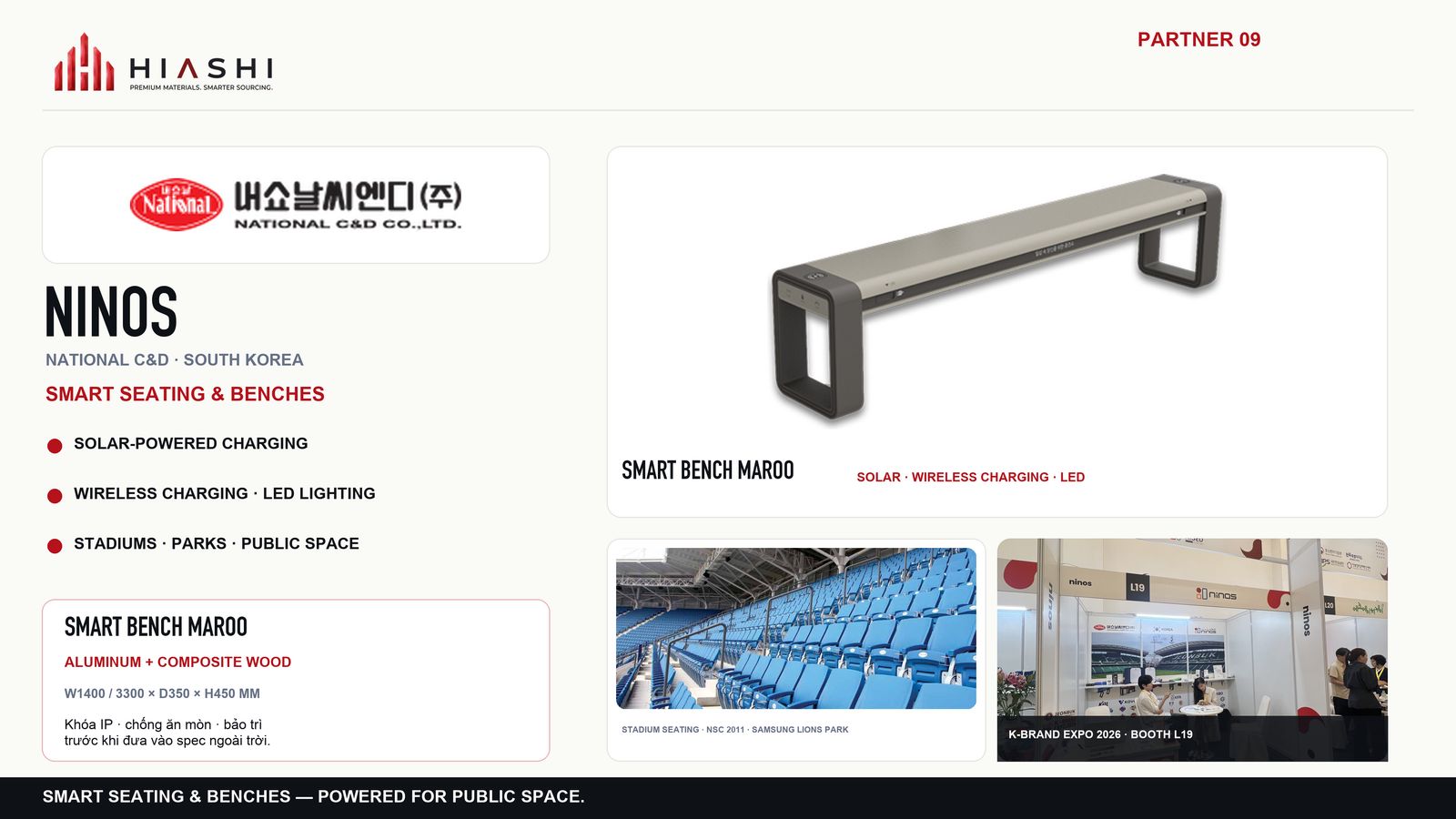
8. Ninos — Smart bench transforms seating into urban amenities
Ninos, a brand under National C&D, develops smart benches for parks, plazas, school campuses, and public spaces. The product combines seating with solar power, USB ports, wireless charging, and LED lighting. Ninos's USP is integrating multiple amenities into a single module that can be flexibly deployed outdoors.
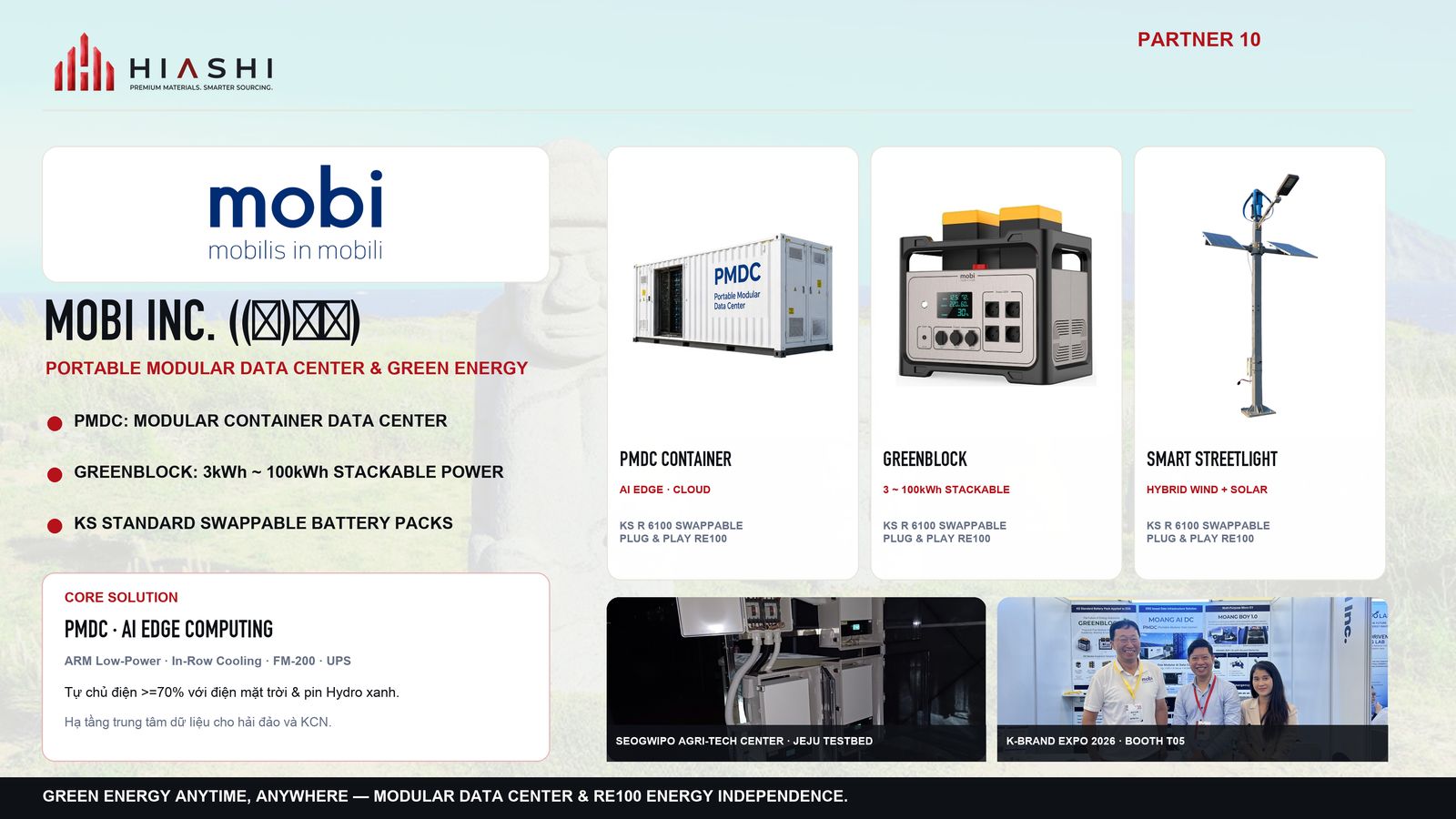
9. MOBI PMDC — Modular data and energy infrastructure
MOBI is an energy technology company based in Jeju, developing PMDC (Portable Modular Data Center) along with a distributed energy storage ecosystem. MOBI's USP is its modular approach: data infrastructure, batteries, and power sources can be deployed in blocks, scaled according to demand, and integrated with solar power or other distributed energy sources.
TRADITIONAL DISTRIBUTOR OR AI SOURCING PLATFORM?
The correct comparison is not "old model bad, new model good." A distributor with a strong technical team can still create significant value. The key differences to measure are the level of transparency, traceability, and the speed of converting manufacturer data into project decisions.
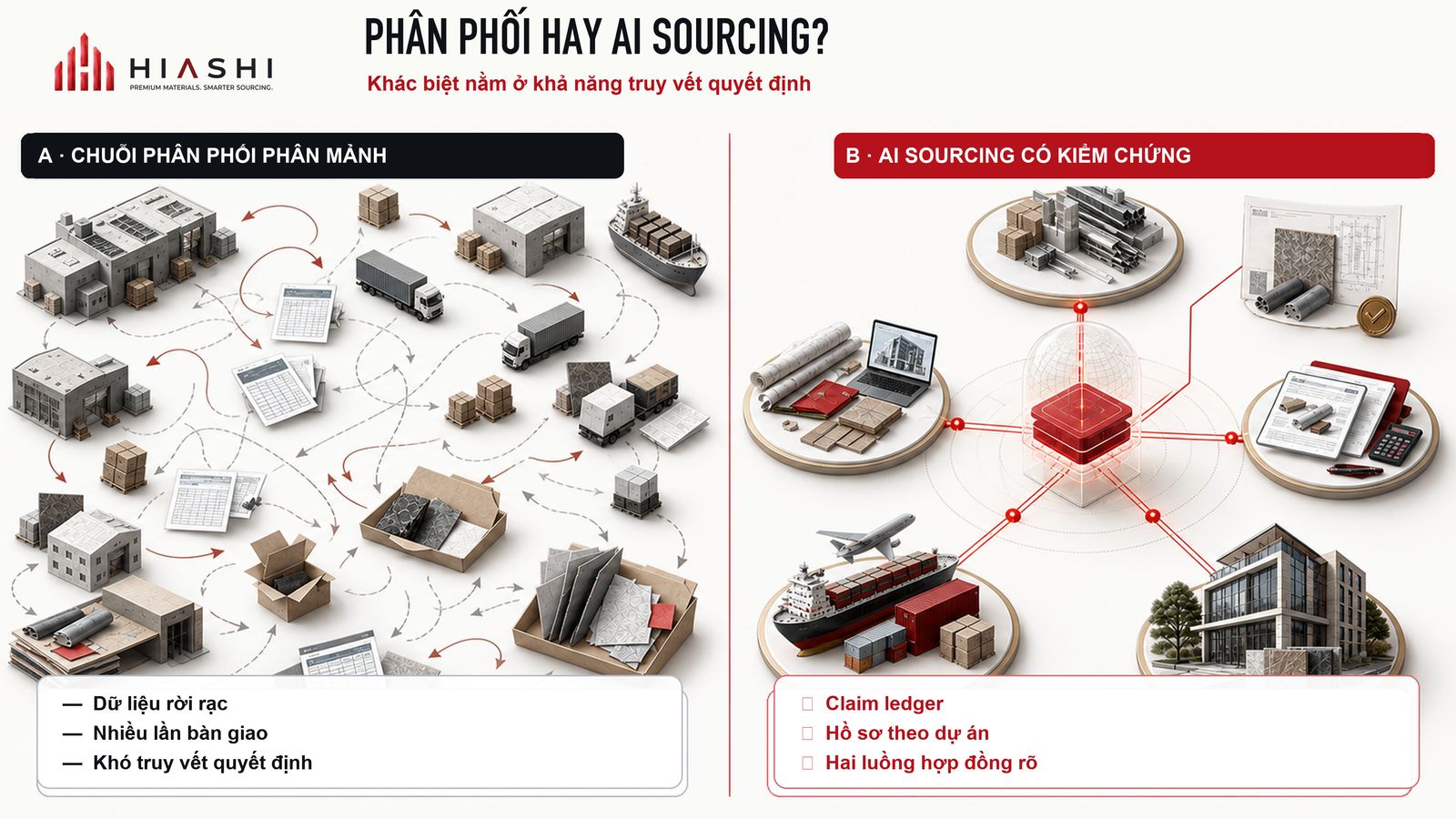
Seven differences to observe in the process
- Product Identity: Fragmented processes lead to scattered data; AI Sourcing standardizes brand, model, version, and source records.
- Technical Claim: Fragmented processes easily separate claims from test conditions; AI Sourcing links each claim to its value, baseline, source, and approver.
- Project Handoff: Fragmented processes create multiple loops; AI Sourcing maintains a brief with version control and a decision log.
- Sample, TDS, and RFQ: Fragmented processes involve manual tracking; AI Sourcing links samples, documentation, questions, and deadlines.
- Commercial: Fragmented processes often only show a single sales flow; the HIASHI model clearly separates direct transactions with the manufacturer or authorized import.
- Compliance: Fragmented processes easily use a general checklist; AI Sourcing classifies by HS code, risk group, and relevant regulatory framework.
- Value of AI: AI must help standardize, detect missing data, and create an auditable trail.
AI does not turn a weak claim into strong evidence. AI is only valuable when it reveals missing data before the project pays the price for it.
Two ways to work with HIASHI
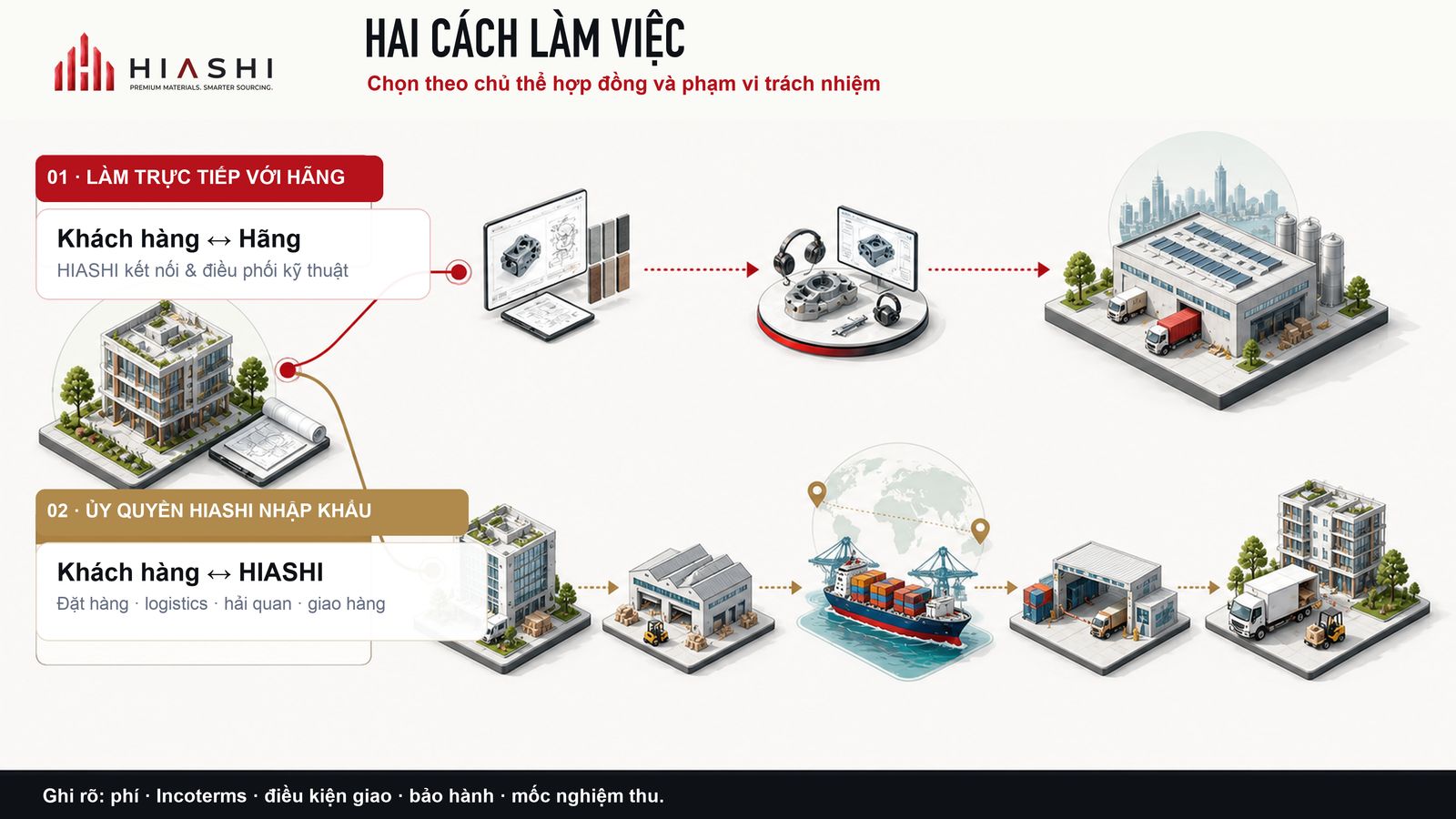
1. Direct engagement with the manufacturer: HIASHI connects and supports clarifying briefs, technical documentation, samples, pilots, and contacts. Clients sign and transact directly with the manufacturer using tools like HIASHI Manufacturer Contracts. 2. Authorizing HIASHI for import: HIASHI signs a supply contract with the client and executes the agreed scope: ordering, shipping, customs declaration, and delivery to the construction site. Learn more at HIASHI Import Operations.
Conclusion
With the HIASHI AI Sourcing Platform, we don't just provide information; we also offer a reliable digital platform for technical evidence. You can learn more about this process at HIASHI Knowledge Homepage.
Need material guidance for a project?
Share the technical brief so HIASHI can support material shortlisting, samples, TDS and RFQ preparation.