
Material Guide
Choosing Facade Materials for Vietnam: What to Check Before Specifying
Compare fibre cement, exterior compact HPL, ACP and terracotta by product evidence, facade assembly, wind loading and project fire-safety requirements.
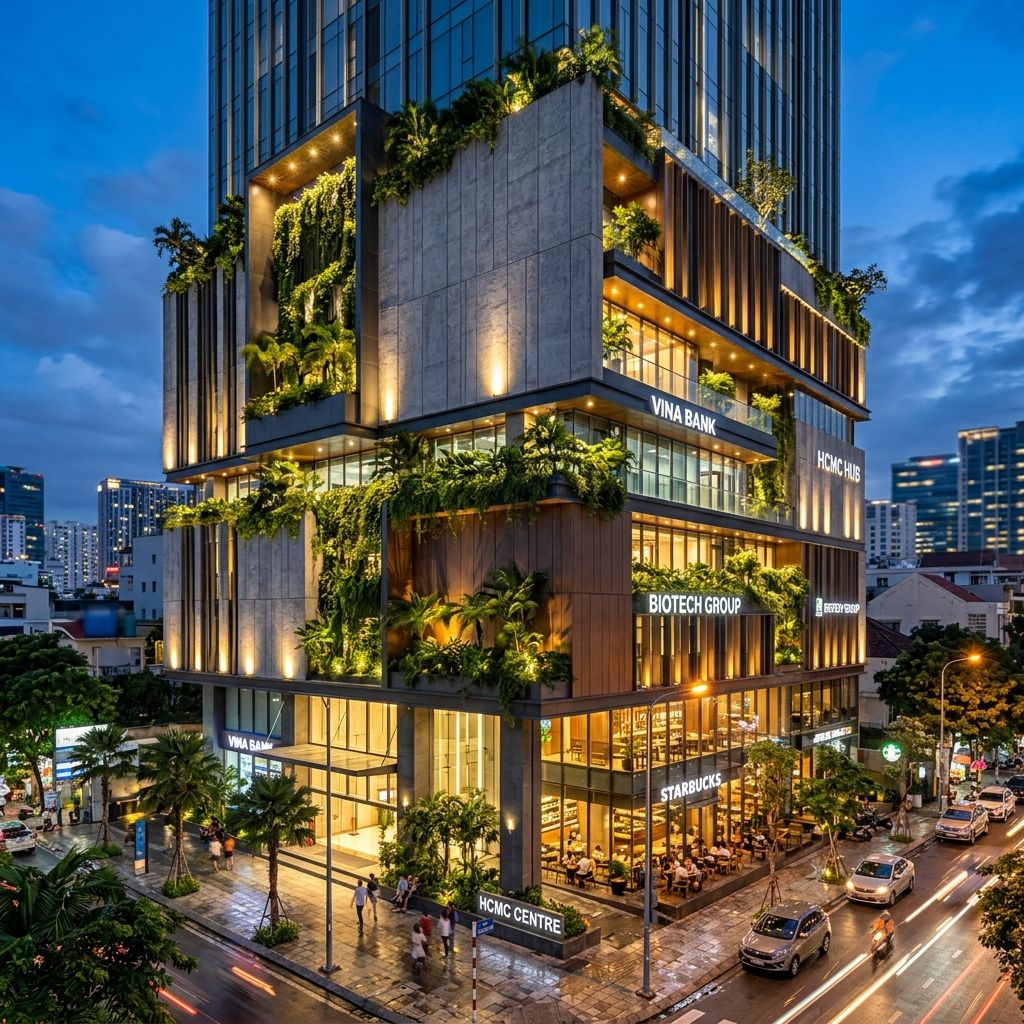
Choosing Facade Materials for Vietnam: What to Check Before Specifying
Short answer: No cladding material is best for every project. Establish the location, wall assembly, height and wind loading first. Then compare the exact product's installation guide, fire-test evidence, dimensions, weight, finish and warranty. A property of one product does not automatically apply to every fibre-cement, HPL or ACP panel.
Four questions that decide the specification
- How does the wall drain and ventilate? The cavity, air inlet/outlet and base detail must follow the selected system and building height. For example, the Swisspearl Patina aluminium-frame installation guide gives different minimum cavity depths by cladding height. A single 20 mm rule is not suitable for every facade.
- Have the subframe and fixings been assessed for this building? The Swisspearl Patina steel-frame guide calls for wind-load assessment, substrate-appropriate fixings and corrosion resistance suited to the environment.
- Which exact product and assembly has the stated fire classification? Do not infer classification from material name or core type alone. Compare test reports and permitted applications with the project's fire-safety design and QCVN 06:2022/BXD with Amendment 1:2023 published by Vietnam's Ministry of Construction. A blanket 28 m rule does not establish whether a particular ACP may be used.
- Do the commercial and technical documents match? Confirm product code, finish, dimensions, technical data sheet, installation guide, applicable certificates and warranty terms before approving a sample.
Compare the product evidence
| Material | Design questions | Documents to request |
|---|---|---|
| Fibre cement | Panel mass, surface finish, drainage, installation limits and fixings | Exact product TDS, installation guide and fire classification |
| Exterior compact HPL | Exterior grade, weathering, movement, finish and subframe | Grade-specific TDS and installation guide; interior HPL evidence is not a substitute |
| Aluminium composite panel (ACP) | Core construction, product/assembly fire classification, fixings and use limits | Test report, assembly details and project fire-safety review |
| Terracotta | Mass, anchorage, impact resistance, drainage and panel construction | TDS, anchorage tests and manufacturer installation guide |
A product-specific mass example: Swisspearl lists its 8 mm Patina Original/Rough/Structure panels at approximately 14.9 kg/m², an indicative value for those products. Fundermax Exterior Pro 2.3 lists a typical Max Compact Exterior density of 1.44 g/cm³; at 8 mm, density × thickness gives approximately 11.5 kg/m² before subframe and fixings. These examples do not prove that every HPL panel is lighter than every fibre-cement panel. Swisspearl source.
For coastal projects, include corrosion exposure of fixings, anchors and subframes in the design review. Select a fastening material for the actual environment and system rather than assuming one stainless-steel grade suits every project.
Checklist before issue
- Record site location, building height, rain/wind exposure, wall construction and drainage strategy.
- Lock the exact product code, thickness, finish and current technical documentation.
- Check wind loading, anchorage, subframe, movement joints and ventilation against the chosen system.
- Match fire classification and test scope to the project's fire-safety design; avoid generic ACP/HPL permission tables.
- Confirm warranty, maintenance requirements and a representative installed sample with the supplier.
Scope and review date: Reviewed 14 September 2026 using the primary documents linked above. This is an initial selection framework, not a substitute for project engineering, product testing or fire-safety approval.
Need material guidance for a project?
Share the technical brief so HIASHI can support material shortlisting, samples, TDS and RFQ preparation.