
Material Guide
Don't Choose a Material Just Because the Image Looks Good: 3 Questions Before Shortlisting
A short framework for turning visual inspiration into a material decision that architects, contractors and sourcing teams can verify.
Don't Choose a Material Just Because the Image Looks Good
A beautiful image can earn a place on a moodboard. A moodboard is not yet a technical decision.
Before a material enters a shortlist, the design team should answer three questions: what context will it work in, how will the interfaces be resolved, and what evidence is available to verify the choice?
This framework does not rank brands. It turns an aesthetic reaction into a clearer brief for architecture, façade, contractors and sourcing.
1. What is the use context?
“For a wall” or “for a floor” is rarely enough. Describe the context more precisely:
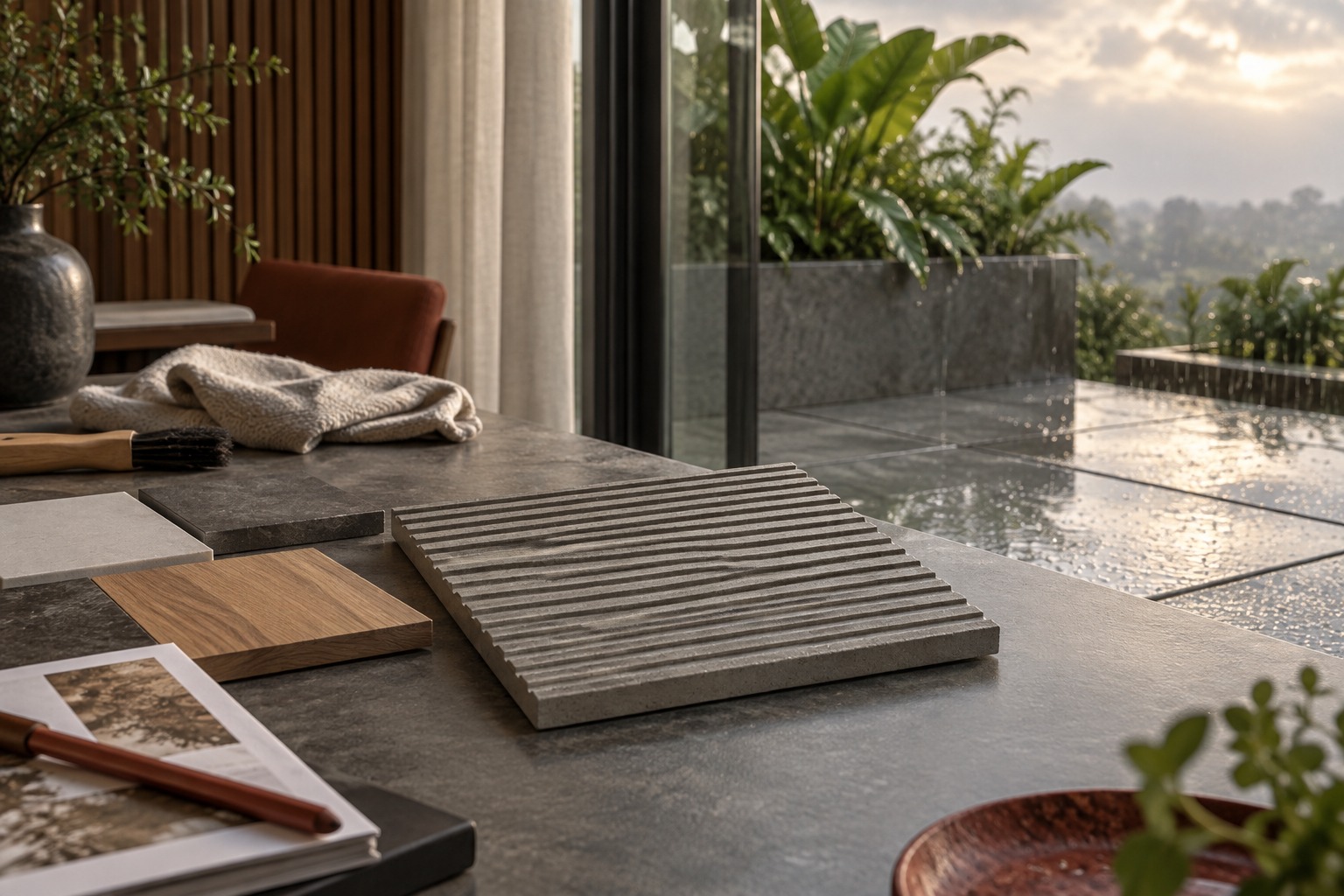
- Location: indoor, outdoor or semi-outdoor?
- Light: daylight, spot lighting, changing light or stable light?
- Environment: humidity, rain, salt air, dust, cleaning chemicals or temperature swings?
- Traffic: private, low-traffic or high-density use?
- Operations: who will clean, inspect and maintain the surface after handover?
Two surfaces can look similar in a studio image but behave very differently in a hotel lobby, a west-facing façade or an outdoor terrace.
Quick test: write one sentence: “This material sits at ___, is exposed to ___, is viewed under ___ and is maintained by ___.” If that sentence is incomplete, the brief still lacks context.
2. How are the interfaces resolved?
Materials rarely stand alone. The final experience is often decided by the parts missing from a marketing image.
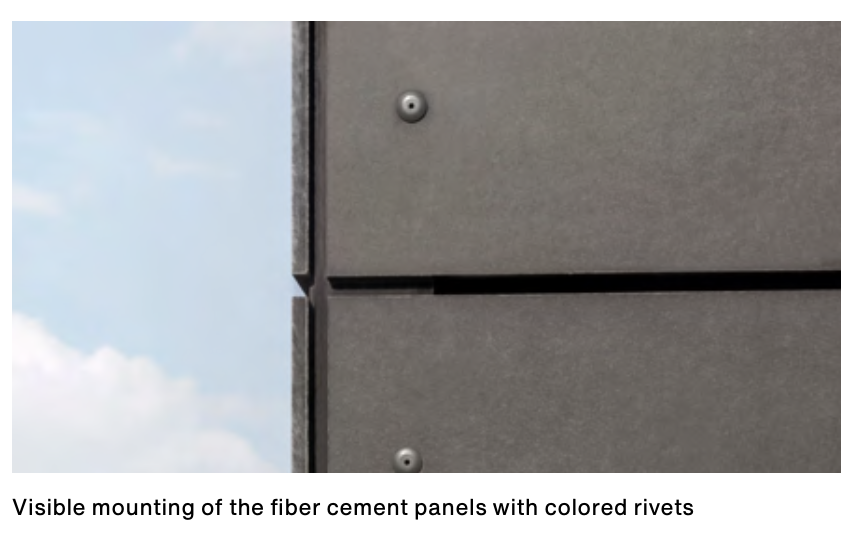
Ask about the joint width and rhythm, the edge and corner treatment, the substrate or support frame, the path for water and air, and any access panel, movement joint or installation tolerance.
At concept stage, an illustration cannot replace a shop drawing. It can, however, reveal which questions must move into a detail, sample or mock-up.
Quick test: zoom into one moodboard corner and mark three points: joint, edge and backing layer. If you cannot see or describe all three, the option is not ready to be called “spec-ready”.
3. What evidence do we have?
Every material statement should be matched to the right kind of evidence. One brochure cannot replace every conclusion.

| Information | Question | Evidence to check |
|---|---|---|
| Surface impression | Does colour, texture and scale match in person? | Physical sample; photos under different light |
| Build-up and format | What are the code, thickness, module and installation system? | TDS, correct catalogue, detail or installation guide |
| Performance | What exactly was tested? | Test report with sample code and test method |
| Certification | Who verified it, within what scope, and is it current? | Certificate, scope, validity date and revision |
| Application | What does the project image actually prove? | Completed project record and image rights |
If a document is missing, write “to be verified”. That is an information-management state, not a negative judgement about the product.
A correct TDS for the wrong product code or an expired revision is not enough. A beautiful project photograph proves only what can be seen in that image; it does not automatically prove fire rating, service life, load or suitability in another context.
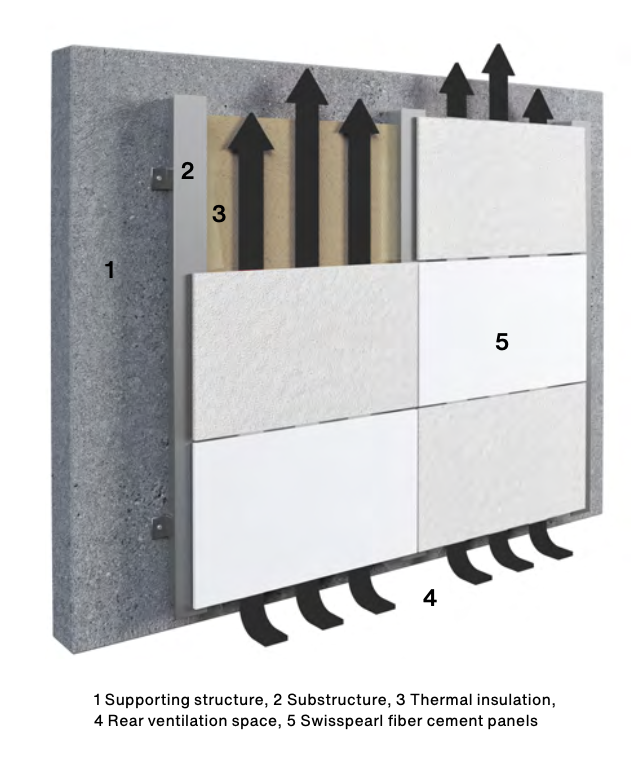
The facade-system diagram shows why substrate and rear ventilation cannot be reduced to “a beautiful panel”. When the concept moves into detail, each layer and its continuity through the build-up must be locked.

Reference image from the Swisspearl Design and Installation Manual, page 61: Visionshuset, Ålborg, Denmark; KPF arkitekter. It illustrates the type of application evidence to check and is not a HIASHI project.
From inspiration to a shortlist in five minutes
- Write the use context in one specific sentence.
- Mark the joint, edge and backing details that need answers.
- Separate “known” from “to be verified”.
- Request the sample and the correct document set for the exact code.
- Compare options only when they share the same criteria.
The result is not necessarily a product. The better result is an explainable shortlist: why it fits the context, which detail must be locked, and which evidence is still missing.
Conclusion
A beautiful image is the starting point. A material decision needs context, detail and evidence.
If an option cannot answer the three questions above, keep it in concept or to be verified status instead of moving it directly into a specification.
HIASHI will continue building short checklists for architects, contractors and sourcing teams. When sharing a Material Clinic question, remove client names, addresses, confidential drawings and commercial information first.
Need material guidance for a project?
Share the technical brief so HIASHI can support material shortlisting, samples, TDS and RFQ preparation.