
Material Selection
Aluminum facades aren't cheap because of thin panels: They're expensive when they need fixing
A 100-point scale helping developers and architects choose aluminum composite panels for facades and interiors; verifying skin, surface, core, coating, and MFR fastening systems.
The Vietnamese market does not lack aluminum composite panels. Buyers can encounter many familiar names such as Triều Chen, Alcorest, and imported brands from China, India, or many other markets.
The problem lies in how they are purchased. Aluminum panels are often reduced to three questions: how much per square meter, how many millimeters thick, and what colors are available? When price is the primary filter, products easily have their configurations cut to reach a low number: thin aluminum skins, basic coatings, inappropriate cores, missing technical documentation, or the framing systems treated as an afterthought.
There isn't enough public data to say that "most brands in Vietnam sell poor products." Nor can quality be concluded solely from the brand name. Triều Chen announces multiple PE, SP, PVDF, and fire-resistant lines; Alcorest also has its own standard specifications. What needs to be compared is the exact product code, the correct batch, and the proper installation system.
Do not buy just an aluminum panel. Buy a facade result: flat, correct color, safe, well-drained, replaceable, and documented for commissioning.
SHORT ANSWER FOR SPEC REVIEWERS
If you only have 60 seconds, remember these 5 points:
- Total thickness is not aluminum skin thickness: A "4 mm" panel can still use two very different aluminum face layers. The thickness of each skin must be specified separately.
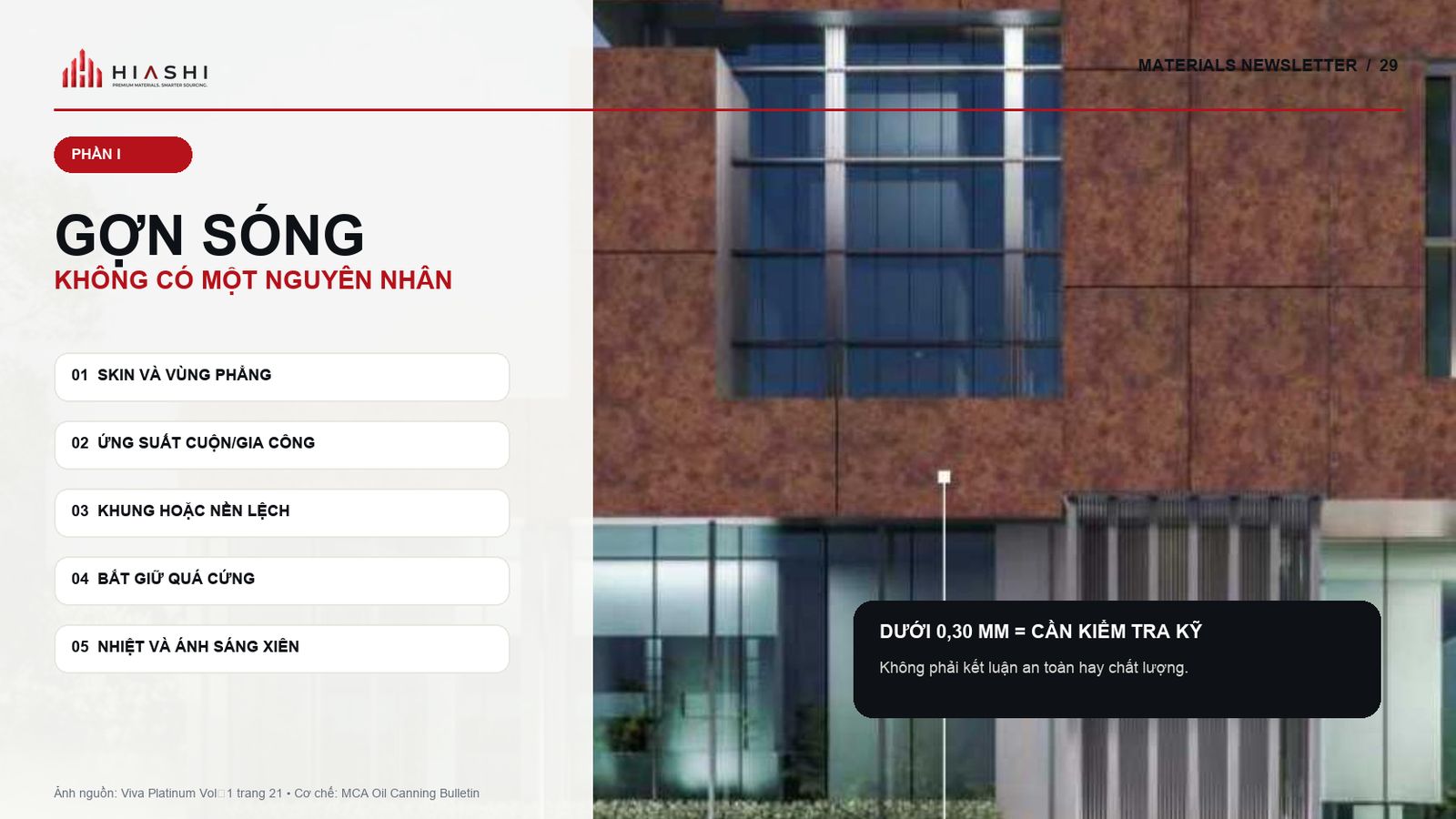
- A skin under 0.30 mm is a signal for closer inspection, not a death sentence: Thinner materials easily reveal stress, uneven substrates, and installation tolerances; but oil canning also depends on flat area size, core, fabrication, framing, temperature, and lighting.
- A beautiful color sample is not enough: Samples must have codes, batches, coatings, gloss levels, thicknesses, cores, alloys, and test reports for the exact build-up.
- Good panels on poor framing still yield a poor facade: Rails, brackets, anchors, gaps, fixed–sliding points, WRB, and cavity barriers must be designed together.
- Only finalize price after passing technical thresholds: Use a 100-point scale, build mock-ups, and lock the configuration into the RFQ/PO.
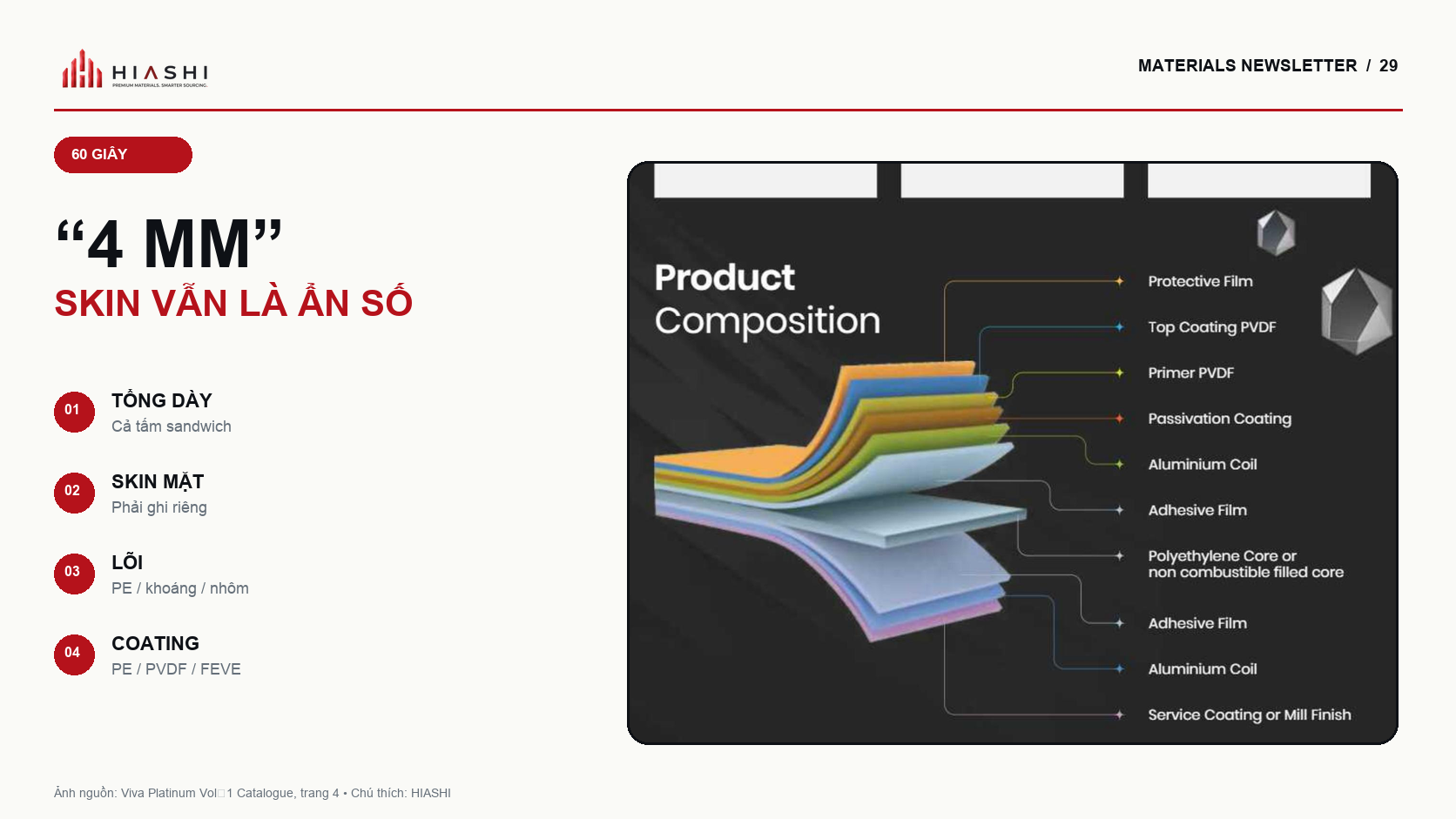
WHY CAN A "4 MM PANEL" YIELD TWO VERY DIFFERENT RESULTS?
ACP is a sandwich panel: an outer protective paint layer, aluminum skin, adhesive layer, core, and then repeated on the back. Therefore, the number 4 mm only indicates total thickness. It does not answer four critical questions:
- How thick is each aluminum skin?
- What alloy/temper is the aluminum?
- Is the core PE, mineral core, or corrugated aluminum?
- Is the coating PE, PVDF, FEVE, or another system?
How does a thin skin affect aesthetics?
When the skin is thinner, the bending stiffness of the face layer decreases. Minor deviations from the aluminum coil, rolling-slitting processes, routing, folding, corner keys, screws/rivets, uneven framing, or thermal expansion easily appear across large flat areas. Under raking light, the human eye sees bands of light and dark collectively called "oil canning".
However, one shouldn't write a simple formula like "under 0.30 mm guarantees waves" or "0.50 mm guarantees flatness." The Metal Construction Association describes oil canning as a multi-causal phenomenon: material stress, flat area dimensions, fabrication, storage, overtightened screws, misaligned substrates, thermal movement, and installation sequence can all contribute.
Why do these defects often appear late?
In a sample room, small panels are viewed face-on under uniform lighting. On the job site, large cassettes face hourly sun, wind suction, temperature changes, and raking light sweeping across the elevation. A deviation hard to spot on a 300 × 300 mm sample can be glaring on a large module.
Therefore, for facades, full-size mock-ups must be approved with the correct orientation, framing, and observed from multiple angles during times of raking sunlight. For interiors, mock-ups must be built under actual lighting systems; glossy or metallic surfaces can make ripples more visible.
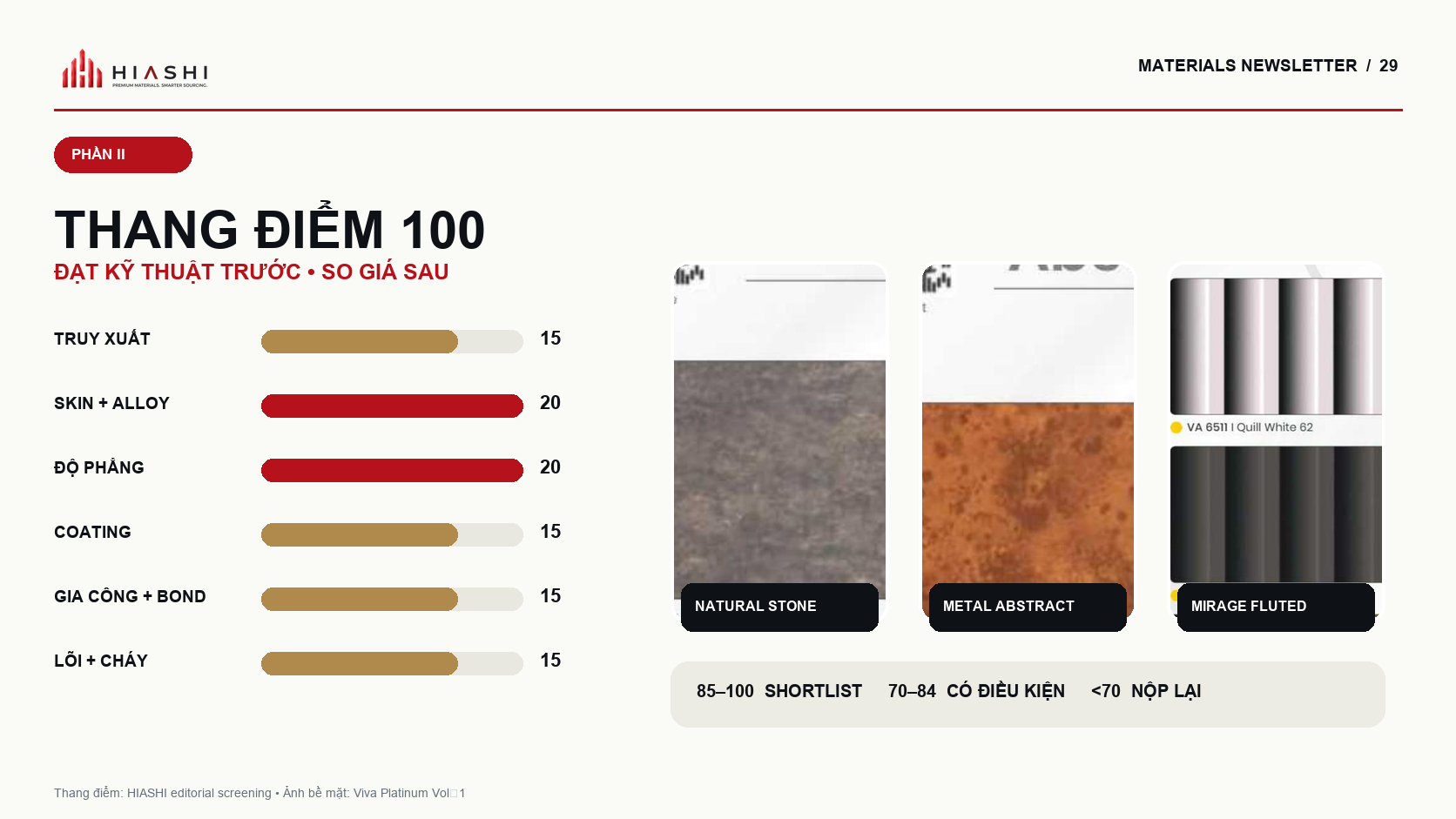
A 100-POINT SCALE FOR ALUMINUM PANEL SAMPLES
This is a screening scale edited by HIASHI, not a legal standard or product certification. The goal is to help developers, architects, and procurement compare samples on a level playing field before sending them for testing or technical approval.
- 1. Identity and traceability (15 points): Has brand, factory, product code, color code, batch, production date, and documentation matching the sample.
- 2. Aluminum skin and alloy (20 points): Clearly states thickness of each face, tolerances, alloy/temper; includes measurement methods or CoC/MTC.
- 3. Flatness and appearance (20 points): Large samples/mock-ups viewed under raking sunlight or actual lighting; color, gloss, scratch, and ripple criteria are agreed upon.
- 4. Coating and color durability (15 points): Correctly states PE/PVDF/FEVE, coating build-up, paint supplier, color-gloss requirements, and warranty conditions.
- 5. Fabrication and adhesion (15 points): Routed-folded samples don't crack the outer skin; corners/rivets are clear; peel/bond strength has data for the exact build-up.
- 6. Core, fire, and test records (15 points): Identifies the core; reports match the factory, thickness, skin, coating, standards, and application scope.
Total 100 points: Only compare prices among samples that have passed technical thresholds.
How to read the results
- 85–100 points — Eligible for shortlisting: Still requires checking the fastening system, wind loads, water management, and project mock-ups.
- 70–84 points — Conditional approval: Clearly state what documents or tests must be supplemented and the deadline for closing the score.
- Under 70 points — Do not finalize price yet: Request resubmission of samples with the correct configuration or choose alternative options.
Three rules to prevent "bait-and-switch"
- Seal the approved sample with signatures and batch codes.
- Write the configuration into the RFQ, PO, and approved material submittal; don't just write "Grey 4 mm Alu".
- When goods arrive, randomly sample to check thickness, color, gloss, appearance, and cross-reference documents.
BEYOND THE ALUMINUM PANEL, FASTENING SYSTEMS DECIDE THE OTHER HALF
A durable facade isn't created by panels alone. Wind loads transfer from the cassette through profiles, rails, brackets, anchors, and into the wall or main structure. Water penetrating joints must meet a secondary water-resistive barrier and have an exit path. Heat causes aluminum to expand, so the system must have fixed and sliding points.
The project team needs to lock down at least six items:
- Safety: Wind loads by facade zone, especially corner zones; capacities of cassettes, profiles, brackets, anchors, and substrates.
- Flatness: Bracket/rail elevations, support spacing, cassette stiffness, alignment sequences, and appearance limits.
- Water management: WRB, flashings, weep holes, end caps, and details around windows or penetrations.
- Movement: Fixed points, sliding points, panel gaps, rail splices, and temperature at installation.
- Fire compartmentation: Core matches documentation; cavity barriers/fire stopping align with the project's fire strategy.
- Maintenance: Accessibility to screws/clips, surface cleaning, clearing drainage paths, and replacing single modules without tearing down the entire wall.
This is also why a quote listing only "panel price/m²" is hardly enough to compare total costs. Two options using the same panels but different profiles, bracket spacing, anchors, flashings, fabrication, and panel replacement methods can yield vastly different outcomes.
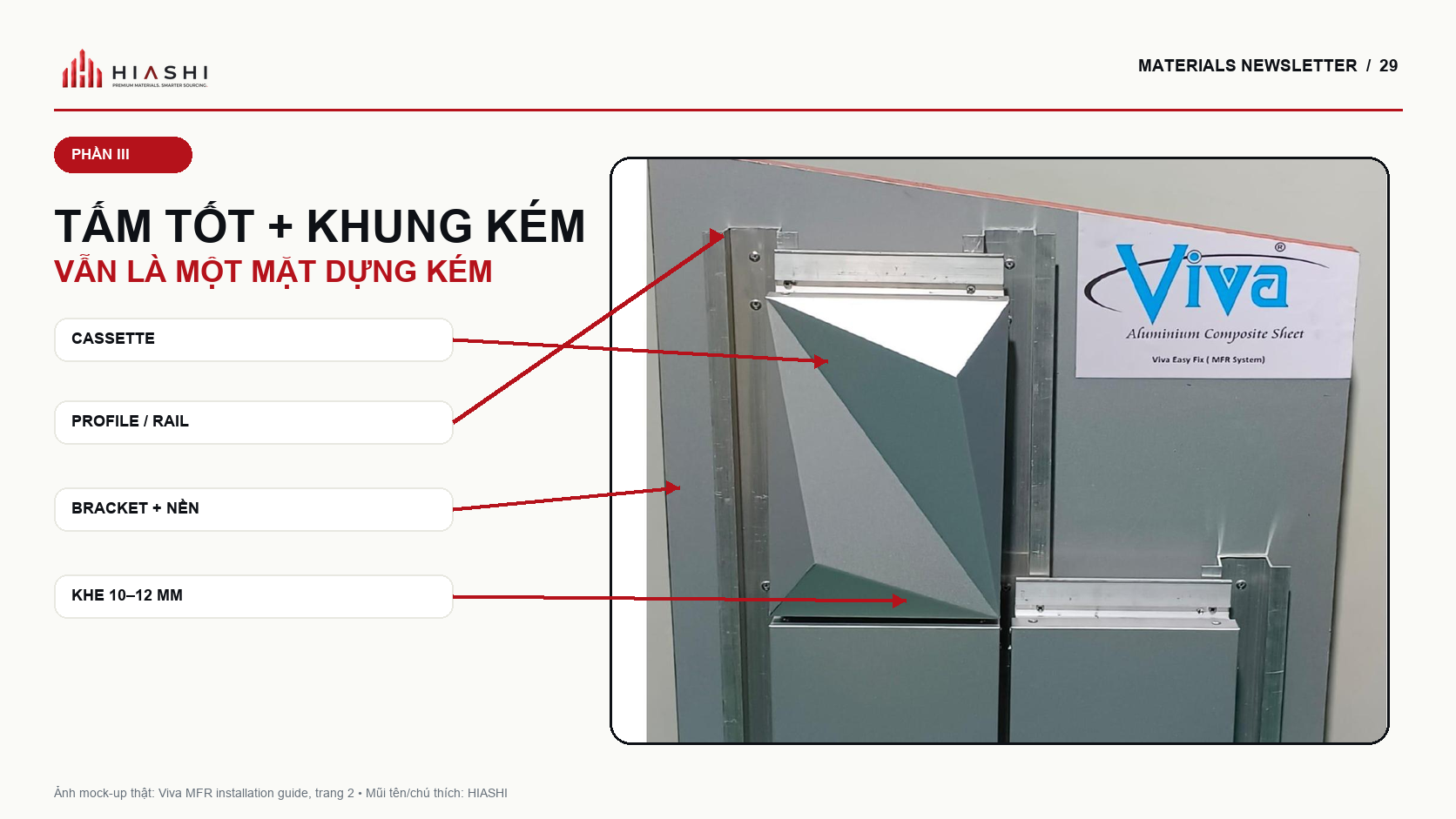
READING THE VIVA SOLUTION: FROM PANEL SPEC TO PLATINUM SURFACES
Once criteria are set, Viva becomes an option that can be evaluated with data rather than brand names alone.
The Platinum Vol-1 Catalogue publishes the 7 Star, 5/6 Star, 801, Eco, Decor, and HPL series with varying configurations. The catalogue's technical data sheets show:
- Common sizes 2440/3050/3660 × 1220 mm: Check modules and wastage; do not assume every color comes in every size.
- Total thickness 3 or 4 mm depending on series; HPL 6 mm: Choose based on application, avoiding one configuration for both facades and interiors.
- Published alloys include AA1100, AA3003, AA3105, AA5005 depending on series/requirements: Lock the correct alloy/temper in technical submittals and batches.
- Coatings PE, PVDF, FEVE, or SDP/HDPE depending on series: Facades and interiors require different coatings; confirm the correct color code and exposure.
- The core technical page lists 4 mm builds with 0.5 mm coils for listed PE/mineral/corrugated samples: This is data for those specific configurations, not broadly applicable to every SKU in the catalogue.
- Published tolerances include coil thickness ±0.03 mm: When specifying "0.50 mm", clarify if it's nominal or minimum actual thickness.
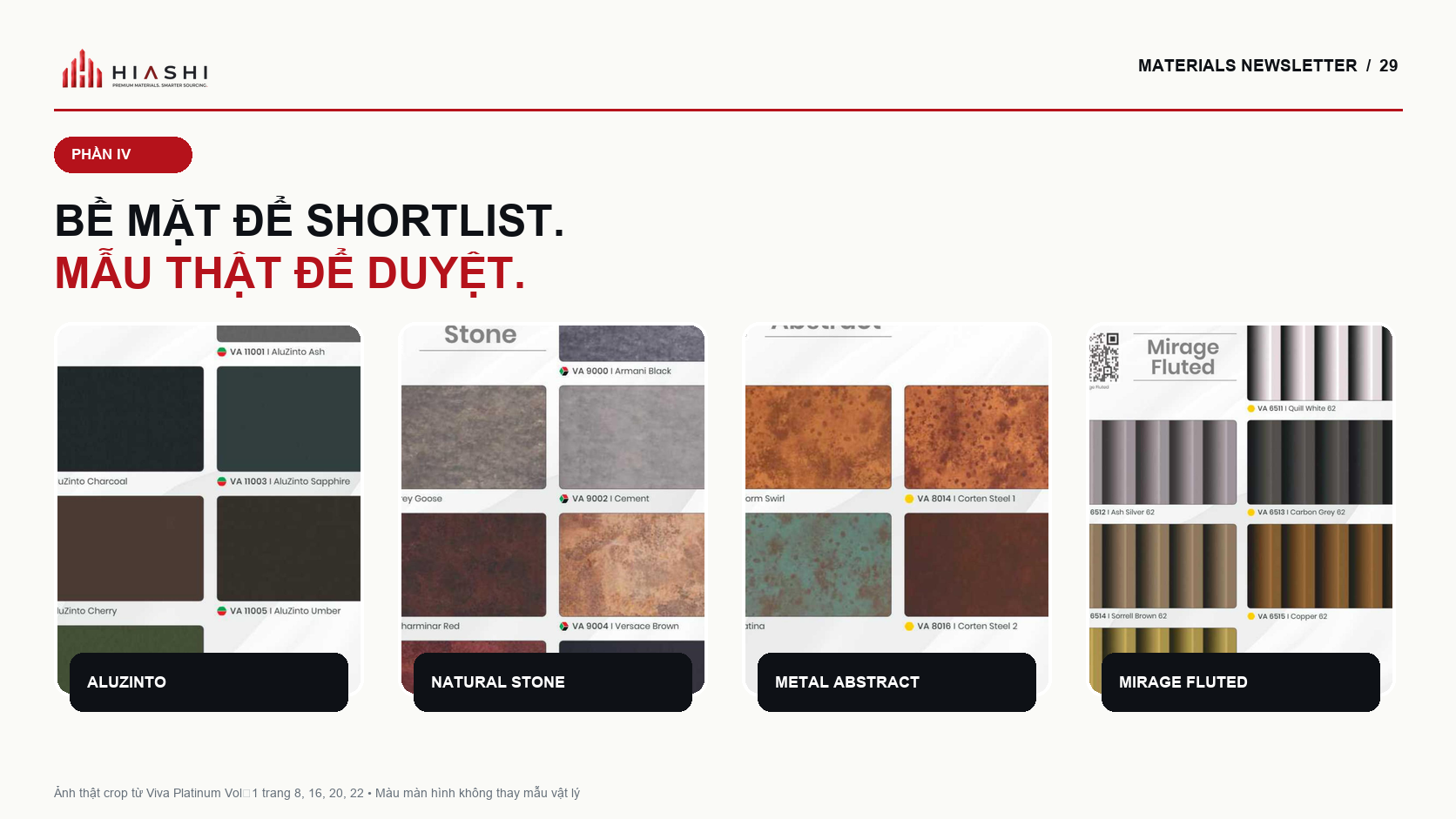
The catalogue showcases several surface groups: anodized-look, AluZinto, Tarnish Metallum, Natural Stone, Metal Abstract, and Mirage Fluted. Printed color charts are only for shortlisting; the catalogue notes printed colors may vary from real samples. Final approvals should rely on physical samples and control samples.
Warranties must be locked to the exact coating and contract
Viva's official site references 10 years for PVDF and 15 years for FEVE coatings; the manufacturer also notes total duration may change based on the product. Conditions include proper use, maintenance, and cleaning records. Therefore, purchasing documents must include a project warranty letter clearly stating panel codes, color codes, coatings, environment, location, duration, covered defect scopes, exclusions, and claim processes. Do not use phrases like "up to 30 years warranty" as a default baseline for all orders.
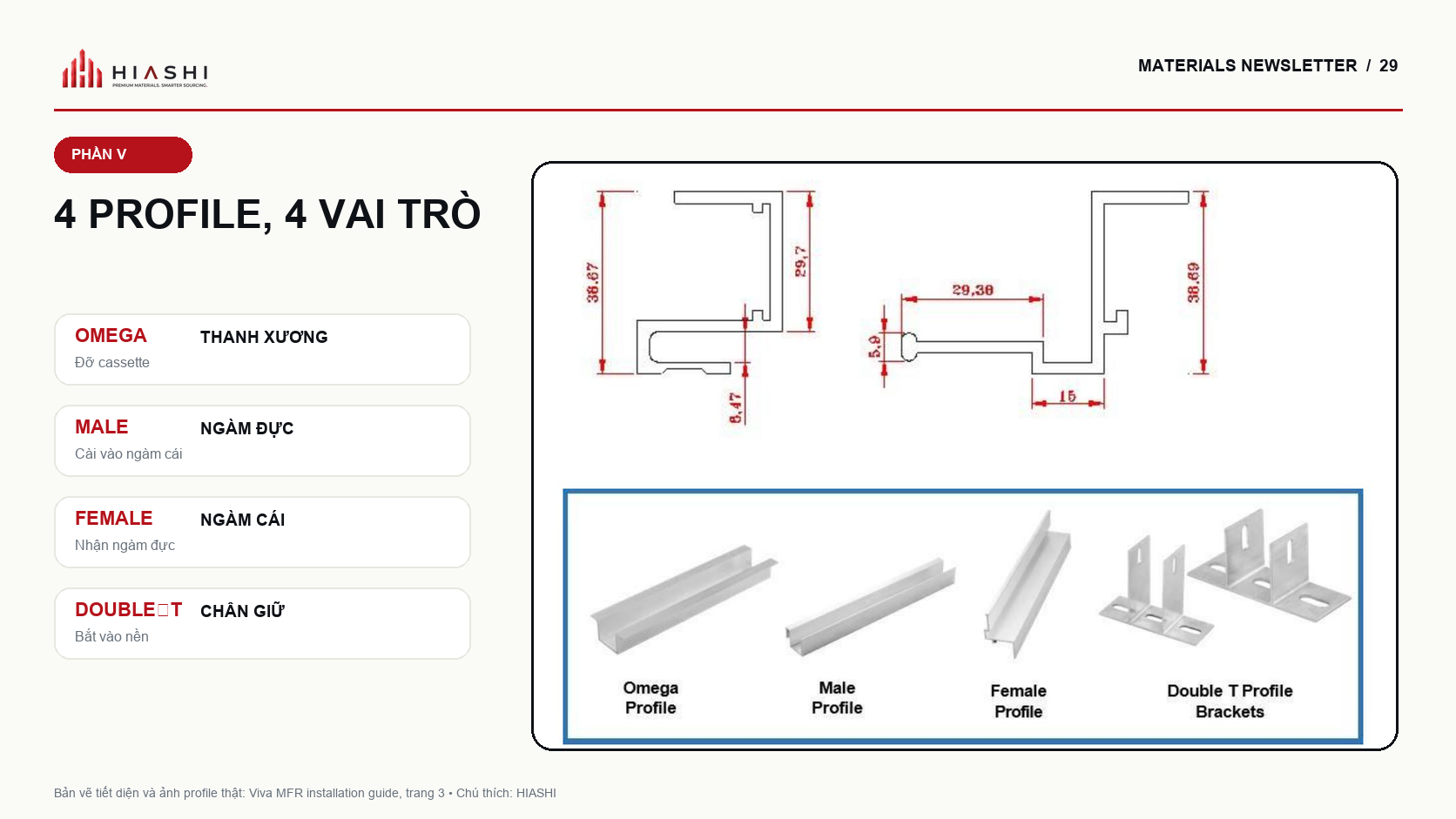
VIVA'S MFR SYSTEM: WHICH PROFILE DOES WHAT?
Viva's MFR installation manual outlines four structural component groups: Double-T brackets, Omega profiles, Male profiles, and Female profiles.
Reading profile diagrams in plain language
- Double-T bracket: Anchors to the substrate and supports rails. Anchors, spacing, and projection depths must follow calculations.
- Omega profile: Creates a flat plane to support cassettes and transfers loads back to brackets.
- Male profile: The protruding section that engages with the opposite female clip.
- Female profile: The section receiving the male clip; engagement and tolerances determine structural integrity and removability.
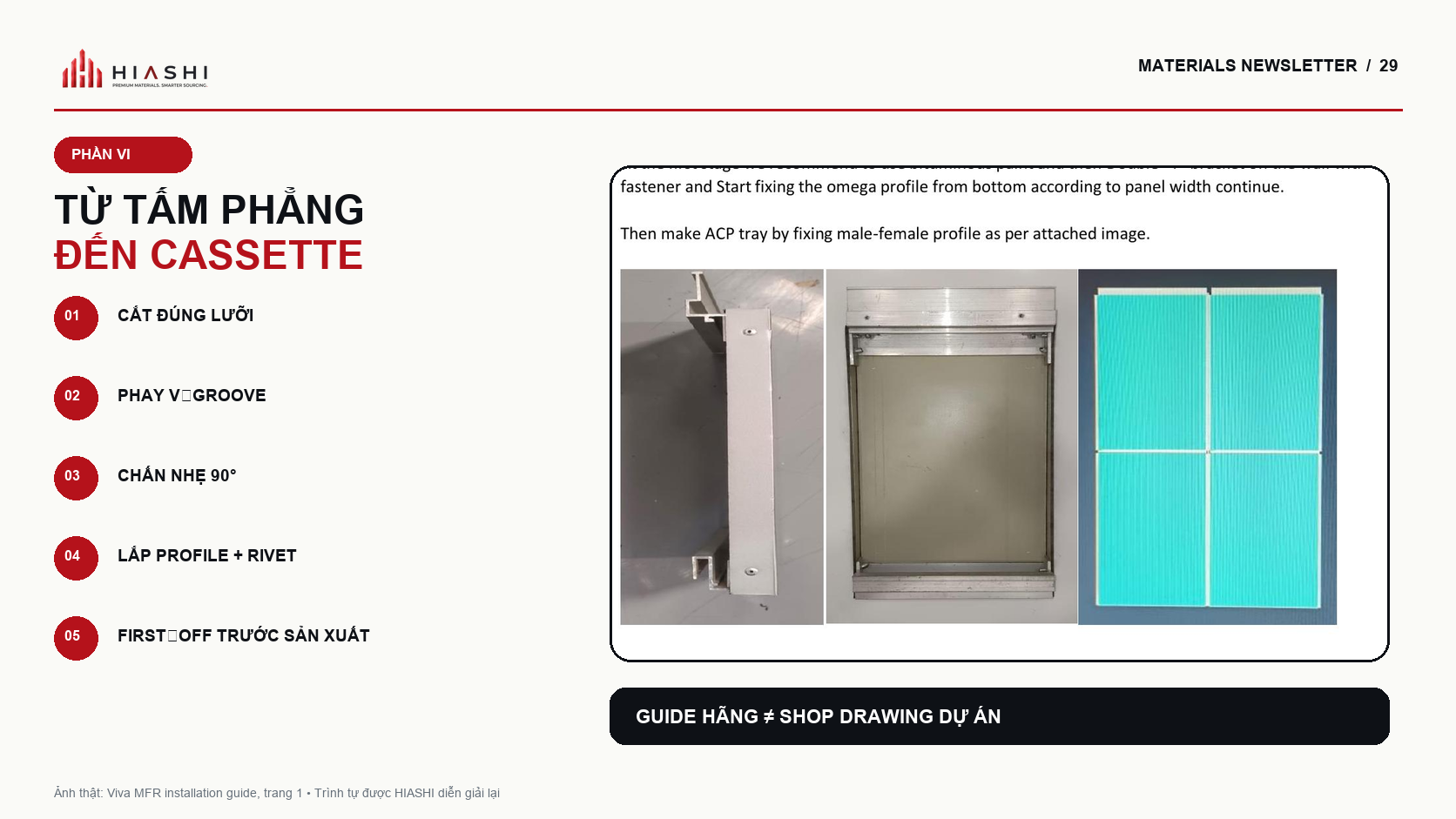
The manual illustrates 10–12 mm gaps between panels and procedures for cutting, routing, and folding cassettes. These are system guidelines from Viva, not complete shop drawings for a specific project.
What MFR can deliver when designed correctly?
- Clean joint appearance: No exposed sealant lines at main module joints.
- Drier installation: Cassettes are pre-fabricated and mechanically engaged, clarifying installation sequencing given accurate surveying.
- Intentional removability: Potential to replace modules if the removal sequence is resolved during shop drawings.
- Rainscreen water management: The outer cladding intercepts most rain; the cavity, WRB, and flashings behind collect and drain water penetrating the joints.
- Controlled movement allowance: Clip systems can accommodate fixed/sliding points, but the manufacturer and facade engineer must confirm this through drawings, calculations, and mock-ups.
What MFR does not automatically resolve
MFR doesn't waterproof substrate walls by itself, doesn't replace cavity barriers, doesn't prove wind loads, doesn't eliminate oil canning, and doesn't magically make all interfaces around windows "sealant-free". Transition areas may still require gaskets, flashings, or sealants per design.
CHECKLIST BEFORE SENDING RFQS OR APPROVING SAMPLES
- Application: Facade, soffit, canopy, ceiling, or interior partition; elevations, and coastal/urban environments.
- Panel: Series code, total thickness, skin thickness per side, alloy/temper, core, coating, color code, and tolerances.
- Surface: Control samples, color/gloss limits, directional arrows, batch planning, and oil canning criteria.
- Fire: Reports matching exact build-ups and scope; cavity barriers, fire stopping, and floor/window details.
- Structure: Wind loads by zone, module sizes, rails/brackets/anchors, pull-out tests, and deflection limits.
- Water: WRB, flashings, end caps, weep holes, parapets, windows, and penetrations.
- Movement: Fixed/sliding points, joints, rail splices, building movement joints, and installation temperatures.
- Fabrication: Saw blades, routers, groove depths, folding, corner keys, rivets, and first-off inspections.
- Mock-up: True sizes, true orientation, true framing; visual approval, water tests, and panel replacement operations.
- Commercial documents: Lead times, Incoterms, packaging, spare stock, project warranty letters, and split responsibilities.
Purchasing rule: achieve technical targets first, compare total costs later.
CONCLUSION
The stereotype that "alu is a cheap, fast, easy-to-replace material" isn't entirely wrong. ACP can be installed quickly and offers a vast range of finishes. The mistake occurs when these three advantages become excuses to ignore skins, coatings, cores, framing, water management, and commissioning documents.
For aluminum facade panels, thicker skins generally help reduce aesthetic sensitivity but don't replace system design. For interiors, skins and coatings might be optimized differently, but flatness, scratch resistance, fire ratings, machined edges, and replaceability must still be evaluated.
Viva Platinum gives design teams numerous surface options; the 0.5 mm configurations in their technical data and the MFR system are notable points for shortlists. The final decision must still rely on item codes, technical confirmation letters, test reports, mock-ups, and project-specific shop drawings.
A brand name opens an evaluation. The spec, control samples, and fastening systems close the risk.
TECHNICAL SOURCES
- Triều Chen — brand introduction and ACP series
- Alcorest — ACP base standard 2021
- Metal Construction Association — Oil Canning Technical Bulletin
- Viva ACP — warranty scope and conditions
- Viva ACP — Aluminium Composite Panel
- Viva Platinum Vol-1 Catalogue, pages 4, 6–23, 26–27
- How to install Viva’s sealant free Rain Screen system (MFR), pages 1–3
Evidence note:
- The 100-point scale is HIASHI's editorial screening framework, not replacing standards, facade consultants, fire strategies, or project testing.
- All specifications and warranties must be reconfirmed by the manufacturer per product code, factory, batch, and contract prior to purchase.
Need material guidance for a project?
Share the technical brief so HIASHI can support material shortlisting, samples, TDS and RFQ preparation.