
System Knowledge
Seeing the Crowd Doesn't Mean Seeing the Risk
A framework for evaluating AI crowd management systems for stadiums, malls, and events: bottleneck forecasting, Digital Twin, privacy, and practical pilot criteria.
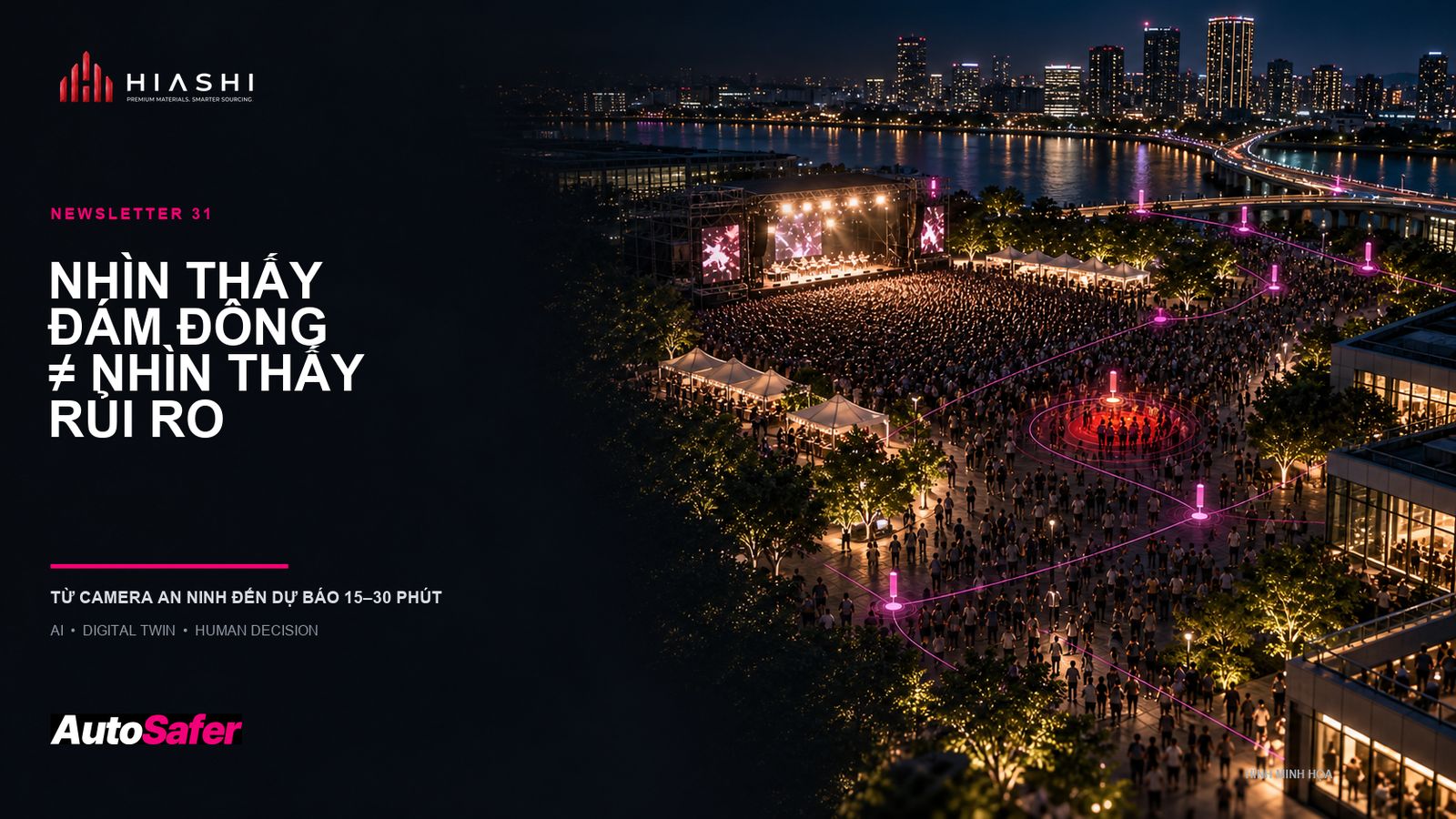
From Present Images to 15–30 Minute Forecasts: How to Evaluate an AI Crowd Management System Before Implementation
A control room might display dozens of CCTV streams, yet fail to answer four critical questions.
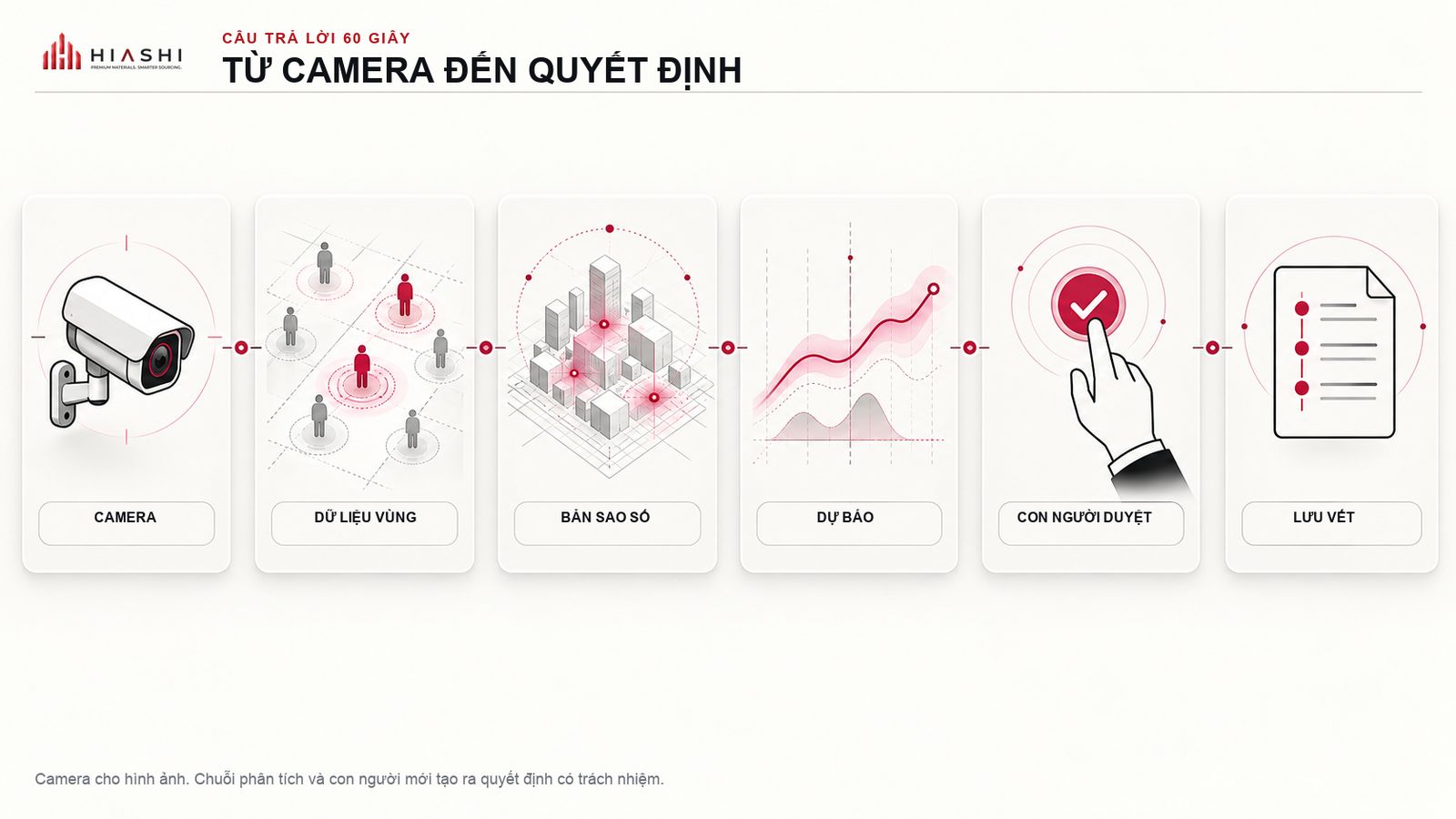
What is CCTV? This is the security camera system commonly seen in lobbies, corridors, parking lots, malls, or stadiums. Images from cameras are transmitted to screens for staff to monitor. Simply put, CCTV helps humans see what is happening; the camera itself usually does not know where a bottleneck is about to form, the level of danger, or how it should be handled.
- Which areas are approaching a dangerous state?
- Where and when might a bottleneck form?
- If entry limits are imposed or secondary exits opened, how might the situation change?
- Who receives the warning, who approves, and what actions have been taken?
The Itaewon tragedy on October 29, 2022, which claimed 159 lives, serves as a stark reminder that crowd management cannot rely solely on cameras or manual observation. Images must be transformed into warnings, action plans, and accountability early enough.
Cameras give us images. Safety only emerges when images are translated into verifiable decisions.
Newsletter #31 analyzes AutoSafer—an AI and Digital Twin system—through a single question: what must the system prove in a pilot before going live?
THE SHORT ANSWER FOR SPEC REVIEWERS
- CCTV primarily aids observation: Cameras transmit images to the control room; the new AI layer analyzes density by zone, issues warnings, forecasts, and logs actions.
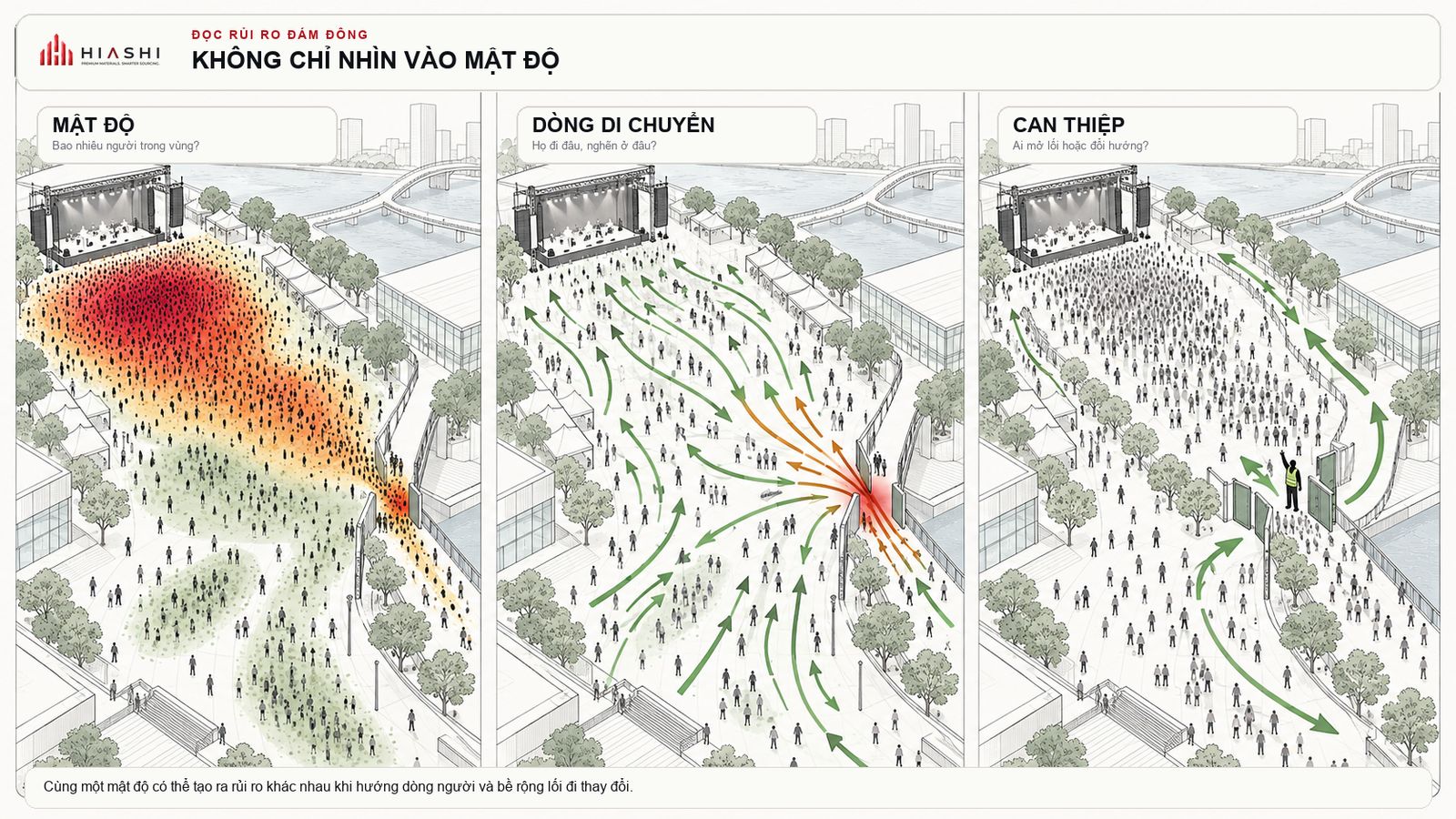
- Density is not enough for diagnosis: Movement direction, speed, intersections, usable width, stairs, and continuous influx all alter the risk.
- A Digital Twin is not just a 3D model: It must accurately contain zones, walkways, usable areas, capacity limits, and camera-to-floorplan mapping.
- The 15–30 minute forecast is a claim requiring a pilot: Zone forecast errors, latency, false alarms, and recommendation quality must be tested in real-world conditions.
- AI does not replace the commander: The system analyzes and proposes; the on-site manager still approves and executes actions.
PART I — A CROWD IS NOT DANGEROUS JUST BECAUSE THERE ARE MANY PEOPLE
Density, typically measured in people per square meter, is a critical signal but insufficient. A square with people moving in the same direction is not the same as a narrow corridor where two streams intersect; a stable waiting area is not the same as a bottleneck where the inflow exceeds the outflow capacity.
Therefore, do not just ask "how many people were counted?". Ask:
- Is density calculated based on geometric area or usable area after subtracting counters, barriers, and columns?
- Does the system track inflow, outflow, and the rate of change?
- How are intersections, stairs, ticket gates, and dead ends modeled?
- What are the warning thresholds for different types of spaces and scenarios?
Crowd turbulence is a state where a high-density crowd exhibits unexpected movements beyond individual control. Research in Mina/Makkah shows that risk is also related to velocity variance and "crowd pressure"; signs of decreasing flow can appear early. A single study should not be turned into a universal threshold: each location must be verified with its own data.
PART II — HOW AUTOSAFER TURNS CCTV INTO A DECISION LOOP
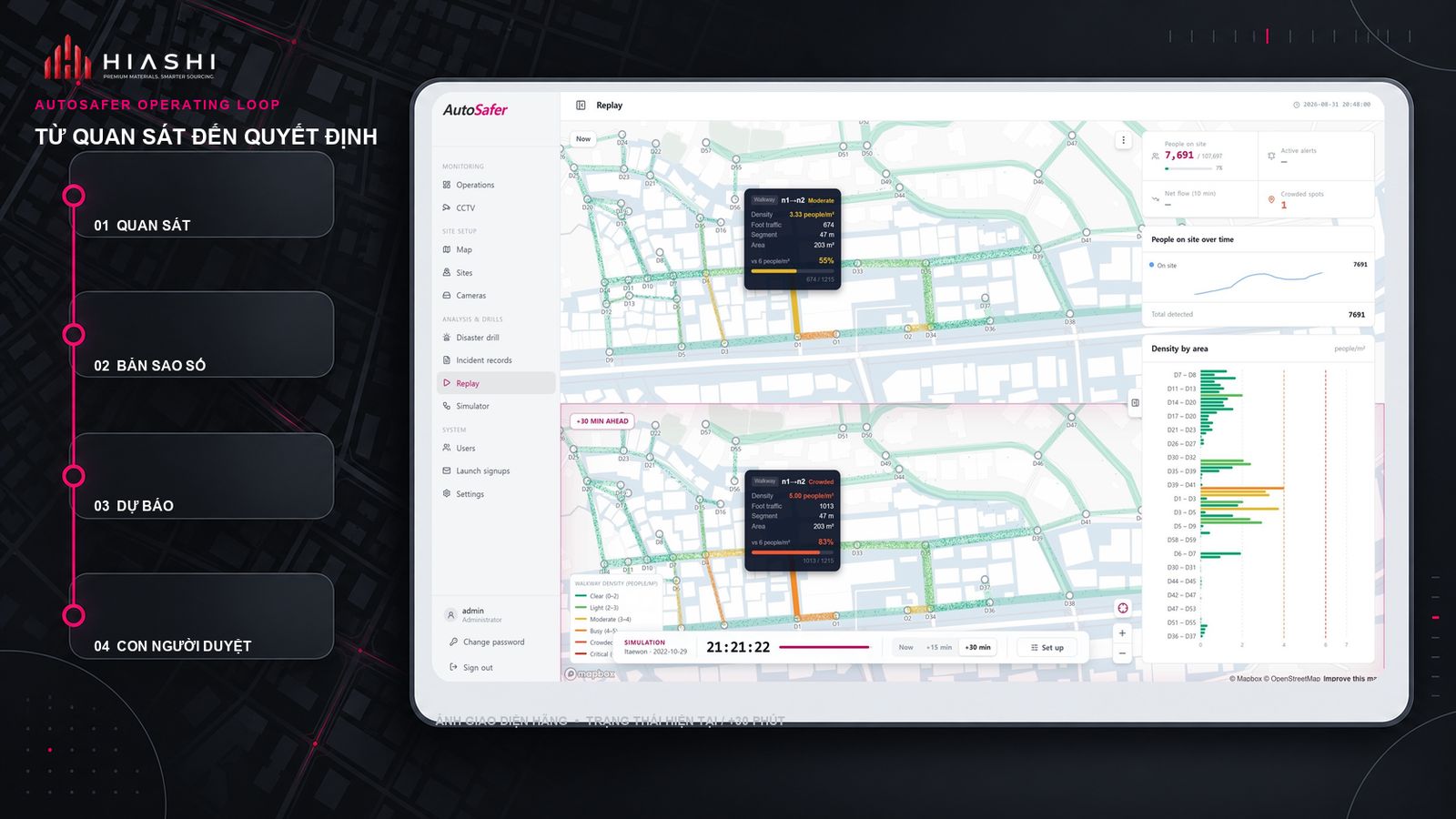
According to the AutoSafer System Overview 2026, the platform operates in five steps: Observe — Replicate — Predict — Guide — Record.
Observe — Zone-Based Observation
The system receives video from multiple cameras, counts people, and calculates density per walkway/zone. Temporary or existing CCTV cameras can be used after a technical review.
Replicate — Mapping to the Digital Twin
Camera data is translated into floor plan coordinates and usable areas. Total attendance might still be within limits while a small walkway has already become a bottleneck.
Predict — 15 and 30-Minute Forecasts
AutoSafer claims +15 and +30 minute milestones for identifying where and when bottlenecks might form. This is the claim that must be verified most rigorously: public documentation does not state the error margin, false alarm rate, or performance under varying camera conditions. The company indicates detailed specifications are provided post-NDA.
Guide and Record — Recommendation, Approval, Logging
The system compares options such as redirecting flow, limiting entries, or opening additional routes, but the on-site manager retains approval authority. Density, warnings, recommendations, and actions are logged on a timeline for post-event review.
A Digital Twin is not a one-time handover drawing. It is an operational model that must be commissioned and updated as the site changes.
PART III — PRIVACY BY DESIGN IS GOOD, BUT NOT ENOUGH TO CONCLUDE COMPLIANCE
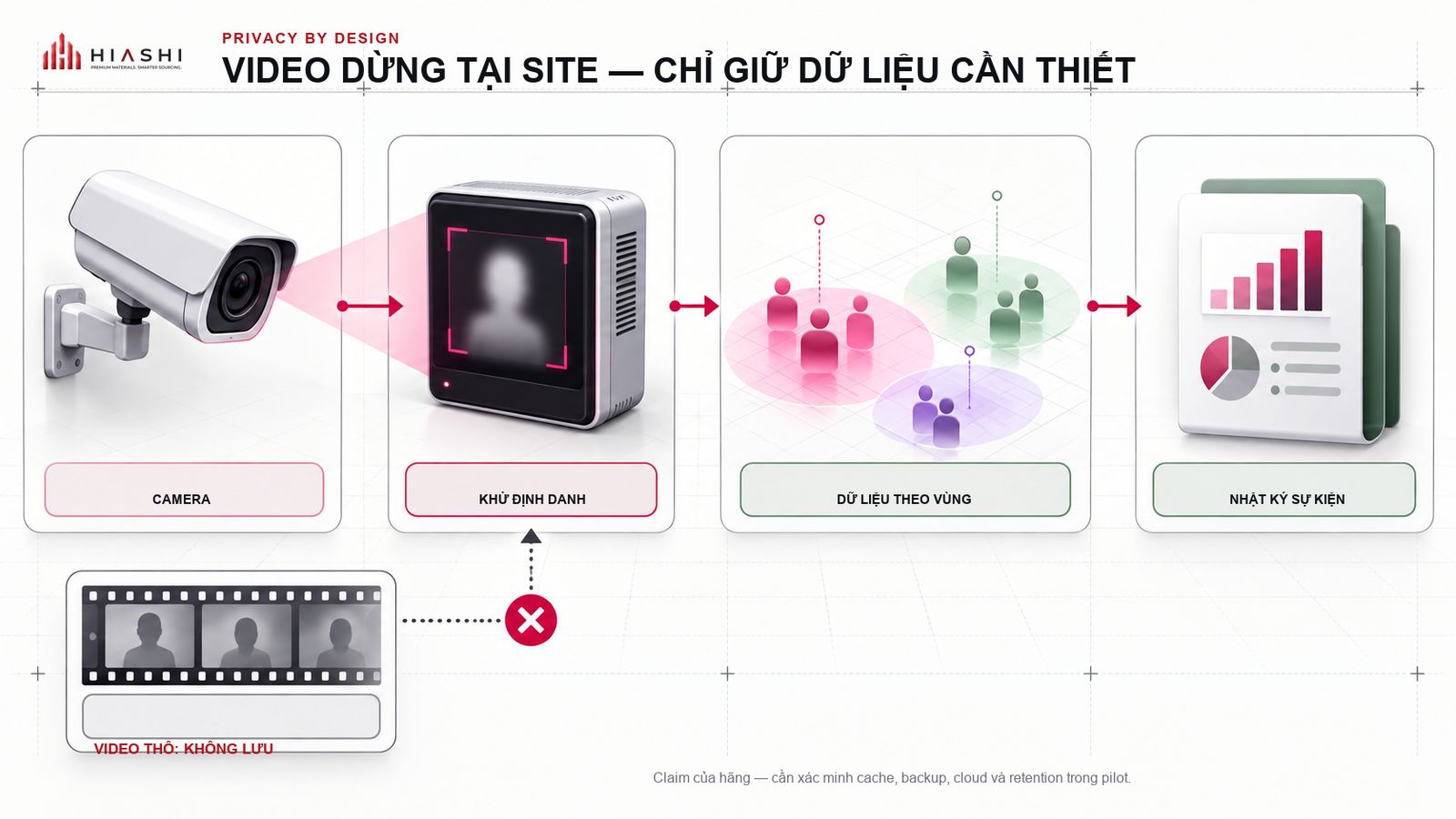
AutoSafer states that video is de-identified on-site: faces are blurred, subjects are given anonymous IDs, and raw video is not stored; only aggregate zone data and event logs are kept. The system also offers an on-premises/no-egress option. This is a risk-reduction architecture, not a legal conclusion.
In Vietnam, the Personal Data Protection Law No. 91/2025/QH15 takes effect on January 1, 2026. Recording in public places remains tied to the purpose of processing, notification, retention periods, and data protection obligations.
Before a pilot, a project needs to secure at least five points:
- Data path: Which devices does the video pass through, where is it processed, and what data does it become?
- Retention: How long are zone aggregates and event logs stored?
- Access: Who can view the dashboard, replay events, and export data?
- Data location: Where is the cloud hosted; does the on-premises configuration prevent data egress?
- Incident response: Who is responsible in the event of unauthorized access or misconfiguration?
Privacy by Design is a prerequisite. Compliance is the outcome of technology, contracts, and actual operational practices.
PART IV — FIVE MISTAKES WHEN DEPLOYING AI CROWD MANAGEMENT
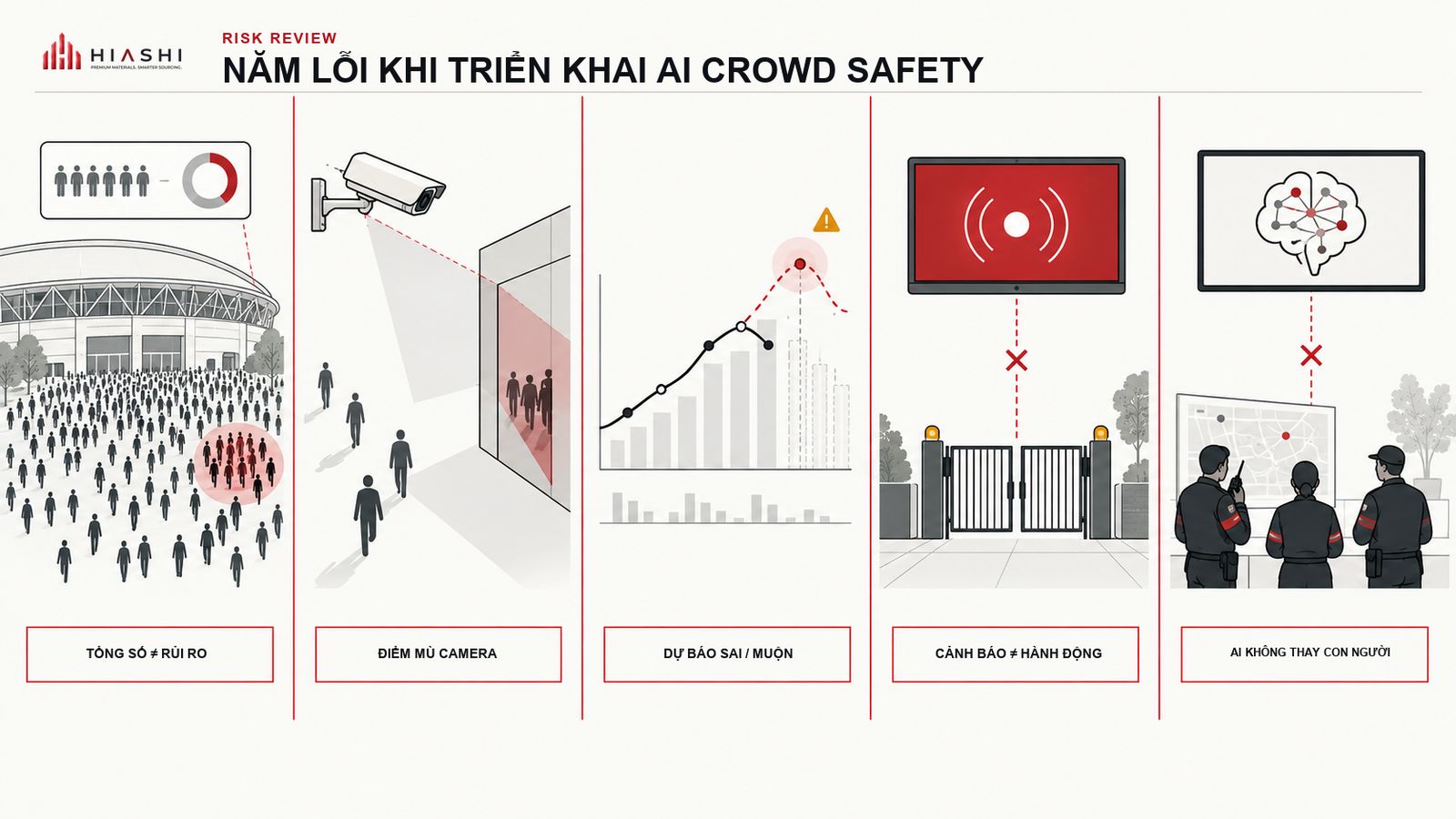
1. Using total attendance instead of zone density
The number of tickets sold does not indicate the load on a specific corridor. Zones must be divided based on operational decisions.
2. Believing all existing cameras are usable
RTSP/ONVIF only relates to connectivity. Viewing angles, lighting, occlusions, and the network still require surveying.
3. Accepting a "30-minute forecast" without acceptance criteria
A pilot must measure forecast error and false alarms by zone; a beautiful interface cannot compensate for false or delayed warnings.
4. Lacking a playbook for each warning level
A red alert on a screen does not open a gate by itself. Each risk level must be tied to a recipient, response time, permissible actions, and approval authority.
5. Viewing technology as a guarantee against incidents
AutoSafer supports decision-making; it does not guarantee the elimination of incidents. The system must be accompanied by capacity plans, escape routes, personnel, and on-site command.
PART V — PILOT CHECKLIST: EIGHT CRITICAL QUESTIONS
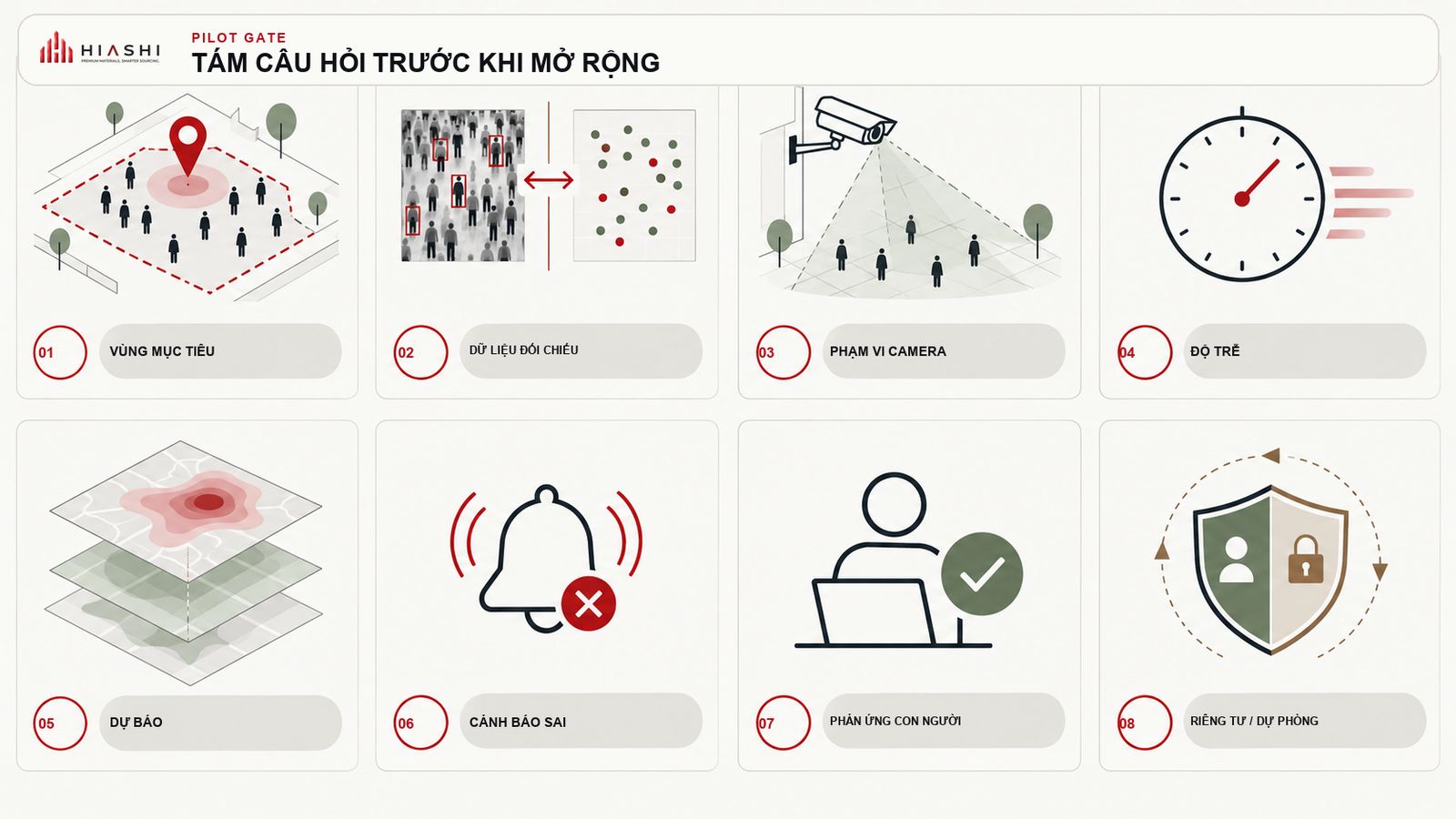
A good pilot asks if the system provides enough evidence to support the specific decisions of the venue.
- Use case: Which areas and failure modes are being controlled?
- Ground truth: What data is used to cross-reference counts and density by zone?
- Coverage: How are blind spots, occlusions, nighttime conditions, and backlighting tested?
- Latency: How long does it take from video input to a warning?
- Forecast: What is the error margin for location, time, and risk level at the +15/+30 minute marks?
- False alarm: What are the acceptable thresholds for false positives and false negatives?
- Human response: Who receives the alert, who approves it, what actions are permitted, and what is the SLA?
- Privacy & fallback: How is data stored; what is the SOP if cameras, networks, or compute fail?
Only expand when counting, latency, forecast, false alarm, privacy, and operator usability reach mutually agreed thresholds prior to the pilot.
CONCLUSION — DO NOT ACCEPT A DASHBOARD
AI crowd management is valuable when it helps teams identify risks early, consider options, and define accountability. AutoSafer connects cameras, Digital Twins, 15/30-minute forecasts, and decision logs while keeping humans in the loop. However, a system overview is not technical acceptance: a project still requires post-NDA documentation, site surveys, privacy reviews, SOPs, and a pilot with ground truth.
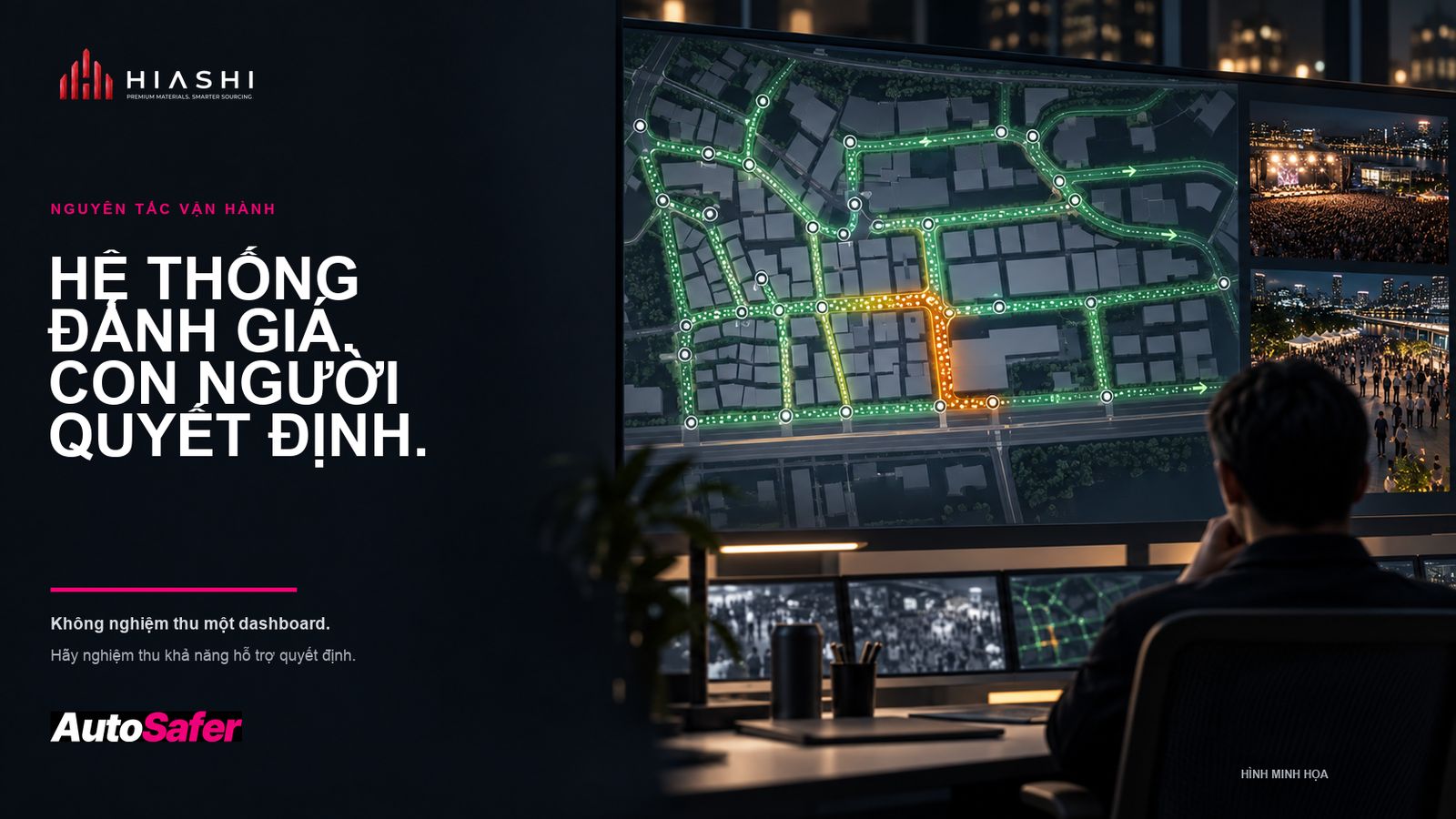
Do not accept a dashboard. Accept the capability for early detection, decision support, and accountability logging under real conditions.
A follow-up email on September 1, 2026, from CEO Sanghwa Lee confirmed that HIASHI and AutoSafer signed an MOU at the MEGA-US EXPO 2026. This is the starting point for qualification; the next step must be a verified use case and pilot.
For a preliminary pilot proposal, please submit:
- Type of building/event, floor plan, and operational schedule;
- Expected attendance by time frame;
- List of cameras, VMS/NVR, and network infrastructure;
- Failure modes to control;
- Command structure and authorized actions;
- Data policies and pilot success criteria.
👉 Submit briefs, floor plans, and demo requests at hiashi.vn.
TWO WAYS TO WORK WITH HIASHI
1. Direct Engagement with the Manufacturer
HIASHI connects with AutoSafer and assists in clarifying briefs, post-NDA documentation, site surveys, and pilots. The client transacts directly with the manufacturer; HIASHI charges a pre-disclosed connection or technical coordination fee. The contract must lock in licensing, data processing, SLAs, maintenance, and compliance responsibilities.
2. HIASHI as the Authorized Importer
If the scope includes camera kits, compute hardware, or specialized equipment, HIASHI can sign a supply contract and handle ordering, shipping, customs, and site delivery as agreed. Software, integration, data, and commissioning must be clearly separated from hardware; pricing, Incoterms, and warranties are only confirmed after a site review.
KEY TECHNICAL SOURCES
- AutoSafer, AutoSafer System Overview 2026, Version 1.0, September 2026 — documentation provided directly by the manufacturer; detailed performance metrics noted to be provided post-NDA.
- AutoSafer CEO Sanghwa Lee, follow-up email dated September 1, 2026 — confirming the meeting and the signing of the MOU at the MEGA-US EXPO 2026.
- AutoSafer — official website.
- Seoul Metropolitan Government — A message to citizens on the 1st anniversary of the Itaewon tragedy.
- Helbing, Johansson & Al-Abideen — Dynamics of Crowd Disasters.
- Vietnam Government — Regulations on personal data protection from public audio/video recording.
Need material guidance for a project?
Share the technical brief so HIASHI can support material shortlisting, samples, TDS and RFQ preparation.