
Sourcing Guide
Classic Bottlenecks in Premium Material Sourcing & The International Vetting Matrix
An in-depth analysis of premium B2B sourcing for 5-star projects. Cultural and technical profiles of 4 major supplying countries (Europe, Japan, China, India) and AI-powered Supplier Fit Score vetting.
Classic Bottlenecks in Premium Material Sourcing & The International Vetting Matrix
In the execution of iconic architectural projects—such as 5-star resorts, luxury hotels, and premium villas—the Facade and exterior surface finishes always consume the largest portion of the budget and pose the highest supply chain risks.
Procurement and Sourcing departments of developers and main contractors are constantly caught in a pincer movement: Executive boards push to minimize costs and schedules; sub-contractors seek to swap specified designs for cheaper generic alternatives; and international manufacturers quote long lead times and offer minimal flexibility.
Choosing materials for such landmark projects should never be a sentimental gamble. It must be a smart, transparent, and data-driven quantitative decision.
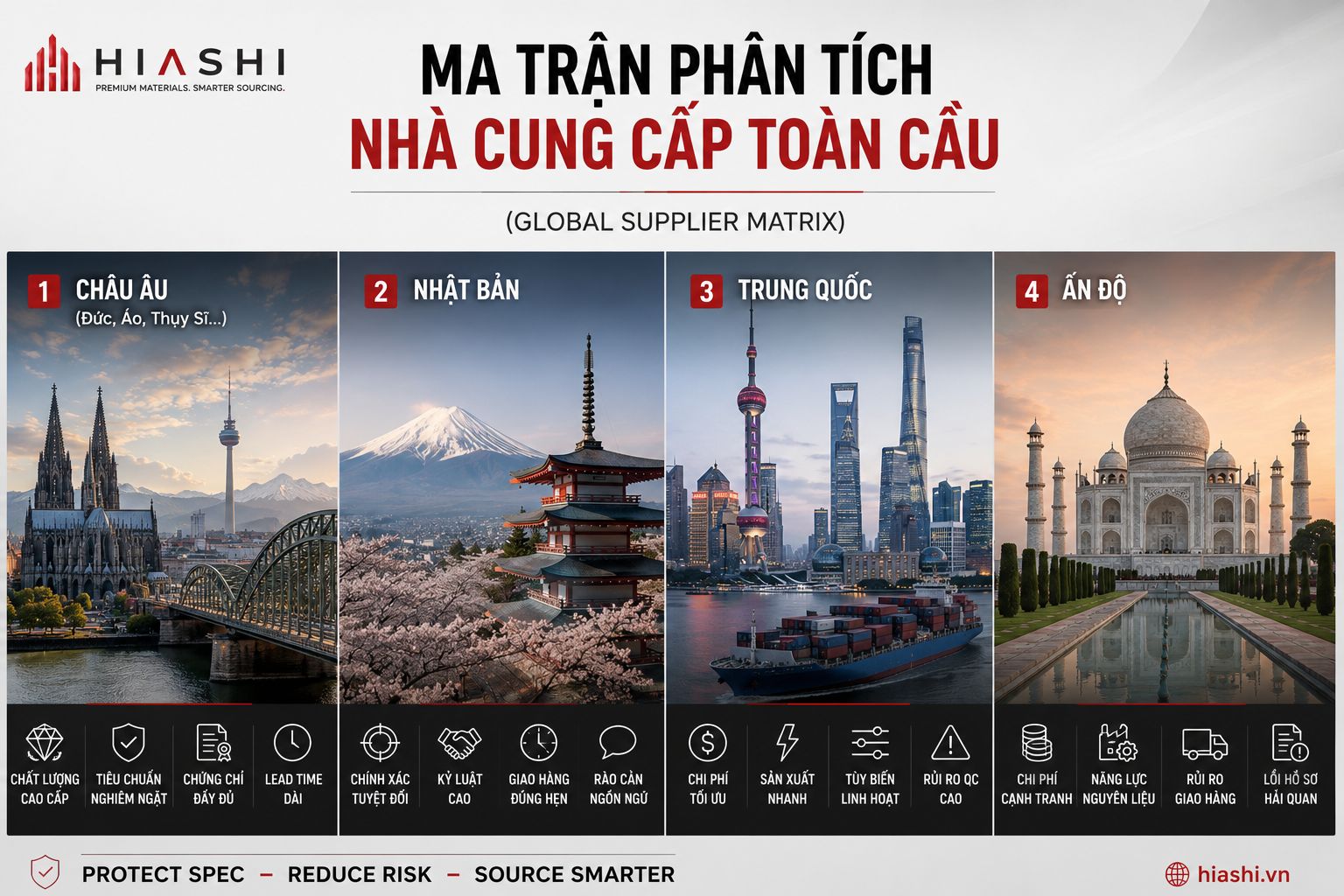
1. Global Supplier Analysis Matrix
Each country manufacturing architectural building materials possesses a unique business culture, technical strength, and specific risks under a B2B trade lens:
Europe (Germany, Austria, Switzerland...)
Representative brands: GKD Metal Fabrics (Germany), FunderMax HPL (Austria), Swisspearl (Switzerland).
- Business Culture & Mentality: Highly standardized, strictly principled, prioritizing legal contracts and ESG criteria (FSC green certificates, EPD).
- Pros: Immutable technical quality, optimum durability in harsh coastal environments (e.g., exceptional anti-corrosion with marine-grade 316 Stainless Steel). Flawless CO/CQ documentation, meeting the most rigorous fire safety codes (international certificates like EN 13501-1 Class A2-s1,d0).
- Cons: Very high initial FOB costs, minimal margin for price negotiation. Long manufacturing lead times (average 45 to 90 days, excluding sea freight transit). Rigid customization options once production lines start. High Minimum Order Quantities (MOQ).
Japan
- Business Culture & Mentality: Extremely cautious and detail-oriented. Internal decision-making processes are highly layered, requiring absolute consensus (Ringisho system). Deep respect for trust, integrity, and scheduling discipline.
- Pros: Flawless mechanical tolerances and manufacturing precision. Transparent delivery schedules and exemplary service standards.
- Cons: Prolonged contract negotiations (often taking 2 to 3 months). High language barriers (most Japanese factories do not deal directly in English, requiring intermediate trading companies like Sogo Shosha).
China
Representative brands: Chambroad Timber, HiYo Bamboo (THJ).
- Business Culture & Mentality: Highly pragmatic, prioritizing lightning-fast turnaround times, flexibility, and opportunity. Strongly driven by personal business relationships (Guanxi).
- Pros: Most optimized sourcing costs and incredibly short production lead times. Highly flexible sample customization to match developers' target budgets.
- Cons: Fluctuations in quality (QC) between approved Mockup samples and final bulk shipments. Lack of long-term technical documentation support and international green certifications.
India
Representative brand: VIVA ACP.
- Business Culture & Mentality: Protracted negotiations and hard bargaining. Flexible, but sometimes lacks tight schedule commitment.
- Pros: Highly competitive costs for large-scale Aluminum Composite Panel (ACP) supplies. Abundant raw material capacity, insulated from trade tariffs.
- Cons: Higher rate of final-mile delivery delays due to domestic logistical bottlenecks. Minor compliance or documentation errors at customs.
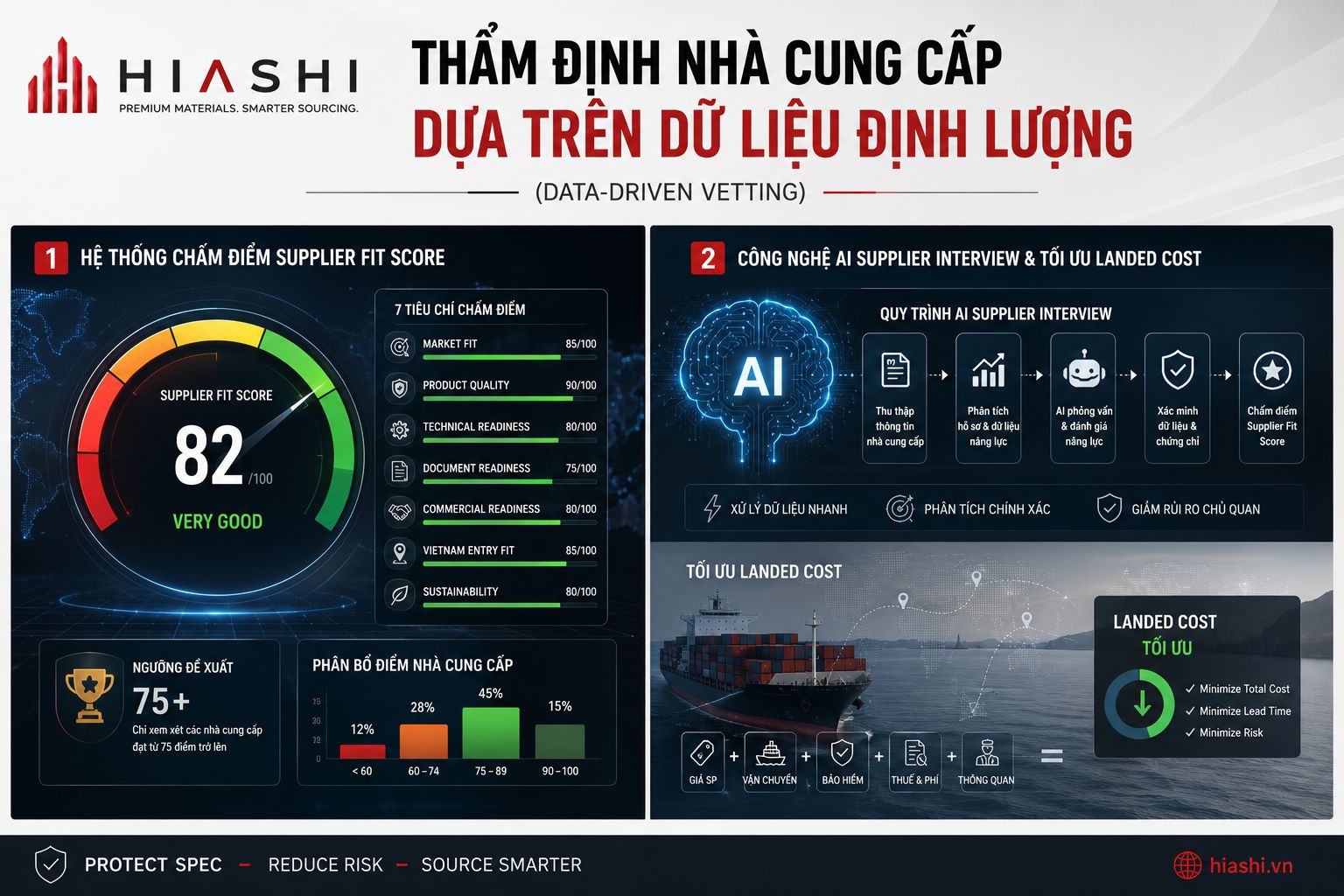
2. Quantitative Data-Driven Vetting
To eliminate subjective risks, HIASHI introduces the HIASHI Sourcing Material AI Service, digitizing and standardizing the vetting process for international manufacturers:
The Supplier Fit Score System (100-Point Scale)
We evaluate international suppliers across 7 rigorous categories to ensure flawless supply chain compatibility for construction projects in Vietnam:
- Market Fit (20%): Evaluates how well the material's properties withstand Vietnam's tropical monsoon/coastal climates and national building standards.
- Product Quality (20%): Validates technical performance and durability using verified global references and warranty commitments.
- Technical Readiness (15%): Assesses the availability of CAD details, BIM models, specification sheets, and certified test reports.
- Document Readiness (15%): Checks for complete and valid Brochures, Catalogues, independent lab test certifications, and proper CO/CQ documentation.
- Commercial Readiness (15%): Assesses Minimum Order Quantity (MOQ) limits, guaranteed production Lead times, and sample policies.
- Vietnam Entry Fit (10%): Evaluates readiness to support local general contractors, specialized installers, and local commercial discount policies.
- Sustainability / ESG (5%): Evaluates green certifications like FSC, PEFC, EPD, and low VOC emission standards.
- 85 – 100 Points (Strategic Supplier): Highly compatible strategic partner. Prioritized for spec-in on high-end luxury projects.
- 70 – 84 Points (Qualified Supplier): Approved supplier. Requires minor documentation updates before project specification.
- 55 – 69 Points (Potential Supplier): Under observation. Requires improvements in commercial terms or documentation quality.
- Below 55 Points (Not Fit): Not recommended for premium B2B construction projects.
AI-Driven Supplier Interviews & Landed Cost Optimization
- The AI Interviewer Agent automatically initiates a 7-step digital dialogue with international factories, extracting deep technical parameters trapped in thousands of document pages using advanced OCR.
- Calculates the accurate Landed Cost (total delivery cost to site, including taxes, duties, port clearances, and final-mile logistics) from FOB quotes in just 4 hours instead of 2 days of manual calculation. This enables procurement teams to quickly compare options and present accurate numbers to the executive board.
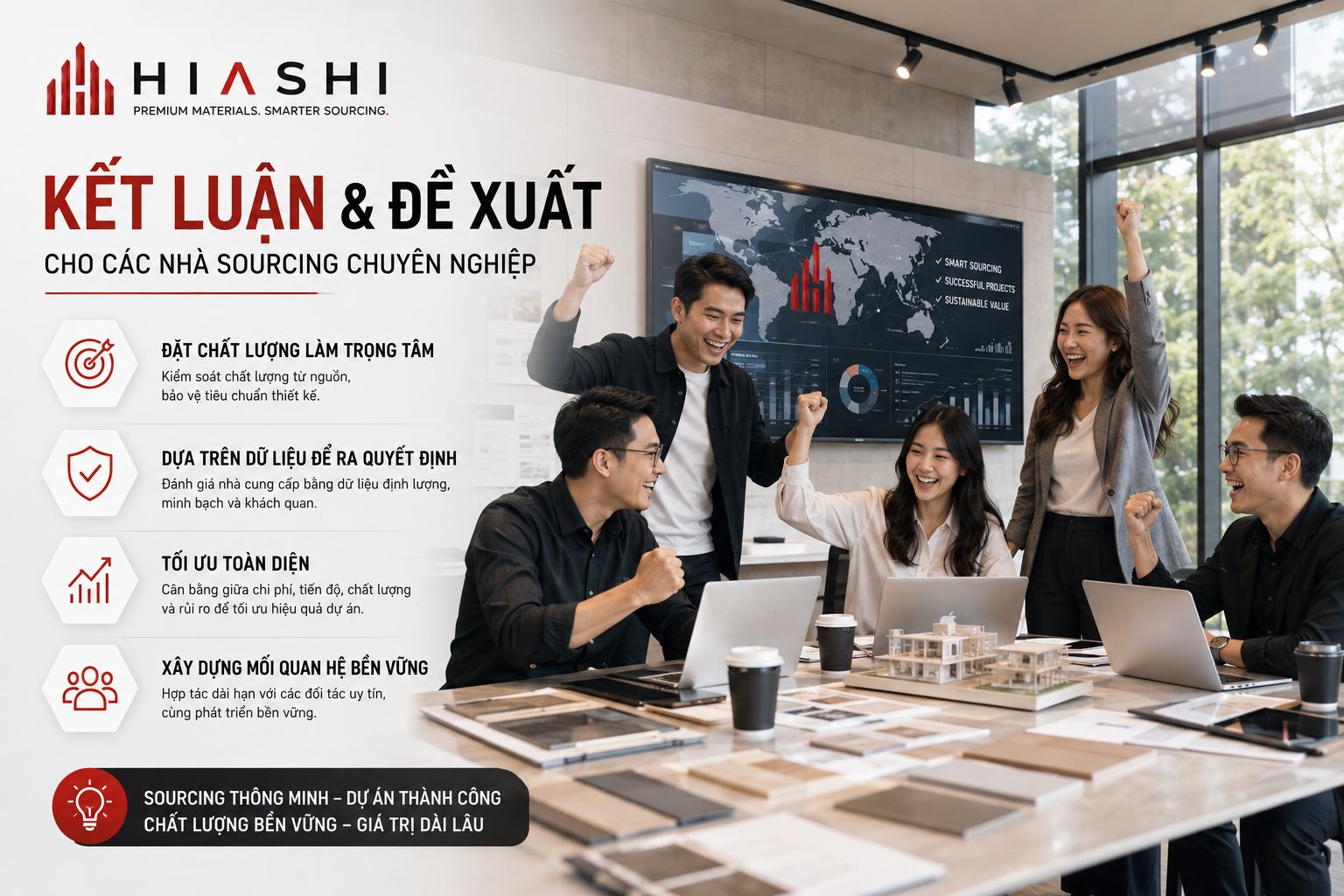
CONCLUSION & RECOMMENDATIONS FOR PROCUREMENT TEAMS
Professional sourcing is not about finding the cheapest supplier; it is about finding the supplier with the most optimal Supplier Fit Score for your project's unique requirements.
A standardized RFQ (Request for Quote) containing detailed Bill of Quantities (BOQ), project geographical coordinates, fire safety regulations, and initial specs reduces 95% of trade disputes and accelerates transactions threefold.
👉 Is your procurement team facing hurdles in negotiating with global manufacturers?
👉 Are your project architects looking for equivalent European-standard material alternatives?
🌐 Submit your project files or raw BOQ to experience the HIASHI Sourcing Material AI Service completely free of charge at: hiashi.vn
Need material guidance for a project?
Share the technical brief so HIASHI can support material shortlisting, samples, TDS and RFQ preparation.