
Material Guide
Facade Material Physics: HPL, Fibre Cement, Aluminium vs Direct Painting & Double Skin Ventilation
An in-depth engineering analysis comparing compact HPL (Fundermax), fibre cement (Swisspearl), and aluminium composite panels (ACP), contrasting barrier paint systems with double skin ventilated facade systems using statistics from developed countries.
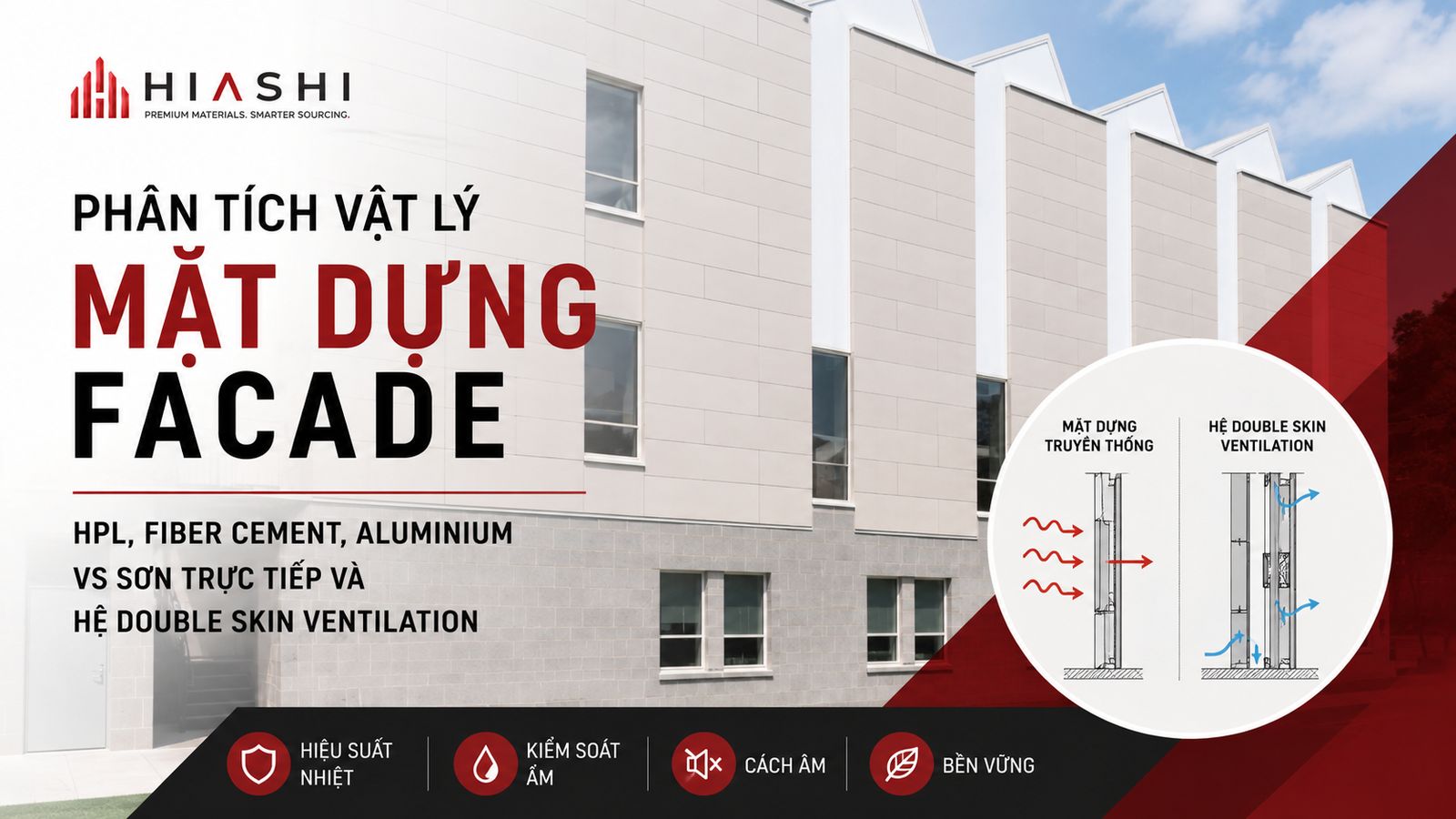
Facade Material Physics: HPL, Fibre Cement, Aluminium vs Direct Painting & Double Skin Ventilation
For the building envelope of premium residential villas and commercial high-rises in tropical regions like Vietnam, selecting facade materials and installation systems is a rigorous exercise in physics. Engineers and architects must balance thermal transmission, heat accumulation, moisture absorption, UV degradation, wind loading, and fire safety (compliance with local regulations such as QCVN 06).
A building envelope (facade) is not a decorative skin — it is the second skin (The Second Skin) protecting the entire load-bearing skeleton of the building.
This technical guide presents an engineering deep-dive into the physical properties of three widely specified cladding materials: High-Pressure Laminate (HPL), Fibre Cement, and Aluminium/Aluminium Composite Panels (ACP). It further contrasts the performance of direct exterior painting (using high-performance elastomeric coatings like Seamaster Paint) against the double skin ventilated facade system (rainscreen).
I. Physical & Mechanical Properties of Core Facade Materials
To establish proper specifications, designers must evaluate the fundamental physical parameters of each material category:
| Physical & Technical Parameters | HPL Compact Panels (Fundermax - Austria) | Fibre Cement Panels (Swisspearl - Switzerland) | Aluminium Composite Panel (VIVA ACP) |
|---|---|---|---|
| Material Composition | ~65% natural wood fibres + 35% thermosetting phenolic/melamine resins cured at 150°C and 9 MPa | ~80% Portland cement + 5-10% synthetic organic/cellulose reinforcement fibres | Core material (PE or mineral-filled FR/A2) sandwiched between two PVDF aluminium skins |
| Density (Specific Gravity) | 1,350 – 1,450 kg/m³ | 1,600 – 1,800 kg/m³ | ~5.5 kg/m² (for a standard 4mm thick panel) |
| Common Facade Thickness | 8mm, 10mm, 12mm | 8mm, 12mm | 4mm (with 0.4mm or 0.5mm aluminium skin thickness) |
| Bending Strength (Flexural) | ≥ 80 MPa (EN ISO 178) | ≥ 18 MPa (EN 12467, Class 4) | N/A (high elastic-ductile performance) |
| Thermal Expansion Coeff. ($\alpha$) | $\approx 1.8 \times 10^ / \text$ | $\approx 1.0 \times 10^ / \text$ | $\approx 2.3 \times 10^ / \text$ |
| Fire Classification (Euroclass) | B-s2, d0 (Standard); m.look reaches A2-s1, d0 | A2-s1, d0 or A1 (Non-combustible) | PE Core: Class B/C; FR/A2 Core: A2-s1, d0 (QCVN 06 compliant) |
| UV Resistance (Color Fastness) | Grade 4-5 (Standard grey scale ISO 105-A02) | Grade 4 (Through-coloured mineral finish) | Kynar 500 PVDF coating offers 15-20 years fade resistance |
1. HPL Compact Panels — e.g., Fundermax Max Compact Exterior
- Physical Behaviour: The high-pressure curing process produces an extremely dense core with superior impact resistance and flexural modulus. The surface is cured using patented electron-beam technology (Fundermax NT surface), which seals the acrylic polyurethane layer. This provides absolute defense against photochemical degradation (UV radiation) and prevents surface chalking or degradation.
- Key Engineering Advantages: Complete immunity to acid rain and chemical attacks. It allows replication of natural textures (wood grains, concrete, stone) with zero risk of warping, moisture absorption, or pest infestation.
- Installation Note: Due to its thermal expansion coefficient, fixing holes on the panels must be oversized (sliding points) relative to the rivet/screw shank. This allows the panel to expand and contract freely without inducing mechanical stresses at the connection points.
2. Fibre Cement Panels — e.g., Swisspearl
- Physical Behaviour: Swisspearl fibre cement uses inorganic mineral components to achieve the highest fire rating (Euroclass A1/A2-s1, d0). It is completely non-combustible and does not emit toxic smoke when exposed to direct flames.
- Key Engineering Advantages: Excellent moisture regulation. The microscopic porosity of the cement matrix allows the panel to "breathe," venting indoor moisture while blocking exterior liquid water intrusion.
- Installation Note: Fibre cement is a brittle flexural material. Avoid high impact loads at corners. Drilling must maintain a minimum edge distance of 80mm to prevent shear failure at corner connections.
3. Aluminium Composite Panels (ACP) — e.g., VIVA ACP
- Physical Behaviour: ACP has a very low dead load, minimizing structural subframe sizes and foundation loads. It is highly ductile, allowing for routing, folding, tray configurations, and organic curved geometries.
- Key Engineering Advantages: Excellent flatness over large spans. The Kynar 500 PVDF coating (minimum 70% fluorocarbon resin) resists chloride-induced corrosion in coastal areas.
- Premium Dry Joint System (MFR System - Silicone-Free): VIVA offers the specialized MFR (Male-Female Rainscreen) System for silicone-free exterior cladding. This mechanical interlocking system eliminates the use of wet silicone sealants, preventing oil staining (black streaks running down the facade), cutting down future re-caulking maintenance costs, and ensuring a natural pressure-equalized ventilation cavity behind the panels.
- Installation Note: Strictly follow local fire codes (e.g., Vietnam's QCVN 06/2022). Standard polyethylene (PE) cores are highly flammable and are restricted on buildings taller than 28 meters. Mineral-filled fire-rated cores (FR or A2) must be specified.
II. Anatomy of a Rear-Ventilated Facade System
A rear-ventilated facade (also known as a rainscreen system) is not just a single layer; it is an engineered multi-component system designed to optimize structural and thermal physics:
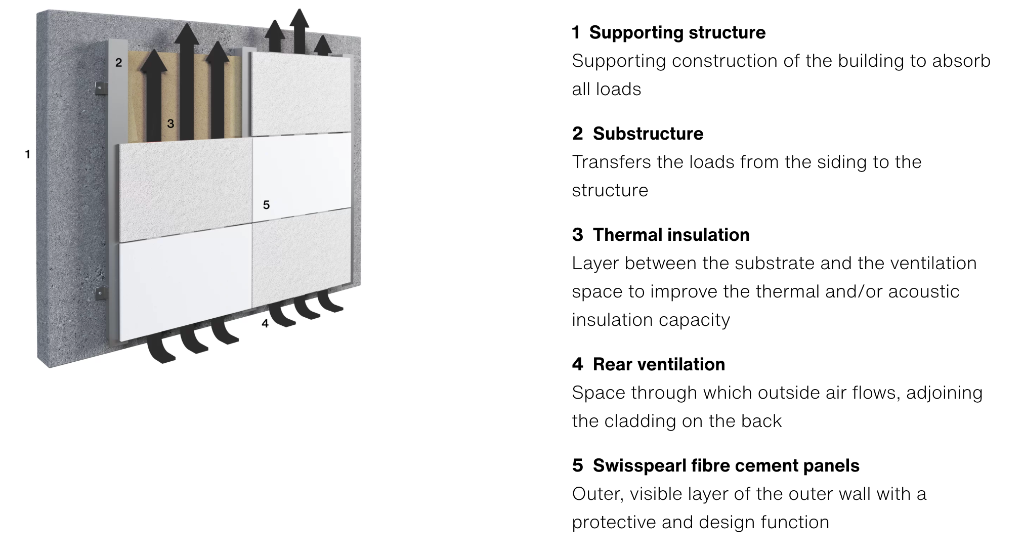
The system consists of five key layers (corresponding to the Swisspearl technical model):
- Supporting structure (1): Supporting construction of the building (concrete or masonry backup wall) to absorb all loads.
- Substructure (2): Transfers the loads from the siding (cladding) to the supporting structure of the building.
- Thermal insulation (3): Layer between the substrate and the ventilation space to improve the thermal and/or acoustic insulation capacity.
- Rear ventilation (4): Space through which outside air flows, adjoining the cladding on the back.
- Swisspearl fibre cement panels (5): Outer, visible layer of the outer wall with a protective and design function.
Physical Mechanics:
- The Stack Effect (Chimney Effect): Solar radiation heats the cladding panel (5), warming the air in the cavity (4). The heated air expands, becomes less dense, and rises, escaping through the top ventilation slots. This draws cooler air in from the bottom. This continuous, natural convective loop vents solar heat, keeping the structural backup wall cool.
- Rainscreen Water Management: The cladding panel deflects 95% of rainwater. Any water crossing the open joints runs down the rear face of the panel and drains out at the base, keeping the insulation layer (3) dry. The ventilated cavity equalizes air pressure across the joints, preventing wind pressure from forcing rain into structural concrete cracks.
III. Barrier Painting vs. Double Skin Ventilated Facades (Rainscreen)
Let's evaluate direct painting against a double skin ventilated facade system, using metrics from premium exterior paint benchmarks (such as Seamaster Paint's Weathercare Excel 9000 and IPRO Crack Guard elastomeric coatings):
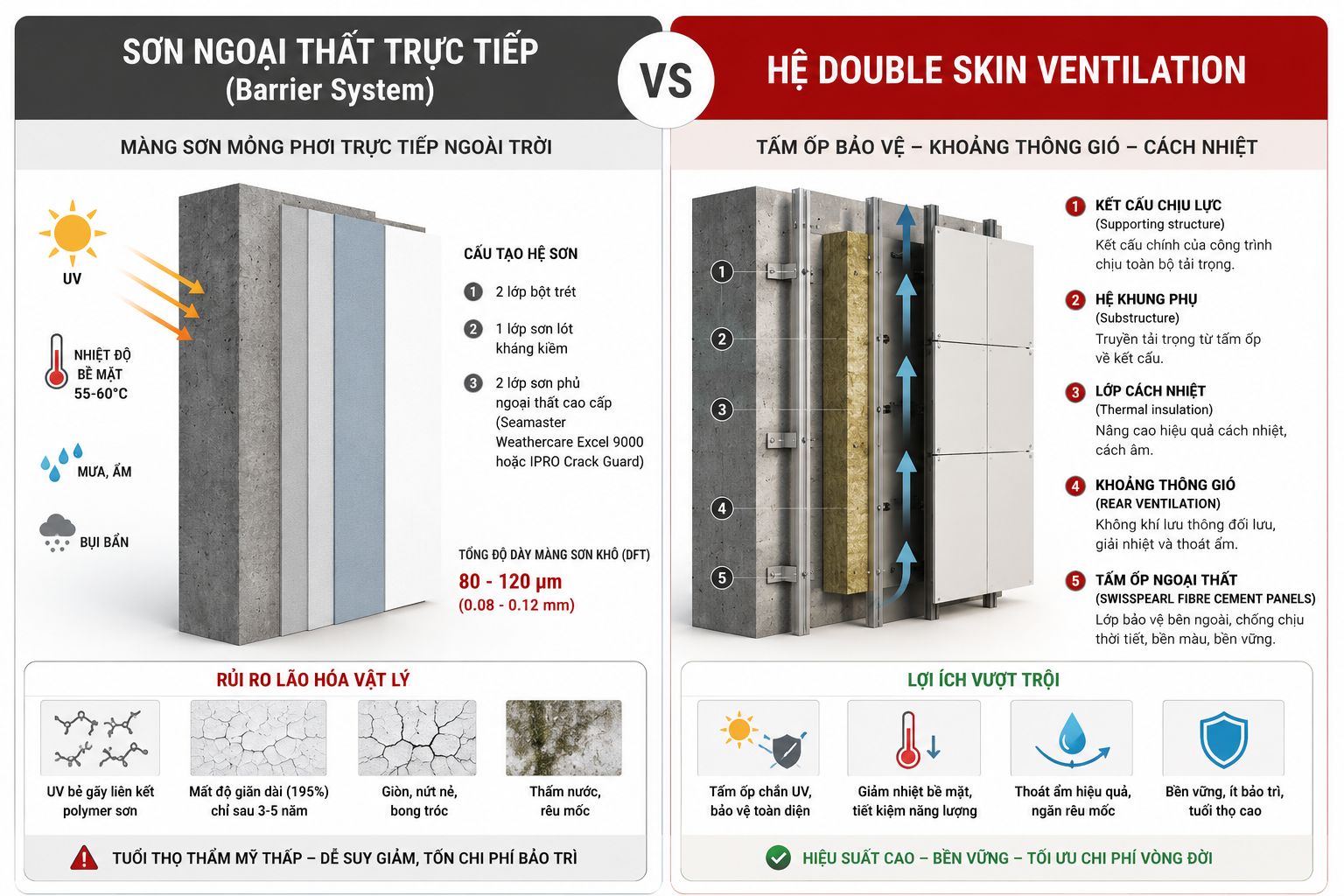
1. Direct Paint Application (Barrier System)
- Dry Film Thickness (DFT):
- Premium decorative systems (e.g., Seamaster 9000): The total DFT for primer + topcoats ranges from 80 to 120 µm (0.08 - 0.12mm).
- Elastomeric crack-bridging systems (e.g., Seamaster IPRO Crack Guard): Lying at 35 to 40 µm per topcoat. While offering an elongation of up to 195% (ASTM D 2370) to bridge micro-cracks in the concrete substrate, this ultra-thin film has limited mechanical resistance.
- Degradation Mechanism:
- As a direct "barrier system," the thin paint film absorbs the full impact of solar UV radiation and temperature fluctuations.
- UV Degradation: UV radiation breaks down the acrylic polymer binder over 3-5 years, causing chalking and loss of elasticity. Once elongation drops, concrete cracks tear the paint film, allowing rain to penetrate and cause efflorescence and mould.
2. Why Developed Countries (EU, US, Australia) Specify Ventilated Facades
In developed nations, direct exterior painting has been largely replaced by ventilated facades for commercial high-rises and premium residential projects. This shift is driven by energy regulations and life cycle economics:
- EU Energy Performance of Buildings Directive (EPBD): Under NZEB (Nearly Zero-Energy Buildings) mandates, all new buildings must minimize operational energy. According to the FVHF (German Association for Ventilated Facades), rear-ventilated facades reduce thermal bridging by up to 70% and reduce cooling energy consumption by 20% to 35%.
- ASHRAE 90.1 (US): Mandates continuous insulation (ci) on the exterior of structural walls to eliminate thermal bridging through concrete slabs and studs. Ventilated facades are the primary method used to meet these technical requirements.
- Life Cycle Costing (LCC): A study by the Fraunhofer Institute for Building Physics (Germany) showed that while a ventilated facade's initial cost is 8-10 times higher than direct painting, its 50-year Life Cycle Cost is 40% lower. Paint systems require repainting every 5-7 years, creating recurring maintenance costs over the building's lifespan.
IV. Ventilated Opaque Facades vs. Glass Curtain Walls
Opaque ventilated facades (using HPL or fibre cement) and glass curtain walls have different physical behaviors:
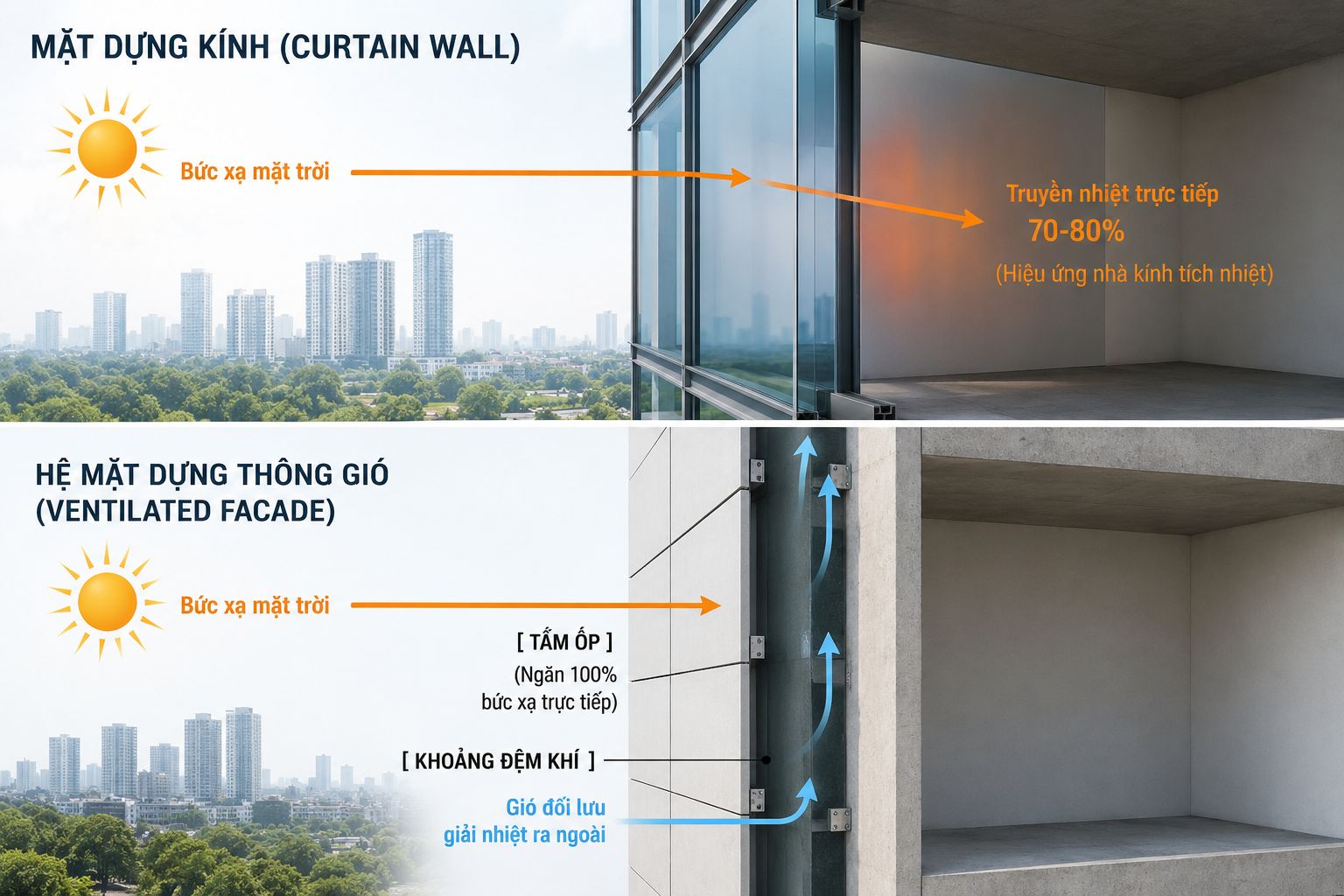
1. Glass Curtain Walls:
- The Greenhouse Effect: Glass allows solar energy to enter directly. This energy is absorbed by the floor and interior furniture, converting to long-wave infrared radiation that cannot escape back through the glass. This increases interior temperatures and cooling loads.
- Light Pollution: Large glass facades reflect light, causing glare and contributing to urban light pollution.
- Mechanical & Thermal Stress: Glass is susceptible to thermal stress, which can lead to spontaneous breakage. During seismic events, structural deflection can also cause glass panes to detach.
2. Ventilated Opaque Facades (Fundermax HPL / Swisspearl):
- Solar Radiation Shielding: Opaque cladding blocks solar radiation from reaching the backup wall. The heat absorbed by the panels is vented away through the air cavity.
- Moisture Management: The open-joint configuration allows air pressure equalization and natural moisture vapor transmission, preventing indoor humidity buildup and reducing the risk of Sick Building Syndrome.
- Urban Integration: Fibre cement surfaces absorb light rather than reflecting it, reducing glare in urban areas.
V. Technical Conclusion
A facade is not a decorative skin — it is a physical shield protecting the building envelope from weathering.
- For Commercial & Premium Projects (30+ Year Lifecycle): A Double Skin Ventilated Facade using premium cladding (such as Swisspearl or Fundermax) is the recommended technical solution. The initial investment is offset over 7-10 years through lower cooling costs and reduced maintenance.
- Hybrid Envelope Design: Modern practice in developed countries combines glass facades for daylighting (20-30% of envelope area) with ventilated opaque facades (70-80% of area) to optimize both natural light and energy efficiency.
Source Premium Facade Materials via HIASHI
HIASHI's AI-assisted sourcing platform connects your project with verified premium facade manufacturers and distributors. Submit your facade dimensions, structural height, and climate zone to receive optimized material proposals and competitive estimates via the BCP Matching Network.
Need material guidance for a project?
Share the technical brief so HIASHI can support material shortlisting, samples, TDS and RFQ preparation.